Best Platform to Sell Digital Products for Beginners: What Should You Use in 2026?

You finished the ebook, template, workbook, course or digital download.
Now you face a question that can affect both your profit margin and how complicated your business becomes:
Where should you sell it?
Search for a platform and you will quickly find very different answers.
One creator says Gumroad because it is simple. Another recommends Payhip because its free plan charges a lower platform fee. Ecommerce sellers point to Shopify. Funnel marketers prefer an all-in-one system such as Systeme.io.
They can all be right.
The mistake is assuming there is one universally best platform for every digital-product seller.
A person selling one $9 PDF from a social-media link has different requirements from a creator building email funnels around a $99 course. A business selling physical and digital products together needs something different again.
This guide compares four practical options for beginners in 2026—Systeme.io, Gumroad, Payhip and Shopify—based on the business you are actually trying to build.
Best Platform to Sell Digital Products for Beginners: Start With Your Business Model
Before comparing features, decide which sentence sounds most like you.
“I just want the fastest simple checkout for a finished product.”
Look closely at Gumroad.
“I want a free digital storefront with lots of selling features and a lower platform fee.”
Payhip deserves serious consideration.
“I need sales pages, email marketing, funnels and automation around my digital product.”
Systeme.io becomes particularly relevant.
“I want a full ecommerce store that may sell physical products too.”
Shopify is designed for that broader ecommerce job.
That is a more useful starting point than asking which platform has the longest feature list.
Best Platform to Sell Digital Products for Beginners Depends on What Happens Before and After Checkout
Uploading a PDF is easy.
The real differences appear around the transaction.
Ask what you need before someone buys:
- landing pages?
- lead capture?
- email campaigns?
- automated follow-up?
- content marketing?
- a marketplace?
Then ask what you need after the sale:
- instant download?
- course access?
- email onboarding?
- upsells?
- affiliate management?
- a broader ecommerce customer account?
The platform that handles your complete customer journey with the least unnecessary complexity is usually more useful than the platform with the cheapest headline price.
Quick Comparison: Systeme.io vs Gumroad vs Payhip vs Shopify
| Platform | Current Entry Cost | Platform Fee | Strong Fit |
|---|---|---|---|
| Systeme.io | $0 Free plan | 0% Systeme.io transaction fee | Funnels + email + automation + digital selling |
| Gumroad | No monthly fee | 10% + $0.50 direct sales; 30% Discover | Simple creator checkout + Merchant of Record |
| Payhip | $0 Free Forever | 5% Free; 2% Plus; 0% Pro | Digital storefront + selling tools |
| Shopify | Basic $29/mo when billed yearly | Standard Shopify/payment fees apply | Full ecommerce, especially mixed physical + digital |
Those percentages are not perfectly interchangeable.
For example, Payhip says Stripe or PayPal processing fees still apply in addition to its platform fee. Gumroad’s current direct-sale fee also excludes card processing, while its 30% Discover fee includes processing. Systeme.io charges 0% as a platform transaction fee, but your connected payment processor can still charge you. Shopify has subscription and payment-processing economics that depend on plan, country and payment setup.
Always calculate the actual cost for your own country, processor, product price and sales volume.
Option 1: Systeme.io — When the Product Is Only Part of the Business
Systeme.io is different from a lightweight digital storefront.
Its strongest case appears when you need a marketing system around the product.
Imagine you sell a $29 client-onboarding template pack.
You do not only want:
Product Page → Checkout → Download
You want:
YouTube / Blog / Social → Free Checklist → Email Follow-Up → Sales Page → Checkout → Download → Follow-Up
Now your platform needs to do more than host a file.
Systeme.io currently combines:
- sales funnels;
- landing and sales pages;
- email marketing;
- automation;
- order forms;
- digital-product delivery;
- online courses;
- affiliate management;
- CRM pipeline functionality.
What Does Systeme.io Cost in 2026?
The current official pricing is:
- Free: $0;
- Startup: $17/month;
- Webinar: $47/month;
- Unlimited: $97/month.
The Free plan currently includes up to 2,000 contacts, 3 sales funnels, 1 course, 1 affiliate program, 1 custom domain, unlimited email sends and unlimited file storage.
Systeme.io currently charges 0% platform transaction fees. Payment-processor fees still apply.
This matters for a beginner because you can test the broader funnel model without immediately paying a monthly subscription.
If that is the type of business you want to build, you can create a free Systeme.io account here.
Affiliate disclosure: The Systeme.io link above is an affiliate link. If you later upgrade to a paid plan, I may earn a commission at no additional cost to you.
Where Systeme.io Has an Advantage
Its advantage is consolidation.
You can keep the lead, email campaign, sales page, checkout and product delivery inside the same ecosystem.
For someone planning to generate leads before asking for a purchase, this can reduce the number of integrations required.
It is especially relevant for:
- lead magnets that sell a paid product later;
- ebooks with an email funnel;
- template packs promoted through content;
- online courses;
- digital products using upsells/order bumps;
- businesses planning to recruit affiliates;
- creators who want landing pages and email without separate subscriptions.
Where Systeme.io May Be More Than You Need
If your only requirement is:
upload file → create checkout link → send download
then a dedicated creator storefront may feel more direct.
Gumroad and Payhip deserve comparison precisely because simplicity can be a feature.
Option 2: Gumroad — Simple Selling With Merchant-of-Record Convenience
Gumroad is built around a straightforward creator-selling model.
You create a product, share the link and let Gumroad handle the transaction and delivery experience.
There is no monthly subscription fee for the standard model.
Instead, Gumroad currently charges:
- 10% + $0.50 per transaction for sales through your profile or direct links;
- 30% for sales where a new customer discovers and buys from you through Gumroad Discover.
For direct sales, Gumroad’s own fee does not include card processing. Its current help documentation lists credit-card processing at 2.9% + $0.30, while PayPal fees can differ.
Gumroad’s Big Operational Advantage: Merchant of Record
Since January 1, 2025, Gumroad says it acts as Merchant of Record and manages sales-tax collection and remittance worldwide.
That can be a meaningful operational advantage for creators selling internationally.
Tax responsibilities are complex and depend on your business and jurisdiction, so this should not be interpreted as personal tax advice. But it is an important platform difference to investigate when choosing where to sell.
Gumroad Is Not Just a Download Button
Gumroad also supports memberships, email audiences and Workflows.
Its Workflows can send scheduled emails based on triggers such as:
- purchase;
- new subscriber;
- membership cancellation;
- new affiliate;
- abandoned cart.
There is an important current restriction: Gumroad says creators cannot send emails until they have earned $100 after fees and received a payout.
That restriction matters if email nurturing is central to your launch from day one.
Who Should Consider Gumroad?
Gumroad is worth considering if:
- you value setup simplicity;
- you do not want a monthly subscription;
- Merchant-of-Record tax handling is valuable to you;
- you are comfortable with a percentage-based fee;
- you mainly need a creator commerce layer rather than a complete funnel system.
The trade-off is straightforward: convenience can become expensive as direct sales grow because the platform takes a meaningful percentage of each transaction.
Option 3: Payhip — A Strong Free Digital-Store Alternative
Payhip should not be treated as an afterthought in this comparison.
Its current Free Forever plan is:
- $0/month;
- 5% Payhip transaction fee;
- unlimited products;
- unlimited revenue;
- all features.
Payhip says Stripe and PayPal still charge their standard processing fees.
Its paid plans currently reduce the platform fee:
- Plus: $29/month + 2% transaction fee;
- Pro: $99/month + 0% Payhip transaction fee.
What You Get on Payhip’s Free Plan
Payhip currently supports more than basic PDF delivery.
Its platform covers:
- digital downloads;
- courses;
- coaching;
- memberships;
- physical products;
- store builder;
- coupons;
- affiliates;
- cross-sells and upsells;
- referrals;
- customer reviews;
- email updates;
- external email-marketing integrations.
Payhip also says it collects and remits digital EU/UK VAT and US/Canadian sales tax on sellers’ behalf. Sellers should still understand their own tax obligations outside the platform’s stated scope.
Where Payhip Can Beat the Other Options
If your priority is a straightforward digital storefront with a broad feature set and no monthly fee, Payhip is particularly competitive.
For example:
Instagram → Payhip Product Page → Checkout → Instant Download
That is a clean setup for a creator who does not need a multi-step lead-generation funnel.
The current 5% Free-plan platform fee is also materially lower than Gumroad’s current 10% + $0.50 direct-sale platform fee, although payment-processing and tax-handling differences mean you should not compare those percentages in isolation.
Where Systeme.io and Payhip Differ
This is an important distinction.
Payhip is naturally centered around the store/product.
Systeme.io is naturally centered around the funnel/customer journey.
A Payhip-oriented path might be:
Traffic → Store/Product Page → Checkout → Download
A Systeme.io-oriented path can be:
Traffic → Opt-In → Email Sequence → Sales Page → Checkout → Download → Follow-Up
Neither architecture is automatically better.
Choose based on how you plan to acquire and nurture customers.
Option 4: Shopify — When You Are Building a Real Ecommerce Store
Shopify becomes more relevant when the digital product is part of a larger ecommerce operation.
Its current US pricing page lists Basic at $29/month when billed yearly, with card rates starting at 2.9% + $0.30 USD. Pricing and payment rates vary by location and setup.
Shopify now provides its own free Digital Products app for Shopify stores.
According to Shopify, it can deliver:
- ebooks;
- PDFs;
- guides;
- workbooks;
- templates;
- presets;
- worksheets;
- courses;
- videos;
- audio;
- digital art;
- other downloadable files or hosted links.
Shopify Makes More Sense When Your Store Is the Business
Consider a creator who sells:
- a physical planner;
- a printable PDF version;
- a template bundle;
- branded merchandise;
- a recorded workshop.
Now a full ecommerce platform makes much more sense.
Shopify specifically supports selling physical and digital products together in the same store.
For that business model, comparing Shopify only on the cost of delivering one PDF misses the point.
Where Shopify May Be Overkill for a First PDF
If you have:
- one PDF;
- no physical inventory;
- no existing store;
- no need for a large product catalog;
- no reason to pay a monthly ecommerce subscription yet;
then Gumroad, Payhip or Systeme.io may give you a shorter path to testing the offer.
You can always move to a more elaborate commerce stack when the business actually requires it.
Which Platform Is Cheapest?
There is no single answer because the pricing models are different.
Consider a simplified hypothetical $20 product sold 10 times.
Gross revenue: $200.
Before processor fees and other applicable costs:
- Systeme.io’s own platform transaction fee would be $0;
- Payhip Free’s 5% platform fee would be $10;
- Gumroad’s 10% + $0.50 direct-sale platform fee would be $25;
- Shopify would involve its subscription plus applicable payment costs rather than a comparable free percentage-only entry model.
This example deliberately excludes payment processing, taxes and other costs because those vary and are not identical across the platforms.
The lesson is not “pick the lowest percentage.”
The lesson is to understand what you are paying for.
Do You Need Built-In Traffic?
This question changes the comparison.
Most selling platforms do not magically create demand for your product.
Gumroad has a Discover marketplace, but sales through it currently carry a 30% fee.
For Systeme.io, Payhip and a standalone Shopify store, you should generally plan to generate your own traffic through content, email, social media, partnerships, advertising or other channels.
If marketplace discovery is central to your strategy, you may also need to evaluate marketplaces such as Etsy or other niche-specific platforms separately.
Do You Need Email Marketing Before the Sale?
This is where the decision becomes more interesting.
If somebody sees your product and buys immediately, almost any competent checkout platform can work.
But many customers do not buy on the first visit.
You may want:
Free Resource → Subscriber → Educational Emails → Offer
Systeme.io is built around this kind of integrated funnel.
Gumroad has audience emails and Workflows, but its current email-sending eligibility restriction is relevant for a brand-new creator.
Payhip provides customer email updates and integrations with external email-marketing services.
Shopify has a broader ecommerce ecosystem with its own marketing capabilities and apps.
Decide whether email is a core part of your sales process before choosing purely on checkout fees.
Do You Want to Build an Affiliate Program Later?
Affiliate selling can become useful after you have a product that converts.
Systeme.io currently includes one affiliate program even on its Free plan.
Payhip also includes affiliate functionality among its marketing tools.
Gumroad supports affiliates and can trigger affiliate-related Workflows.
Shopify can add affiliate capabilities through its ecosystem.
You do not need to make this your first selection criterion, but it matters if partner-driven growth is already part of your plan.
What About Online Courses?
All four platforms can participate in course-selling workflows, but their emphasis differs.
Systeme.io includes course functionality as part of a broader funnel/email platform.
Payhip has a dedicated course player with lessons, quizzes, assignments, drip content and certificates; it also offers optional hosted video for an additional fee.
Gumroad can sell course-style content and memberships, including delivery through Workflows.
Shopify can sell course products and hosted-content links, with additional course functionality available through its app ecosystem.
If advanced learning-management features are your primary requirement, compare dedicated course platforms separately rather than choosing solely from this digital-download list.
What If You Sell Only PDFs, Templates or Printables?
For a simple downloadable product, reduce the decision to three questions:
- Do I want a store or a funnel?
- How much am I willing to pay per transaction?
- Do I want the platform to handle broader tax administration as Merchant of Record?
If you want the simplest Merchant-of-Record creator checkout, Gumroad’s convenience may justify its fee.
If you want a free digital store with a lower headline platform fee and broad selling tools, Payhip is compelling.
If you want to capture leads and build email/funnel automation around the download, Systeme.io is a stronger fit.
If the download belongs inside a larger ecommerce catalog, Shopify becomes more logical.
What If You Plan to Sell More Than One Product?
Think about where you want the business to go.
A collection of many downloadable products can benefit from a storefront.
A series of offers that move customers through lead magnets, entry products, upsells and courses may benefit more from a funnel-centric platform.
A mixed physical/digital brand may need full ecommerce infrastructure.
Your future direction matters—but do not pay today for hypothetical complexity five years away.
What If You Already Have a WordPress Website?
You do not necessarily need to rebuild it.
You can use your existing website for SEO and content, then send visitors to the selling platform.
Examples:
WordPress Article → Systeme.io Funnel → Checkout → Download
WordPress Article → Payhip Product → Checkout → Download
WordPress Article → Gumroad Product → Checkout → Download
A hybrid setup lets each tool do the job it is good at.
A Better Way to Choose in Five Minutes
Answer these questions.
1. Do I need a full ecommerce store?
If you expect a broad catalog or physical + digital commerce, investigate Shopify.
2. Do I want a dedicated digital storefront without a monthly fee?
Investigate Payhip.
3. Is Merchant-of-Record convenience important enough to justify a larger per-sale fee?
Investigate Gumroad.
4. Do I need lead capture, email automation and funnels around the product?
Investigate Systeme.io.
5. Am I still unsure?
Build the smallest real customer journey on the two strongest candidates and compare the experience yourself.
Do Not Choose a Platform Based Only on the Free Plan
Free is useful for validation.
But check what happens when you succeed.
Ask:
- What happens at 100 sales per month?
- What happens when my email list grows?
- What happens when I add a second product?
- Can I export my customer data?
- How does tax handling work?
- What payment processors can I use?
- What happens if I need affiliates?
- Will I need another email tool?
- Will I need another landing-page tool?
A free platform that forces three paid integrations later may not remain the lowest-cost architecture.
Do Not Choose Based Only on Transaction Fees Either
A lower fee is attractive.
But paying a little more can make sense if the platform handles a difficult operational responsibility that you otherwise need to solve yourself.
Conversely, paying a large percentage forever for convenience may become painful once you already generate your own traffic and have significant sales volume.
Evaluate:
software cost + platform fee + processing + tax/admin burden + extra tools + your time.
That is closer to the real cost of the system.
Which One Should a Beginner Test First?
Match the test to your business model.
Simple product + simple checkout:
Test Gumroad and Payhip.
Digital product + lead magnet + email funnel:
Test Systeme.io.
Physical + digital ecommerce brand:
Test Shopify.
Course-first business:
Compare Systeme.io and Payhip with dedicated course platforms such as Teachable, Thinkific or Kajabi based on the learning features you require.
This approach avoids pretending that one platform is objectively best at four different jobs.
Why Systeme.io Is Particularly Interesting for a Beginner Building a Funnel
There is one reason Systeme.io deserves attention from a beginner who plans to market rather than simply list a file:
you can test the complete path without immediately assembling several separate subscriptions.
For example:
Landing Page → Email Contact → Campaign → Sales Page → Order Form → Digital Delivery
The Free plan can cover the early version of that system.
If your business grows beyond its limits, the current Startup plan begins at $17/month.
That makes it practical to validate the architecture before committing to a more expensive stack.
If that customer journey matches your plan, you can test Systeme.io’s Free plan here.
Final Takeaway
The best platform to sell digital products for beginners is not determined by the longest feature list.
Choose based on the business you want to run.
Gumroad is compelling when simplicity and Merchant-of-Record tax handling matter enough to justify its current per-sale fees.
Payhip is a strong option for a free digital storefront with broad selling features and a lower headline platform fee.
Systeme.io is particularly useful when the digital product sits inside a broader funnel involving lead capture, email marketing and automation.
Shopify makes more sense when you are building a full ecommerce operation, especially one combining physical and digital products.
Do not ask only:
“Which platform is cheapest today?”
Ask:
“What journey do I need to take a stranger through before and after the sale?”
The answer usually makes the platform decision much easier.
Suggested Articles to Read
 Want to Sell an Online Course Without Building a Website?
 Want to Sell an Online Course? Here’s the System You Actually Need
 Systeme.io vs WooCommerce: Which Is Simpler for Selling One Digital Product?
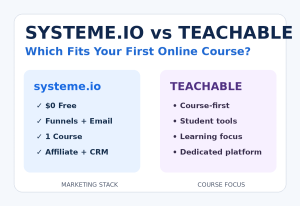 Systeme.io vs Teachable: Which Is Better for Selling Your First Online Course?
 Systeme.io Review: Is It Worth It for Beginners in 2026?