Do You Really Need a Website Before You Make Your First Sale?

You have an idea.
Maybe it is an ebook, a template, a small course, a consulting package or a simple digital product.
You want to see whether somebody will pay for it.
So naturally, you start building a website.
You buy a domain.
Compare hosting.
Choose a theme.
Design the homepage.
Write an About page.
Create a menu.
Adjust the footer.
Spend an hour deciding whether the button should be blue or orange.
Then you realize you still need a sales page.
And checkout.
And email.
And product delivery.
Three weeks later, you have built a respectable-looking website.
But the question you originally wanted answered is still unanswered:
Will anyone actually buy this?
Do You Need a Website Before Your First Sale?
Not necessarily.
You need a way for the right person to discover your offer, understand it, trust it, pay for it and receive what you promised.
A full website is one way to support that process.
It is not always a prerequisite for the first sale.
That distinction can save a beginner a surprising amount of time.
Do You Need a Website Before Your First Sale—or Just a Working Sales Path?
Think about what a customer actually needs.
They need enough information to decide whether the offer is relevant.
They need enough trust to feel comfortable buying.
They need a working payment method.
They need clear expectations about what happens after payment.
None of those requirements automatically says:
“You must first build a five-page website with a blog, navigation menu and carefully designed homepage.”
A Website and a Sales Path Are Not the Same Thing
A traditional business website may contain:
- homepage;
- About page;
- services or product pages;
- blog;
- contact page;
- FAQ;
- navigation;
- footer links;
- legal pages.
Those can all be useful.
But a simple sales path has a narrower job.
For example:
Traffic → Sales Page → Checkout → Thank-You/Delivery
Or, if you want to capture leads first:
Traffic → Opt-In Page → Email Follow-Up → Sales Page → Checkout → Delivery
That may be enough to test whether the offer deserves more investment.
The First Version of Your Business Is an Experiment
Before your first sale, many things are assumptions.
You assume the problem matters.
You assume your target customer understands the offer.
You assume the price makes sense.
You assume the promise is attractive.
You assume people will trust you enough to buy.
Building a large website does not validate those assumptions.
A customer does.
What If You Spend a Month Building the Website and Nobody Buys?
This is the uncomfortable scenario worth considering before you start.
Imagine spending four weeks on:
- hosting;
- WordPress setup;
- theme customization;
- homepage design;
- mobile responsiveness;
- plugins;
- menus;
- SEO settings;
- security;
- backups;
- forms;
- email delivery.
Then you finally publish the offer.
The market does not respond.
Maybe the idea is wrong.
Maybe the audience is wrong.
Maybe the offer is too vague.
Maybe the price is wrong.
Maybe nobody has seen it yet.
The problem is not that the website was useless.
The problem is that you invested heavily in infrastructure before learning whether infrastructure was the current bottleneck.
Your First Sale Gives You Better Questions
Once somebody buys, your questions improve.
Instead of asking:
“What should my homepage look like?”
you can ask:
“What made this person buy?”
Instead of:
“Which theme should I use?”
you can ask:
“What nearly stopped the customer from purchasing?”
Instead of:
“Should I add another plugin?”
you can ask:
“Where are potential buyers getting stuck?”
Real customers turn abstract decisions into specific problems.
What Is the Minimum You Actually Need to Sell?
It depends on what you sell, but a basic digital-product setup may only need five functions:
- Attention: somewhere people discover you.
- Offer: a page explaining what you sell and why it matters.
- Payment: a reliable checkout.
- Delivery: a way to give the customer what they purchased.
- Follow-up: email or another appropriate way to communicate after the interaction.
Notice that “build a complete website” is not one of the functions.
A website can eventually support all of them.
But it is the functions that matter.
Your Traffic Does Not Have to Start From a Website
Early visitors can come from many places:
- YouTube;
- social media;
- online communities;
- email;
- partnerships;
- referrals;
- direct outreach;
- an existing audience;
- paid advertising, where appropriate.
Those visitors can be sent directly to a focused landing or sales page.
This is why a complete website and the ability to sell online should not be treated as identical requirements.
A Focused Page Can Be Better for an Early Test
A homepage usually has multiple jobs.
It may introduce the brand, feature several products, link to articles and direct visitors to different parts of the site.
A focused sales page can have one job:
Help the right visitor decide whether to buy one offer.
That simplicity can make early testing easier.
If visitors are not buying, you have fewer variables to investigate.
But Do Not Confuse “Simple” With “Careless”
Skipping a full website does not mean skipping trust.
Your sales path still needs to look credible.
It should clearly explain:
- what the product or service is;
- who it is for;
- what problem it addresses;
- what the customer receives;
- the price;
- how payment works;
- relevant refund or cancellation terms;
- how to contact you when appropriate.
You also need the legal disclosures, policies and business information required for your jurisdiction and selling model.
“No full website” is not permission to run an anonymous or confusing checkout page.
You May Need Fewer Pages Than You Think
For a very simple offer, the early flow might be:
Sales Page → Order Form → Thank-You Page
If you are building an email list first:
Opt-In Page → Thank-You Page → Email Sequence → Sales Page → Order Form
If the product is a course:
Sales Page → Checkout → Student Access → Welcome Email
These are workflows.
You can add a broader website when the business has a reason to need one.
So Where Do You Build Those Pages?
This is where beginners often accidentally return to the original problem.
They decide not to build a full website.
Then they buy a landing-page tool.
Then a separate checkout tool.
Then an email platform.
Then an automation connector.
Now they have avoided building a website by building a software stack instead.
There is a simpler category of option: an integrated funnel platform.
One Example Is Systeme.io
Systeme.io combines sales funnels, checkout, email marketing, automation, website/blog building, online courses, CRM pipelines and affiliate management within one platform.
Its current Free plan is $0, requires no credit card and supports up to 2,000 contacts and three sales funnels, along with a blog, one course, one affiliate program and one custom domain. Current plans include unlimited email sends and 0% Systeme.io platform transaction fees, although payment processors can still charge their own fees.
That means you can test a simple sales path without first buying web hosting or assembling several separate marketing tools.
You Can Start With a Funnel Instead of a Full Website
Systeme.io’s current funnel documentation makes the distinction particularly clear.
Its preset Build an Audience funnel starts with an opt-in page and a thank-you page.
Its preset Sell funnel starts with an order form and a thank-you page.
You can then add other steps such as a sales page when the flow requires them.
In a more complete sales funnel, the platform supports a sequence such as:
Opt-In → Sales Page → Order Form → Upsell/Downsell → Thank-You
You do not need every step.
The point is that the sales process can exist independently of a conventional multi-page website.
You Also Do Not Have to Design Every Page From Scratch
Systeme.io’s current free template library says it includes hundreds of ready-made funnel and website templates across 35 categories.
The library includes use cases such as business, consulting, coaching, ebooks and guides, courses, ecommerce, marketing, newsletters, software and webinars.
The workflow is straightforward:
Choose a Template → Load It Into Your Account → Replace the Copy and Images → Publish
The current library says templates can be loaded into an account with one click and then customized.
For a beginner, that matters because “I need a sales page” does not have to become “I need to learn web design before I can launch.”
Your Checkout Can Be Part of the Funnel
Systeme.io supports an order-form step inside a sales funnel.
Its current help documentation allows you to choose an order-form template or start from scratch, edit the page and specify whether the offer is a digital or physical product.
After payment, a sales thank-you page can show an order summary and provide the appropriate next step.
This keeps the purchase path connected instead of sending the beginner into another round of software research.
Email Follow-Up Can Live in the Same System
If someone joins your list before buying, you may want to follow up.
Systeme.io’s current platform integrates its email list with funnels, products and courses.
Its email tools include broadcasts, automated sequences, tagging and segmentation.
That means the early workflow can stay relatively compact:
Visitor → Opt-In → Email → Offer → Checkout
without requiring a separate landing-page builder and email platform merely to test the first version.
Start With the Shortest Path to a Real Customer
For a beginner selling one digital product, that could mean:
- Choose one clear offer.
- Choose a ready-made sales-page or funnel template.
- Replace the generic copy with your actual promise and product information.
- Configure the order form and payment method.
- Create the thank-you/delivery step.
- Test the complete purchase yourself.
- Send relevant people to the page.
- Observe what happens.
Only after that do you need to ask what should be expanded.
What Should You Measure Before Building More?
Start with basic questions:
Are people visiting?
If not, you probably need more distribution or marketing.
Are visitors showing interest?
If not, examine the audience, headline and offer.
Are people reaching checkout but not paying?
Investigate trust, price, payment friction and the checkout experience.
Are people buying?
Now talk to them.
Learn why.
That feedback can tell you what the next version of the business needs.
When Does a Full Website Become Worth Building?
A full website becomes increasingly useful when you need things such as:
- a substantial SEO/content strategy;
- multiple products or services;
- stronger brand navigation;
- a large resource library;
- many informational pages;
- complex ecommerce;
- specialized integrations;
- custom functionality;
- a long-term owned publishing hub.
At that stage, the website is solving a real business requirement.
You are no longer building it simply because you assumed every online business must begin with one.
WordPress Can Still Be the Right Choice
There is nothing wrong with starting with WordPress if you know why you need it.
It can be an excellent choice for content-heavy websites, custom development, specialized plugins and businesses that value control over their hosting environment.
If you already know WordPress well, the setup cost in time may also be much lower for you than for a complete beginner.
The point is not “never build a website.”
The point is:
Do not make a full website a gate that prevents you from testing the business.
You Can Use WordPress and a Funnel Together
You also do not have to choose one system forever.
Systeme.io’s current documentation explicitly supports linking an external website, including WordPress, to a Systeme.io funnel or specific funnel step.
A later setup could therefore look like:
WordPress Content → Systeme.io Sales Page/Funnel → Checkout → Follow-Up
Your website can become the content and discovery layer while a focused funnel handles a specific conversion path.
What If You Already Spent Weeks Building the Website?
Do not rebuild everything again.
That can become another form of delay.
If the website works, use it.
Pick the shortest path from the traffic you already have to the offer you want to validate.
Add only what is missing.
Your goal is not to prove that one technology choice was correct.
Your goal is to learn whether customers want what you sell.
Your First Website Does Not Need to Be Your Forever Website
This idea can remove a lot of pressure.
The first version can be temporary.
The first sales page can be replaced.
The first funnel can change.
The first platform may not be the platform you use five years from now.
You are not choosing the permanent infrastructure of a global corporation.
You are choosing the simplest credible way to learn what the market tells you next.
A Simple Rule Before You Build Another Page
Ask:
“What job will this page do?”
If you can answer clearly, build it.
If the answer is “because a proper website should have one,” reconsider whether it is needed before launch.
The same rule works for software.
Every page should have a job.
Every tool should have a job.
Every hour you spend building should have a reason.
Final Takeaway
You do not necessarily need a complete website before making your first sale.
You need a credible path that allows the right person to understand your offer, trust you, pay safely and receive what you promised.
For some businesses, a full website is the best way to create that path.
For others, especially when testing a first digital product or simple offer, a focused sales funnel may be enough to begin learning from real customers.
An integrated platform such as Systeme.io makes that approach practical because landing pages, checkout, email follow-up and product-related tools can live in the same environment, while its free template library gives you a ready-made starting point instead of a blank canvas.
Build the full website when the business gives you a reason to need it.
Until then, do not let the website become the project that prevents you from testing the business.
Your first sale does not care how many pages are in your navigation menu.
Suggested Articles to Read
 Want to Sell an Online Course Without Building a Website?
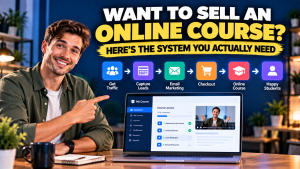 Want to Sell an Online Course? Here’s the System You Actually Need
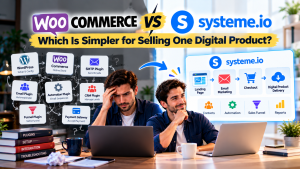 Systeme.io vs WooCommerce: Which Is Simpler for Selling One Digital Product?
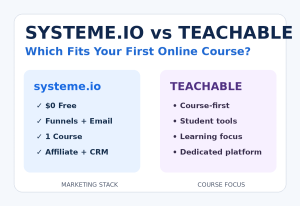 Systeme.io vs Teachable: Which Is Better for Selling Your First Online Course?
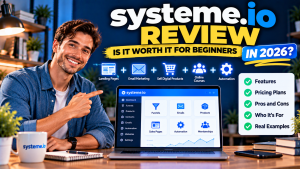 Systeme.io Review: Is It Worth It for Beginners in 2026?