Is Systeme.io Really Free? What You Get Before Paying in 2026
You see “Free” on Systeme.io’s pricing page.
Then the obvious questions begin.
Is it actually free?
Is it a 14-day trial?
Do you need a credit card?
Can you really build a funnel, collect emails and sell something before paying?
Or does the useful part only appear after you upgrade?
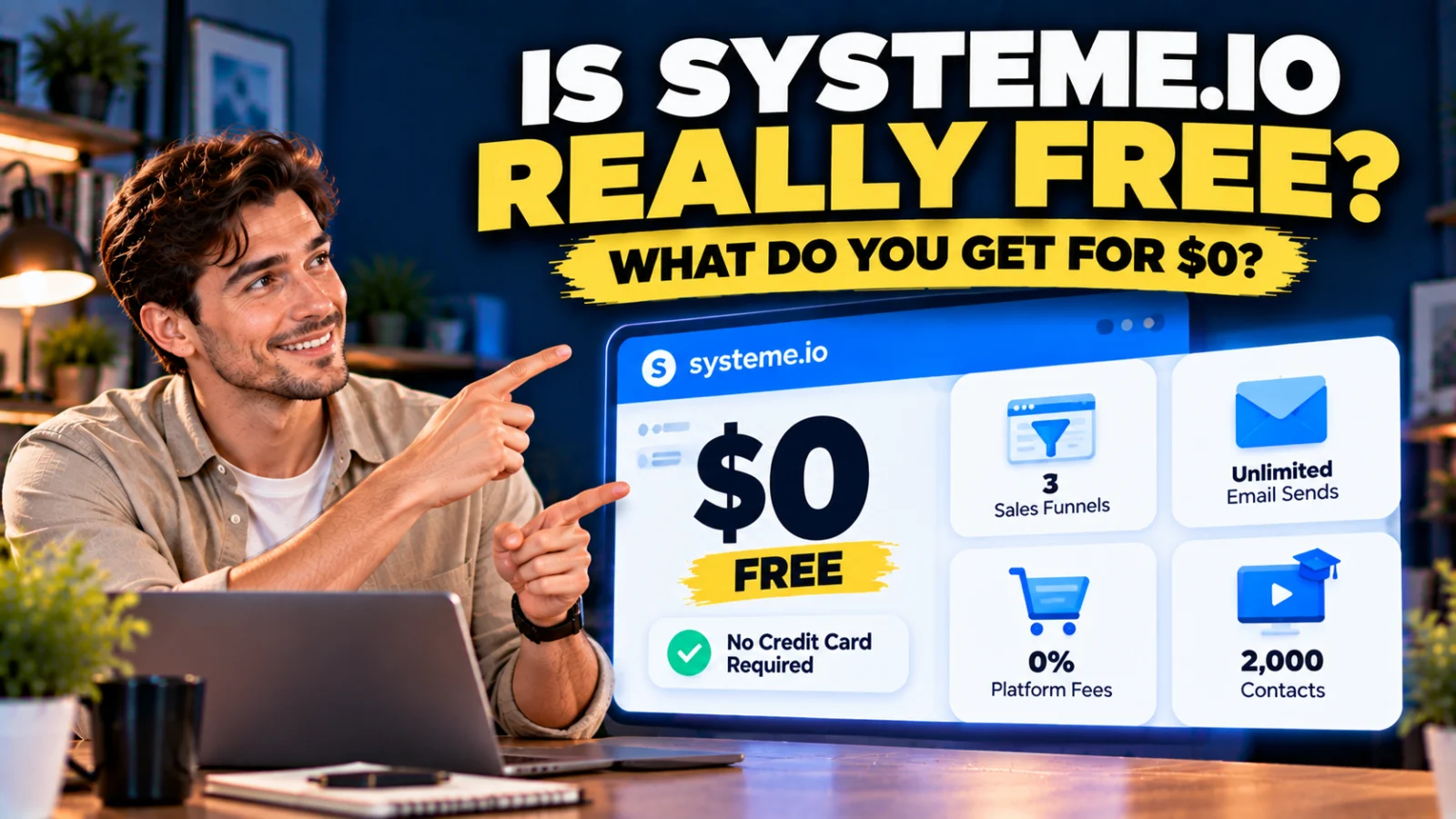
The short answer is that Systeme.io currently has a genuine $0 plan that does not expire and does not require a credit card.
But “free” does not mean unlimited.
The useful question is not whether the Free plan has limits. Every sustainable freemium product needs limits somewhere.
The useful question is:
Are those limits high enough to launch a real beginner business before you need to pay?
Let’s look at exactly what you get.
Is Systeme.io Really Free? What You Get Before Paying
Yes. As of September 2026, Systeme.io’s official pricing page lists a permanent Free plan at $0.
You do not need to enter a credit card to start.
The current Free plan includes up to:
- 2,000 contacts;
- 3 sales funnels;
- 15 funnel steps;
- 1 tag;
- 1 email campaign;
- unlimited newsletters;
- unlimited email sends;
- 1 automation rule;
- 1 workflow;
- 1 A/B test;
- 1 custom domain;
- unlimited file storage;
- 1 one-click upsell;
- 1 order bump;
- 1 website;
- 1 blog;
- 1 CRM pipeline;
- 1 course;
- up to 500 students;
- 1 community;
- 1 booking-calendar event;
- 1 coupon code.
The official pricing table also currently lists 0% Systeme.io transaction fees across its main plans.
That is a surprisingly usable free account.
Is Systeme.io Really Free If You Want to Sell Something?
Yes—you can build a sales funnel and configure a digital-product offer without first buying a Systeme.io subscription.
Systeme.io’s current documentation supports digital-product price plans using:
- one-time payment;
- subscription;
- payment plan.
You can therefore build a path such as:
Sales Page → Order Form → Payment → Product Delivery
on the Free plan, provided your setup remains within its limits.
This is important because some “free” software is useful mainly for exploring the dashboard.
Systeme.io’s Free plan can be used to test an actual customer journey.
Do You Need a Credit Card to Start Systeme.io Free?
No.
The current official pricing page explicitly states that no credit card is required.
That means you can create the account, explore the interface and build your first funnel without entering payment details for a Systeme.io subscription.
If you want to see whether the workflow fits your business, you can create a Free Systeme.io account here.
Affiliate disclosure: The Systeme.io link above is an affiliate link. If you later upgrade to a paid plan, I may earn a commission at no additional cost to you.
Is Systeme.io Free Forever or Just a Trial?
The current Free plan does not have a trial countdown.
Systeme.io describes it as a permanent Free plan.
You do not have to finish building your funnel within seven or fourteen days to avoid losing the account.
That changes how useful the plan is for a beginner.
You can learn slowly, test an offer and wait for actual business needs to create the reason to upgrade.
Can You Build a Real Sales Funnel for Free?
Yes.
The current Free plan allows three sales funnels and fifteen total funnel steps.
For example, Funnel #1 could be:
- Opt-In Page
- Thank-You Page
Funnel #2 could be:
- Sales Page
- Order Form
- Thank-You / Download Page
You would still have a third funnel available for another offer or experiment.
For someone selling a first PDF, template, mini course or service, that can be enough to validate the business.
Can You Use Systeme.io Free for Email Marketing?
Yes.
The current pricing table lists unlimited email sends even on Free.
It also allows unlimited newsletters.
But there is an important distinction.
Unlimited email sending does not mean unlimited email-marketing structure.
Free currently limits you to:
- 2,000 contacts;
- 1 tag;
- 1 email campaign;
- 1 automation rule;
- 1 workflow.
You can send a lot of email.
You cannot build unlimited separate campaigns and automation systems on the Free plan.
The Real Catch: Automation Is Where Free Feels Small First
This is the limitation I would pay the most attention to.
Imagine your first business has one lead magnet and one paid product.
One workflow may be enough.
Then you add:
- a second lead magnet;
- a second product;
- a customer onboarding sequence;
- a course;
- a different segment of subscribers.
Now one tag, one automation rule and one workflow can become restrictive.
This is a much more realistic reason to upgrade than “I need to send more emails.”
Can You Sell a PDF or Ebook on Systeme.io Free?
Yes.
A simple setup can be:
Sales Page → Checkout → Thank-You Page → Download
Systeme.io’s help documentation supports delivering an ebook or PDF using an email attachment, a download link sent by email or a download link on the thank-you page.
For email attachments, the current documented maximum is 5 MB.
For larger files, a hosted download link is often more practical.
Can You Sell an Online Course on Systeme.io Free?
Yes, within the current Free-plan limits.
The detailed pricing table currently lists:
- 1 course;
- up to 500 students.
This is enough to test a first course without immediately subscribing to a dedicated course platform.
If your first course works and you want multiple courses or substantially more capacity, a paid plan becomes more relevant.
Can You Connect Your Own Domain for Free?
Yes.
The Free plan currently includes one custom domain connection.
There is an important distinction:
Systeme.io does not give you a paid domain registration for free.
You still obtain your domain separately from a domain registrar.
Systeme.io lets you connect one custom domain to the Free account.
Does Systeme.io Charge Transaction Fees?
Systeme.io’s current pricing table lists a 0% platform transaction fee across Free, Startup, Webinar and Unlimited.
That does not mean processing a payment costs nothing.
Your payment processor can charge its own fee.
For example, Stripe, PayPal or another supported processor has its own pricing, which can vary by country, payment method and transaction.
The accurate statement is:
Systeme.io currently adds no platform percentage transaction fee, but payment-processing fees can still apply.
What Payment Types Can You Offer?
Systeme.io’s current help documentation allows a digital product to use:
- one-time payment;
- subscription;
- payment plan.
That means the Free subscription tier does not force you to sell only free products.
You can create a paid digital offer.
Can You Create a Website for Free?
The current Free plan includes one website and one blog.
But a beginner selling a single product may not need to build a traditional website first.
You can use a simpler route:
YouTube / Social / Blog → Sales Funnel → Checkout
If you already have WordPress or another website, you can also keep it and link visitors into a Systeme.io funnel.
Can You Use a CRM on the Free Plan?
Yes.
The current Free plan includes one CRM pipeline.
This can be useful for a simple service-business workflow:
Landing Page → Enquiry → Contact → Pipeline → Follow-Up
Businesses with complex sales teams or advanced CRM requirements may still prefer dedicated CRM software.
Can You Create an Affiliate Program for Free?
Systeme.io includes affiliate-program functionality in its platform.
That can be useful once you have a product that converts and want partners to promote it.
You should still configure commissions, tracking and payout processes carefully rather than assuming the platform automatically makes an affiliate program profitable.
What Is Not Included on Free?
Some capabilities are unavailable or significantly constrained.
The most obvious example is Systeme.io’s evergreen webinar feature.
The current pricing table shows:
- Free: 0 evergreen webinars;
- Startup: 0;
- Webinar: 10;
- Unlimited: unlimited.
If evergreen webinars are central to your strategy, Free will not provide that feature.
Other restrictions are capacity limits rather than complete feature exclusions.
What Happens When You Need More Than Three Funnels?
That is a clear upgrade trigger.
The current Startup plan costs $17/month and increases funnel capacity to 10 funnels and 50 funnel steps.
It also raises the contact limit to 5,000.
Do not upgrade merely because 10 funnels sounds better than 3.
Upgrade when you actually need funnel #4.
What Happens When You Need More Automation?
Startup currently increases the relevant limits to:
- 10 tags;
- 10 email campaigns;
- 10 automation rules;
- 5 workflows.
For many small businesses, this is the more meaningful reason to pay $17 than the additional contact capacity.
What Happens When You Reach 2,000 Contacts?
Startup currently supports up to 5,000 contacts.
Webinar supports up to 10,000.
Unlimited removes the contact limit.
If your list is genuinely approaching 2,000 engaged contacts, paying for more capacity is a normal business cost.
You should not delete useful subscribers simply to protect a $0 software bill.
What Does Startup Cost?
Systeme.io’s current monthly pricing is:
- Free: $0;
- Startup: $17/month;
- Webinar: $47/month;
- Unlimited: $97/month.
The official page currently advertises two months free with annual billing.
Prices and plan limits can change, so check the current pricing page before committing to a paid plan.
Does Free Mean You Never Need to Pay for Anything?
No.
This is where marketing language needs context.
You can build and test the software stack without an upfront Systeme.io subscription.
Your broader business may still incur costs such as:
- domain registration;
- payment processing;
- advertising;
- design assets;
- specialist third-party tools;
- taxes and business-registration requirements applicable to you.
Those are not necessarily Systeme.io fees.
But they are still part of operating a business.
What Can a Beginner Actually Build Before Paying?
Here is a realistic example.
Suppose you create a $19 template pack.
You could use the Free plan to build:
Step 1: Free Checklist Landing Page
A visitor enters an email address.
Step 2: Email Campaign
You deliver the checklist and explain the problem.
Step 3: Product Sales Page
You introduce the $19 template pack.
Step 4: Order Form
The customer pays.
Step 5: Thank-You Page
The customer receives the product.
That is not a fake demo.
It is a basic functioning online sales system.
What You Cannot Build Comfortably on Free
Now imagine the business grows to:
- four different lead magnets;
- three paid products;
- two courses;
- multiple customer segments;
- several automated onboarding sequences;
- different workflows for buyers and prospects.
The Free plan is no longer a comfortable fit.
That is exactly what a freemium plan should do: let you validate the model, then create a reason to upgrade when the business becomes more complex.
Free vs Startup: What Are You Really Paying $17 For?
| Feature | Free | Startup |
|---|---|---|
| Contacts | 2,000 | 5,000 |
| Funnels | 3 | 10 |
| Funnel steps | 15 | 50 |
| Tags | 1 | 10 |
| Email campaigns | 1 | 10 |
| Automation rules | 1 | 10 |
| Workflows | 1 | 5 |
| Custom domains | 1 | 3 |
| Email sends | Unlimited | Unlimited |
| Platform transaction fee | 0% | 0% |
You are mainly paying for capacity and complexity.
You are not paying $17 merely to unlock the ability to send an email or make a sale.
Should You Start on Free Even If You Can Afford Startup?
Usually, testing Free first is sensible.
Not because $17 is a large expense.
Because you should confirm that you actually like the platform.
Build one complete workflow.
Use the page editor.
Create a campaign.
Configure an order form.
Test product delivery.
If the system fits and you immediately need more automation or funnels, upgrade with a reason.
When I Would Upgrade Immediately
I would not deliberately stay on Free if I already knew I needed:
- more than 2,000 contacts;
- more than 3 funnels;
- multiple separate email campaigns;
- several automation rules;
- multiple workflows;
- multiple courses;
- multiple custom domains.
In that situation, Free is useful for testing the interface, not for forcing the whole operation into artificial limits.
When I Would Stay Free
I would stay Free while building or validating:
- a first digital product;
- a first lead magnet;
- a first course;
- a first funnel;
- a small email list;
- a simple service lead-generation system.
If the Free limits are not causing a real problem, paying for additional unused capacity provides little benefit.
Is There a Catch With Unlimited Email?
The phrase “unlimited email” can be misunderstood.
The current plan table lists unlimited sends.
But you still have a contact limit and limits on campaign/automation structure.
So Free is not equivalent to:
unlimited contacts + unlimited campaigns + unlimited workflows.
It means you can send unlimited emails within the account and plan structure available to you.
Is Systeme.io Free Better Than a Free Trial?
For validation, a permanent Free plan has a practical advantage: there is no countdown forcing you to evaluate the platform before you are ready.
That does not automatically make Systeme.io better than every product that uses a free trial.
A specialist paid product may be better at a particular job.
But the absence of a trial deadline makes Systeme.io easier to test at a beginner’s pace.
Who Gets the Most Value From Systeme.io Free?
The Free plan is particularly useful for:
- first-time digital-product sellers;
- new affiliate marketers building an email list;
- course creators validating a first course;
- coaches building a simple lead funnel;
- service businesses testing lead capture;
- creators who need a landing page plus email follow-up;
- people trying to reduce a stack of overlapping tools.
Who May Need Something Else?
Free Systeme.io may not be the right solution if your core requirement is:
- advanced ecommerce inventory;
- enterprise CRM;
- sophisticated learning-management features;
- complex custom web development;
- Merchant-of-Record tax handling;
- advanced specialist email segmentation/reporting.
“Free” should never override a major functional requirement.
The Best Way to Find the Free Plan’s Limits
Do not try to memorize every row of the pricing table.
Build the business.
When you attempt something and hit a plan limit, ask:
Is this feature important enough to the business to justify $17/month?
If the answer is yes, the upgrade decision becomes simple.
If the answer is no, stay Free.
A 30-Minute Free-Plan Test
If you are still unsure, create a Free account and try this:
- Create one funnel.
- Choose a landing-page template.
- Add an email form.
- Create one email campaign.
- Create a simple sales page.
- Add an order form.
- Configure a test digital product.
- Create a thank-you/download page.
You do not need to publish the offer.
The goal is to answer:
“Can I see myself building and maintaining my business in this system?”
So, Is Systeme.io Really Free?
Yes.
The current $0 plan is permanent, requires no credit card and is capable of building a real beginner sales system.
But it is intentionally limited.
The limits you are most likely to notice are not email sends or file storage.
They are:
- 2,000 contacts;
- 3 funnels;
- 1 tag;
- 1 campaign;
- 1 automation rule;
- 1 workflow;
- 1 course;
- 1 custom domain.
If those limits are enough for your current business, there is no need to pay simply because a paid plan exists.
If you want to test the system yourself, start with the Systeme.io Free plan here.
Final Takeaway
The Systeme.io Free plan is most valuable when you treat it as a place to validate before you expand.
Build your first funnel.
Collect your first contacts.
Create your first email sequence.
Sell your first product.
Learn which parts of the system you actually use.
Then let a real limit—not fear of missing features—decide when you upgrade.
For a beginner, that is a much healthier software-buying strategy than paying for capacity before the business exists.
Suggested Articles to Read
 Want to Sell an Online Course Without Building a Website?
 Want to Sell an Online Course? Here’s the System You Actually Need
 Systeme.io vs WooCommerce: Which Is Simpler for Selling One Digital Product?
 Systeme.io vs Teachable: Which Is Better for Selling Your First Online Course?
 Systeme.io Review: Is It Worth It for Beginners in 2026?