Systeme.io Review: Is It Worth It for Beginners in 2026?
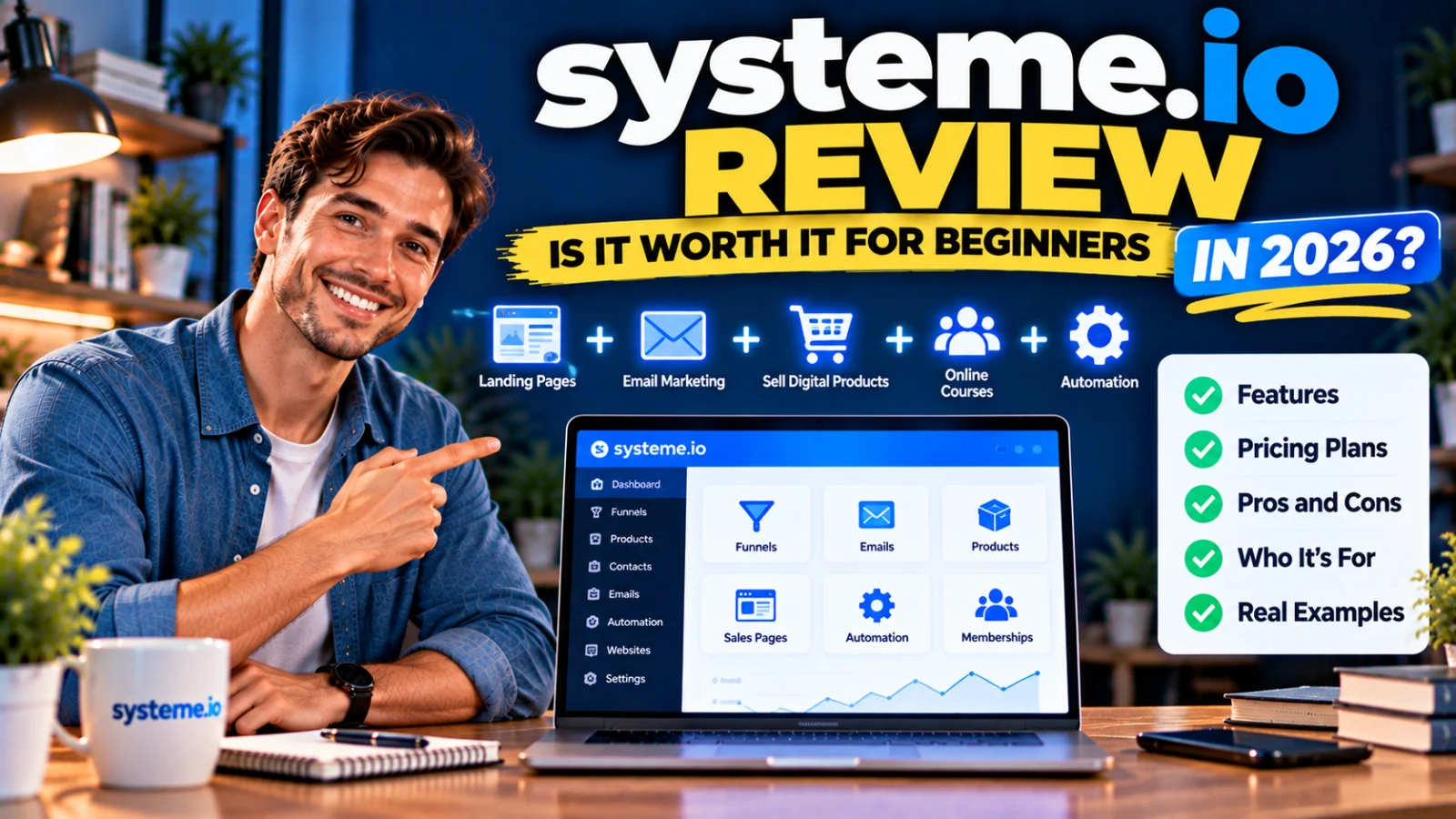
Systeme.io makes an attractive promise to a beginner: instead of connecting a page builder, email service, funnel tool, course platform and affiliate software, you can run much of the business from one account.
That sounds convenient.
But convenience alone does not make software worth using.
The real questions are:
- Can the Free plan run a real beginner business?
- Are the built-in tools good enough to replace separate software?
- What limitations will you notice first?
- When does a specialist platform make more sense?
- And is Systeme.io still worth considering once your business grows?
This review focuses on those questions rather than treating a long feature list as proof that the platform is right for everyone.
Systeme.io Review: Is It Worth It for Beginners in 2026?
For a beginner who wants to build a relatively simple online sales system, Systeme.io is worth testing because the current Free plan can cover the core journey:
Landing Page → Contact → Email → Sales Page → Checkout → Delivery
You can currently start for $0 without a credit card, use up to 2,000 contacts and 3 funnels, send unlimited emails, connect one custom domain, create a course and use basic automation.
Systeme.io also lists 0% platform transaction fees across its main plans. Your payment processor can still charge its own processing fees.
The important qualifier is simple.
If you need an advanced ecommerce catalog, sophisticated CRM, highly specialized course-learning features or a deeply customized website, an all-in-one beginner platform may not replace specialist software.
Systeme.io Review: Is It Worth It for Beginners Who Have Never Built a Funnel?
This is where Systeme.io’s all-in-one approach can be particularly useful.
A beginner often thinks the first task is choosing a website builder.
Then they discover they also need:
- a form;
- email capture;
- an autoresponder;
- a sales page;
- checkout;
- product delivery;
- automation;
- possibly a course area;
- possibly an affiliate system.
Building that from separate tools is possible, and sometimes preferable.
But every connection creates another decision and another potential point of failure.
Systeme.io’s strongest beginner advantage is not that every individual feature is the most advanced in its category.
It is that many of the pieces already understand each other.
What Is Systeme.io?
Systeme.io is an all-in-one online-business platform centered around funnels, contacts, email marketing, automation and selling.
Its current platform includes tools for:
- sales funnels;
- landing pages;
- email marketing;
- workflows and automation rules;
- digital products;
- online courses;
- websites and blogs;
- CRM pipelines;
- communities;
- booking calendars;
- affiliate programs;
- evergreen webinars on eligible plans.
That breadth is the reason it competes with several categories of software at once.
What Does Systeme.io Cost?
The current official monthly pricing is:
| Plan | Price | Contacts | Funnels |
|---|---|---|---|
| Free | $0 | 2,000 | 3 |
| Startup | $17/month | 5,000 | 10 |
| Webinar | $47/month | 10,000 | 50 |
| Unlimited | $97/month | Unlimited | Unlimited |
The official pricing page currently advertises two months free with annual billing.
For a brand-new user, however, the more important question is whether you need to pay at all.
How Useful Is the Free Plan?
More useful than a typical short free trial.
Systeme.io’s Free plan is currently $0 and does not require a credit card.
It includes:
- 2,000 contacts;
- unlimited email sends;
- 1 email campaign;
- unlimited newsletters;
- 1 automation rule;
- 1 workflow;
- 3 funnels;
- 15 funnel steps;
- 1 A/B test;
- 1 custom domain;
- unlimited file storage;
- 1 one-click upsell;
- 1 order bump;
- 1 website;
- 1 blog;
- 1 CRM pipeline;
- 1 course;
- up to 500 students;
- 1 community;
- 1 booking-calendar event;
- 1 coupon code;
- affiliate-program functionality.
This is enough to test an actual business workflow rather than a demo.
What Can You Realistically Build for $0?
Consider a beginner selling a small digital product.
You could build:
Free Checklist → Email Follow-Up → Product Sales Page → Checkout → PDF Delivery
Or:
YouTube Video → Course Sales Page → Checkout → Student Access
Or:
Service Landing Page → Lead Form → Contact → Follow-Up → CRM Pipeline
You will hit limits if the operation becomes more complex, but these are real business flows.
Is Systeme.io Really Free?
The Free plan is currently a permanent $0 plan rather than a time-limited trial.
But “free” should not be interpreted as “running an online business has zero costs.”
You may still pay for:
- payment processing;
- a domain you purchase from a registrar;
- advertising;
- third-party software you choose to add;
- taxes or business costs relevant to your jurisdiction.
Systeme.io’s own current platform transaction fee is 0%, but processors such as Stripe or PayPal have their own pricing.
What I Like About Systeme.io for Beginners
1. You Can Test the Entire Customer Journey Before Paying
This is the most meaningful advantage.
Many tools let you test one component for free.
Systeme.io lets a beginner test multiple connected components.
You can discover whether you even like the workflow before committing to a paid plan.
2. Email and Funnels Live in the Same System
A visitor who submits a form becomes a contact that can enter an email campaign or workflow.
You do not need to begin by learning how to synchronize two separate databases.
This is particularly useful for:
- lead magnets;
- ebook funnels;
- course launches;
- service enquiries;
- follow-up sequences.
3. Unlimited Email Sending Is Available on the Main Plans
The current pricing table lists unlimited email sends across Free, Startup, Webinar and Unlimited.
The limits instead apply to areas such as contacts, campaigns, tags, automation rules and workflows.
That distinction is useful for a beginner who may send regular newsletters but still has a relatively small list.
4. You Can Sell Without Building a Traditional Website First
You can build a sales funnel and send traffic directly to it.
A simple digital-product business can use:
Content / Social / YouTube → Funnel → Checkout → Delivery
A full multi-page website can come later if the business needs one.
5. Digital Product Delivery Is Built Into the Workflow
Systeme.io’s documentation supports delivering an ebook or PDF through an email attachment, an emailed download link or a link on the thank-you page.
For email attachments, its current documented limit is 5 MB.
This means you do not need to manually email every customer after payment.
6. It Can Host Your First Course
The Free plan currently includes one course and up to 500 students.
That makes it possible to test a course business without immediately subscribing to a dedicated LMS.
A specialist course platform may provide deeper learning features, but not every first course requires them.
7. Affiliate Management Is Already Available
Systeme.io includes affiliate-program functionality.
You can configure affiliate commissions for your own offers, provide affiliate tracking and give affiliates access to their dashboard.
This is useful later, after you have an offer worth promoting.
8. The Upgrade Path Starts Relatively Low
When Free becomes restrictive, Startup currently costs $17/month.
It raises capacity to 5,000 contacts, 10 funnels, 10 email campaigns, 10 automation rules, 5 workflows and 5 courses, among other increases.
That gives a growing small business room without immediately jumping to a high monthly software bill.
Where Systeme.io Is Less Impressive
An honest review also needs to explain where an all-in-one platform may not be the strongest option.
1. The Free Automation Limits Are Tight
Free currently includes only:
- 1 tag;
- 1 email campaign;
- 1 automation rule;
- 1 workflow.
That can be enough for one simple offer.
It becomes restrictive once you want different lead magnets, customer segments or product journeys.
This may be the first reason some users upgrade—even before reaching 2,000 contacts.
2. Three Funnels Can Become a Limit Quickly
Three funnels sound generous when you have no product.
They can disappear quickly once you create:
- a lead magnet;
- a digital-product funnel;
- a course funnel.
Your fourth campaign then requires restructuring or upgrading.
3. All-in-One Does Not Mean Best-in-Class at Every Job
A specialist email platform may offer deeper email capabilities.
A specialist CRM may offer more sophisticated sales operations.
A dedicated LMS may provide richer education features.
A mature ecommerce platform may be better for a large physical-product catalog.
Systeme.io’s value is integration and breadth.
If one specialist function is mission-critical to your business, compare dedicated tools for that function.
4. The Interface Still Requires Learning
Combining many business functions in one account reduces integration work, but it does not eliminate setup.
A beginner still needs to understand concepts such as:
- funnels;
- funnel steps;
- contacts;
- campaigns;
- workflows;
- automation rules;
- price plans;
- order forms.
The advantage is that you learn these concepts in one ecosystem rather than across several dashboards.
5. It Is Not a Merchant of Record
This is an important difference when comparing Systeme.io with platforms such as Gumroad.
Systeme.io provides the selling infrastructure and integrates with payment processors, but you should not assume it globally takes over tax/legal merchant responsibilities for your sales.
Understand the obligations that apply to your own business and jurisdiction.
Is Systeme.io Good for Selling PDFs and Ebooks?
Yes, particularly if you want marketing around the file.
A basic flow can be:
Sales Page → Order Form → Payment → Thank-You Page → Download
A more complete flow can be:
Lead Magnet → Email Sequence → Sales Page → Checkout → Ebook → Follow-Up
The second flow is where Systeme.io becomes more differentiated from a simple download checkout.
Is Systeme.io Good for Online Courses?
It can be a strong beginner option when your course needs to live inside the same system as its sales funnel and email marketing.
You can:
- build the course;
- create the sales page;
- take payment;
- grant access;
- email students;
- build automation around the customer journey.
However, if advanced learning-management features are the central product requirement, compare Systeme.io with dedicated course platforms before deciding.
Is Systeme.io Good for Service Businesses?
It can be useful for a relatively simple lead-generation and follow-up workflow.
The platform currently includes CRM pipelines, booking calendars, contacts and automation.
A service business could use:
Landing Page → Enquiry → Contact → CRM Pipeline → Follow-Up → Booking
For complex sales teams, advanced reporting or sophisticated CRM requirements, a dedicated CRM may be more appropriate.
Is Systeme.io Good for Ecommerce?
Systeme.io can sell products, including physical products.
But if your business is fundamentally a large ecommerce store with extensive inventory, merchandising, shipping and retail integrations, compare dedicated ecommerce platforms such as Shopify or WooCommerce.
Do not choose Systeme.io merely because it technically has a product-selling feature.
Choose it when its funnel/email architecture fits how you sell.
Systeme.io vs Using Five Separate Tools
Imagine a beginner assembling:
- landing-page software;
- email marketing;
- checkout;
- course hosting;
- affiliate software.
The problem is not only subscription cost.
You also manage:
- accounts;
- billing;
- integrations;
- contact synchronization;
- tracking;
- different support systems;
- different interfaces.
Separate tools can produce a more powerful specialist stack.
But a beginner should have a reason for accepting that complexity.
If Systeme.io already covers the required workflow, consolidation can be more valuable than having the most advanced individual tool in each category.
When Separate Tools Are the Better Choice
Choose specialist tools when the specialization matters.
Examples:
- a sales organization that needs advanced CRM functionality;
- a major ecommerce operation;
- a school requiring advanced LMS features;
- a publisher with sophisticated email segmentation/reporting needs;
- a business requiring custom development that exceeds a funnel builder.
The goal is not “use fewer tools at all costs.”
The goal is “do not add another tool until it solves a problem your current system cannot solve well enough.”
How Does Systeme.io Compare With Gumroad?
Gumroad is attractive for a different reason.
It offers a simple creator-commerce experience and currently acts as Merchant of Record, handling sales-tax collection and remittance worldwide according to its documentation.
But its current direct-sale fee is 10% + $0.50 per transaction, excluding card processing, while Discover sales carry a 30% fee that includes processing.
Systeme.io currently charges 0% platform transaction fees but does not offer the same Merchant-of-Record proposition.
If you want a simple transaction layer with tax-handling convenience, Gumroad may be appealing.
If you want funnels, lead capture and email automation around the sale, Systeme.io is structured differently.
How Does Systeme.io Compare With Payhip?
Payhip’s current Free Forever plan charges a 5% platform transaction fee while offering unlimited products and revenue with all features.
It is a strong option for a digital storefront.
Systeme.io is more naturally funnel-centric.
The difference can be summarized as:
Payhip: Traffic → Store/Product → Checkout → Delivery
Systeme.io: Traffic → Lead → Email → Sales Page → Checkout → Delivery → Follow-Up
Both can do more than those simplified flows, but the distinction helps identify their natural strengths.
How Does Systeme.io Compare With ClickFunnels?
ClickFunnels is a broader and more mature funnel/business platform than the old “page builder only” description sometimes suggests.
Its current Launch plan is priced at $97/month or $970/year and includes capabilities such as funnels, landing pages, email contacts, courses, communities and store functionality.
Systeme.io’s advantage for a beginner is the much lower entry point: a permanent Free plan and a current Startup plan at $17/month.
That does not make the products identical.
It means a beginner can test the all-in-one funnel model with less upfront software commitment.
How Does Systeme.io Compare With WordPress?
WordPress gives you much more control over a traditional website and a huge plugin ecosystem.
It can be an excellent choice for content-heavy sites, SEO publishing and custom functionality.
But a WordPress sales stack may involve:
- hosting;
- theme/page builder;
- forms;
- SMTP/email delivery;
- marketing email;
- checkout/ecommerce;
- course or membership plugins;
- affiliate plugins;
- maintenance and security.
You do not have to choose only one.
A practical hybrid is:
WordPress Content → Systeme.io Funnel → Checkout → Delivery
That lets WordPress handle publishing while Systeme.io handles the conversion path.
Who Is Systeme.io Best Suited For?
Systeme.io is particularly worth testing if you are:
- a beginner selling your first digital product;
- a creator building a lead magnet and email funnel;
- a coach or consultant with a simple funnel;
- a course creator who wants sales + course + email in one system;
- an affiliate marketer building landing pages and email lists;
- a small business that wants basic CRM/follow-up without a large stack;
- someone currently paying for several overlapping marketing tools.
Who May Want Something Else?
Look more closely at alternatives if you need:
- large-scale ecommerce inventory and retail operations;
- advanced enterprise CRM;
- highly specialized LMS functionality;
- complex website development;
- Merchant-of-Record tax handling as a core requirement;
- very advanced specialist email-marketing capabilities.
This is not a weakness unique to Systeme.io.
It is the normal trade-off of an all-in-one platform.
What Will Make You Upgrade From Free?
The first limit may not be the contact count.
Free currently gives you only one tag, campaign, automation rule and workflow.
A growing business may need more segmentation and automation before it reaches 2,000 contacts.
Startup currently increases capacity to:
- 5,000 contacts;
- 10 tags;
- 10 campaigns;
- 10 automation rules;
- 5 workflows;
- 10 funnels;
- 5 courses;
- 3 custom domains.
Upgrade because one of those limits becomes real—not because the paid plan looks more professional.
Does Systeme.io Have Hidden Costs?
The pricing structure itself is published clearly, but your complete business cost can include things outside the subscription.
Examples:
- payment-processor fees;
- domain registration;
- advertising;
- external tools you voluntarily integrate;
- business/tax costs.
That is different from a hidden platform fee.
Systeme.io currently lists 0% platform transaction fees.
Is the $17 Startup Plan Worth It?
It can be, but only when Free is actually constraining you.
For example, Startup makes sense if:
- you need a fourth funnel;
- one workflow is insufficient;
- you have multiple courses;
- you need more than one campaign;
- your list is approaching 2,000 contacts;
- you operate more than one domain.
If none of those apply, remaining on Free can be perfectly rational.
Is the $97 Unlimited Plan Worth It?
Unlimited is designed for a different stage.
It becomes more relevant when you have more than 10,000 contacts or repeatedly hit capacity limits across funnels, automation, domains, courses and other features.
A beginner should not buy Unlimited merely to avoid thinking about future limits.
Let the business create the need.
A 60-Minute Test Before You Decide
Do not decide based only on reviews—including this one.
Use the Free plan and test the workflow yourself.
Try to build:
- a simple landing page;
- a form;
- an email campaign;
- a sales page;
- an order form;
- a thank-you/download page.
Then ask:
- Is the editor comfortable enough?
- Can I create the design I need?
- Do I understand how contacts and automation work?
- Can I connect my preferred payment method?
- Can I deliver my product?
- Can I see myself maintaining this system?
You will learn more from that hour than from another ten comparison tables.
My Practical Verdict for a Beginner
If your goal is to sell a digital product, build a funnel, collect leads or launch a simple course, Systeme.io is one of the strongest starting options I would consider testing.
The reason is not that it beats every specialist platform at every feature.
It is because the current Free plan lets you test a meaningful amount of the complete business system before paying.
If you discover that you need a specialist capability, you can make that decision with real experience instead of guessing before launch.
Create a Free Systeme.io account and test the workflow yourself.
You do not need to enter a credit card for the current Free plan.
If your intended customer journey matches the funnel-and-email model described above, you can test Systeme.io on the Free plan here before deciding whether you need a paid plan.
Final Takeaway
Systeme.io is worth considering for beginners because it solves a very common early-stage problem:
too many separate tools before the business has proven it needs them.
Its Free plan is capable enough to build a real funnel, send emails, sell a product and test basic automation.
Its limitations become more visible as your funnels, segmentation and automation grow.
And specialist platforms can still be the better choice when your business depends on a specialist function.
So the useful question is not:
“Is Systeme.io the best software?”
It is:
“Can Systeme.io run the customer journey I need without adding unnecessary complexity?”
For many beginners building their first funnel-driven online business, the Free plan gives you enough room to answer that question yourself.
Suggested Articles to Read
 Want to Sell an Online Course Without Building a Website?
 Want to Sell an Online Course? Here’s the System You Actually Need
 Systeme.io vs WooCommerce: Which Is Simpler for Selling One Digital Product?
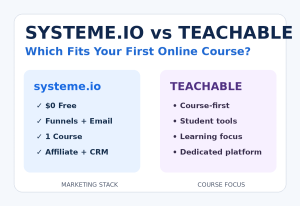 Systeme.io vs Teachable: Which Is Better for Selling Your First Online Course?
 Systeme.io vs Kajabi: Do Beginners Need to Pay for an All-in-One Platform?