Systeme.io vs Kajabi: Do Beginners Need to Pay for an All-in-One Platform?
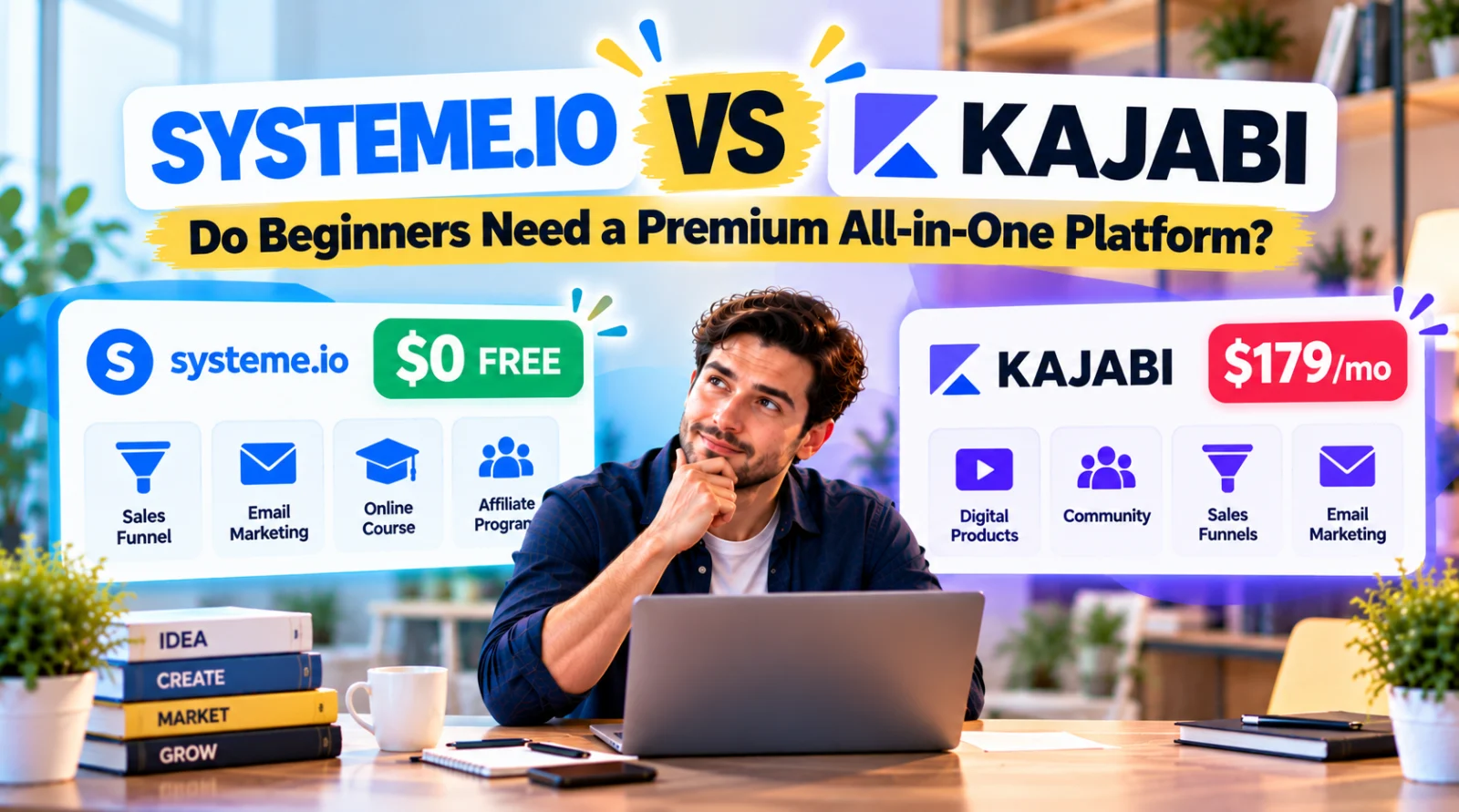
Kajabi and Systeme.io promise something many online-business owners want: fewer disconnected tools.
Both can bring together landing pages, funnels, email marketing, digital products and online courses. Both are designed to reduce the need to assemble a business from separate software subscriptions.
So this comparison is different from comparing Systeme.io with a basic page builder or WooCommerce installation.
The question is not whether Kajabi is a complete platform. It is.
The more useful question for a beginner is whether you need to start with a premium all-in-one platform before you have proven the business.
Systeme.io vs Kajabi: Do Beginners Need a Premium All-in-One Platform?
Kajabi currently positions itself as one platform for experts to build, market, sell and deliver their work. Its official pricing page includes courses and other products, funnels, unlimited landing pages, unlimited marketing emails, communities, checkout, payment integrations and customer-management features.
Systeme.io follows a similar all-in-one philosophy at a much lower entry price. Its current Free plan costs $0 and includes up to 2,000 contacts, three funnels, unlimited email sends, one course, one affiliate program, one CRM pipeline and one custom domain.
That creates a major difference in how a new business can begin.
Kajabi: Start With Premium Capacity → Build → Sell → Scale
Systeme.io: Start Free → Build → Validate → Upgrade When Needed
Systeme.io vs Kajabi Is Really a Question of When You Need Premium Capacity
If you already have customers, a substantial audience and several products, paying for a larger platform can be easy to justify.
If you have zero customers and an unproven course idea, the economics are different.
Your first challenge is not managing 25,000 contacts. It is convincing the first ten people to care.
Kajabi’s Current Pricing Is Important to Get Right
Kajabi’s current official monthly pricing lists:
| Plan | Monthly Billing | Contacts | Products |
|---|---|---|---|
| Basic | $179/month | 2,500 | 5 |
| Growth | $249/month | 25,000 | 50 |
| Pro | $499/month | 100,000 | Unlimited |
When billed annually, Kajabi currently displays lower equivalent monthly rates: $143 for Basic, $199 for Growth and $399 for Pro.
Kajabi also currently offers a free trial rather than a permanent free plan.
This matters because some older comparison pages still show different Kajabi prices. Always check Kajabi’s own current pricing before making a purchase decision.
Systeme.io Starts With a Permanent Free Plan
Systeme.io currently lists:
| Plan | Monthly Price | Contacts | Funnels |
|---|---|---|---|
| Free | $0 | 2,000 | 3 |
| Startup | $17 | 5,000 | 10 |
| Webinar | $47 | 10,000 | 50 |
| Unlimited | $97 | Unlimited | Unlimited |
The Free plan currently requires no credit card and does not expire.
It also includes unlimited email sends, although the Free plan still has a 2,000-contact limit and tighter limits on automation, funnels and other resources.
Do Not Make the Mistake of Calling Kajabi “Limited Marketing Software”
Kajabi Basic currently includes unlimited funnels, unlimited landing pages and unlimited marketing emails.
That is significant.
Kajabi is not charging $179 per month simply to give you five landing pages and a basic course player.
Its value proposition is a more complete premium creator-business environment covering products, marketing, payments and client experiences.
For an established knowledge business, that can be exactly what the owner wants.
Where Kajabi Basic Is Limited
The current Basic plan has limits in other areas, including five products, 2,500 contacts, one website, one community and two admin users.
Those limits are not necessarily restrictive for a new creator. In fact, five products may be far more than a beginner needs.
The question is whether paying $179 every month for that starting environment makes sense before the offer has traction.
What Can a Beginner Actually Build on Systeme.io Free?
A first-time course creator could build:
Lead Magnet → Email → Course Sales Page → Checkout → Course Access
A consultant could build:
Landing Page → Enquiry → CRM Pipeline → Follow-Up
A digital-product creator could build:
Sales Funnel → Checkout → Delivery → Email Follow-Up
Those are real business workflows, not simply test pages.
The limits appear when the business needs more contacts, more funnels, more courses or more automation.
The First 2,000 Contacts Are More Important Than the Next 98,000
Beginners can easily compare software based on future scale.
“What happens when I have 100,000 contacts?”
That is a useful question eventually.
But if you currently have 43 subscribers, the immediate problem is not the 100,001st contact.
It is building a repeatable system that turns the right visitor into a lead and eventually a customer.
Systeme.io Free gives you room to test that process with up to 2,000 contacts before subscription cost becomes mandatory.
Kajabi Gives You More Room From Day One
Kajabi Basic currently allows 2,500 contacts and five products, plus unlimited funnels, landing pages and marketing emails.
Its Growth plan increases that dramatically to 25,000 contacts and 50 products.
This is meaningful for creators migrating an existing audience or established product catalog.
Someone arriving with 15,000 contacts is not realistically comparing Kajabi Growth with Systeme.io Free.
They should compare paid plans at the capacity they actually need.
Course Delivery Is an Important Difference
Systeme.io includes course hosting and currently allows one course on Free.
It supports useful course functionality such as drip scheduling, module locking and student progress tracking.
Kajabi is more deeply positioned around knowledge businesses and professional client experiences. Its broader course and creator ecosystem can be attractive when the learning experience itself is central to the brand.
If you need sophisticated course-specific functionality, evaluate those requirements directly rather than choosing solely from price.
Kajabi’s Customer Experience Can Justify a Premium Platform
A creator selling a $2,000 coaching program may care deeply about how the customer experiences the brand after purchase.
Kajabi currently highlights its customer app, communities, access groups, course capabilities and premium creator tools as part of the platform.
For a high-value knowledge business, that polish and ecosystem can be commercially important.
A $179 subscription supporting a healthy high-ticket business is a very different expense from $179 being paid while someone spends six months preparing a first $29 course.
Email Marketing: Both Platforms Are Serious Options
Systeme.io currently includes unlimited email sends across its plans, including Free, subject to contact limits.
Kajabi’s current plans also list unlimited marketing emails.
So this is not a comparison where one platform has email and the other does not.
Instead, compare:
- contact capacity;
- automation requirements;
- email-building workflow;
- segmentation needs;
- how email connects to your products;
- the total platform cost.
Funnels: Kajabi Basic Is More Generous Than Many Old Comparisons Suggest
Kajabi currently lists unlimited funnels and unlimited landing pages on Basic.
Systeme.io Free currently includes three funnels and 15 funnel steps.
If you immediately need 20 separate funnels, Systeme.io Free is obviously restrictive.
But a beginner can often start with:
Funnel 1: Lead Magnet
Funnel 2: Main Product
Funnel 3: Experiment / Second Offer
Three funnels can be enough to discover whether the business deserves more infrastructure.
Automation: Start With the Process Before the Automation
Systeme.io Free currently includes one automation rule and one workflow.
That is restrictive for a complex operation.
Kajabi provides automation and customer-management functionality, with more advanced capabilities available according to its current plan structure.
But beginners often build automation before they understand the customer journey.
First make this work:
Lead → Useful Follow-Up → Offer → Customer
Then automate the repetitive parts.
A sophisticated automation diagram does not compensate for an offer nobody wants.
Affiliate Programs Can Change the Economics
Systeme.io currently includes the ability to run one affiliate program on its Free plan.
This can be useful once a product converts reliably:
Affiliate → Funnel → Sale → Commission Tracking
Kajabi also lists affiliate-program functionality in its current feature comparison, but access and plan requirements should be verified against the specific Kajabi tier you intend to use.
Do not assume a feature mentioned somewhere on a platform’s website is available identically on every plan.
Payments and Fees Need Careful Comparison
Systeme.io currently states 0% platform transaction fees on its plans, although Stripe, PayPal or another payment processor can still charge processing fees.
Kajabi’s current pricing page says there is no revenue sharing, but payment-processing fees still apply.
It also currently lists additional third-party payment-provider fees in some situations when Kajabi Payments is not used, with rates varying by plan and exceptions including PayPal.
These details can vary by country and payment method, so check the current payment terms for your own business before calculating margins.
Scenario 1: You Have an Idea but No Audience
You want to create a $49 mini-course.
You have 20 email subscribers.
You still need to discover:
- whether people want the topic;
- whether your lead magnet attracts them;
- whether they open your emails;
- whether the sales page converts;
- whether anyone pays $49.
In this situation, a permanent free all-in-one platform can reduce financial pressure while you validate those questions.
Scenario 2: You Already Make $10,000 a Month From Expertise
You sell courses, coaching and a community.
Your business already has customers and cash flow.
Now the priorities may be different:
- premium customer experience;
- larger contact capacity;
- multiple products;
- community features;
- team access;
- advanced automation;
- less concern about a $179 monthly platform bill.
Kajabi’s premium positioning becomes much easier to evaluate in this context.
Scenario 3: You Are Moving From Five Separate Tools
You currently pay separately for a funnel builder, email platform, course platform, community tool and checkout system.
Both Systeme.io and Kajabi deserve consideration because both attempt to consolidate the stack.
Do not compare only the two subscription prices.
Calculate what each platform can actually replace.
If Kajabi at $179 replaces $300 of existing software and improves the customer experience, the price may be rational.
If Systeme.io at $17 or $47 replaces the tools you actually use, paying more merely for unused capacity may not be necessary.
Scenario 4: You Want to Launch This Month
This is where beginners should be careful.
Software research can become a substitute for selling.
You compare templates. Then course players. Then community layouts. Then analytics. Then mobile apps.
Four weeks later, nobody has seen the offer.
A lean first system can be:
1 Lead Magnet → 1 Email Sequence → 1 Sales Page → 1 Checkout → 1 Product
Launch that. Learn. Then decide what needs to become more sophisticated.
The Cost of Waiting Is Harder to See Than the Subscription Price
A monthly software bill is obvious because it appears on a credit-card statement.
The cost of spending three months configuring a business nobody has tested is less obvious.
Launching earlier does not guarantee profit.
But launching creates the possibility of:
- real customer feedback;
- real conversion data;
- real objections;
- real revenue;
- evidence about which software features matter.
That evidence is more useful than designing a hypothetical business around every feature you may need in three years.
Systeme.io Free vs Kajabi Basic: A Beginner-Focused Comparison
| Area | Systeme.io Free | Kajabi Basic |
|---|---|---|
| Current monthly price | $0 | $179 monthly |
| Contacts | 2,000 | 2,500 |
| Funnels | 3 | Unlimited |
| Marketing emails | Unlimited sends | Unlimited |
| Products / courses | 1 course on Free; other plan limits apply | 5 products |
| Affiliate program | 1 included | Feature exists; verify current plan access |
| CRM pipeline | 1 included | Different customer-management model |
| Custom domain | 1 | Available |
| Starting philosophy | Validate with tight limits | Start with broader premium capacity |
What Systeme.io’s Own Kajabi Comparison Gets Right—and What You Should Recheck
Systeme.io’s comparison hub is useful because it highlights the major overlap between the platforms: funnels, email, courses, checkout, automation and affiliate-related functionality.
It is also useful for identifying where Systeme.io’s lower-cost positioning differs from Kajabi.
However, some numbers on dedicated competitor-comparison pages can lag behind current competitor pricing.
For example, Systeme.io’s Kajabi comparison currently contains older Kajabi pricing references, while Kajabi’s official pricing page now lists Basic at $179/month when billed monthly.
Use vendor comparison pages to discover questions. Use the competitor’s current official pricing page to verify the answers.
When Systeme.io Is a Strong Starting Option
Systeme.io is particularly attractive when:
- you have not validated the offer;
- you have fewer than 2,000 contacts;
- you need funnels and email immediately;
- one course is enough to start;
- you want basic automation;
- you may want an affiliate program;
- you want to minimize fixed cost while learning.
When Kajabi’s Premium Platform Can Make Sense
Kajabi deserves strong consideration when:
- your knowledge business already produces revenue;
- you want a polished creator and customer ecosystem;
- you need more products from day one;
- you need more contact capacity;
- community and client experience are central;
- you already know the business model works;
- the platform can replace several existing subscriptions.
Do Beginners Need to Pay for an All-in-One Platform?
Beginners can benefit enormously from an all-in-one platform.
What they do not necessarily need is to pay premium pricing before they have a premium-sized problem.
An integrated system reduces setup friction:
Fewer Integrations → Less Setup → Faster Launch → Earlier Feedback
But there are two ways to buy that simplicity.
You can pay for a broad premium platform from day one.
Or you can start with an integrated free platform, accept tighter limits and upgrade as the business proves itself.
Final Takeaway
Kajabi and Systeme.io are both genuine all-in-one platforms, but they enter the market from very different price points.
Kajabi Basic currently costs $179 per month when billed monthly and provides five products, 2,500 contacts, unlimited funnels, unlimited landing pages, unlimited marketing emails and a broader premium knowledge-business environment.
Systeme.io lets a beginner start at $0 with 2,000 contacts, three funnels, unlimited email sends, one course, one affiliate program, one CRM pipeline and limited automation.
That does not make Systeme.io universally better, and it does not make Kajabi overpriced for an established business.
It creates two different starting strategies.
Kajabi lets you buy more capacity and a premium creator ecosystem immediately.
Systeme.io lets you prove that you need more capacity before paying for it.
For a beginner, the second approach can reduce risk and keep attention on the first customer instead of the perfect software stack.
For an established expert business, the first approach may provide the customer experience, capacity and operating environment that justify the higher monthly investment.
The right question is not, “Which platform has more features?”
It is: which features does your business need at its current stage?
Suggested Articles to Read
 Systeme.io vs WooCommerce: Which Is Simpler for Selling One Digital Product?
 Systeme.io vs Teachable: Which Is Better for Selling Your First Online Course?
 Systeme.io vs Gumroad: Which Is Better for Selling Your First Digital Product?
 Systeme.io vs GoHighLevel: Which Makes More Sense for a Solo Business?
 Systeme.io Review: Is It Worth It for Beginners in 2026?