Want to Sell an Online Course? Here’s the System You Actually Need
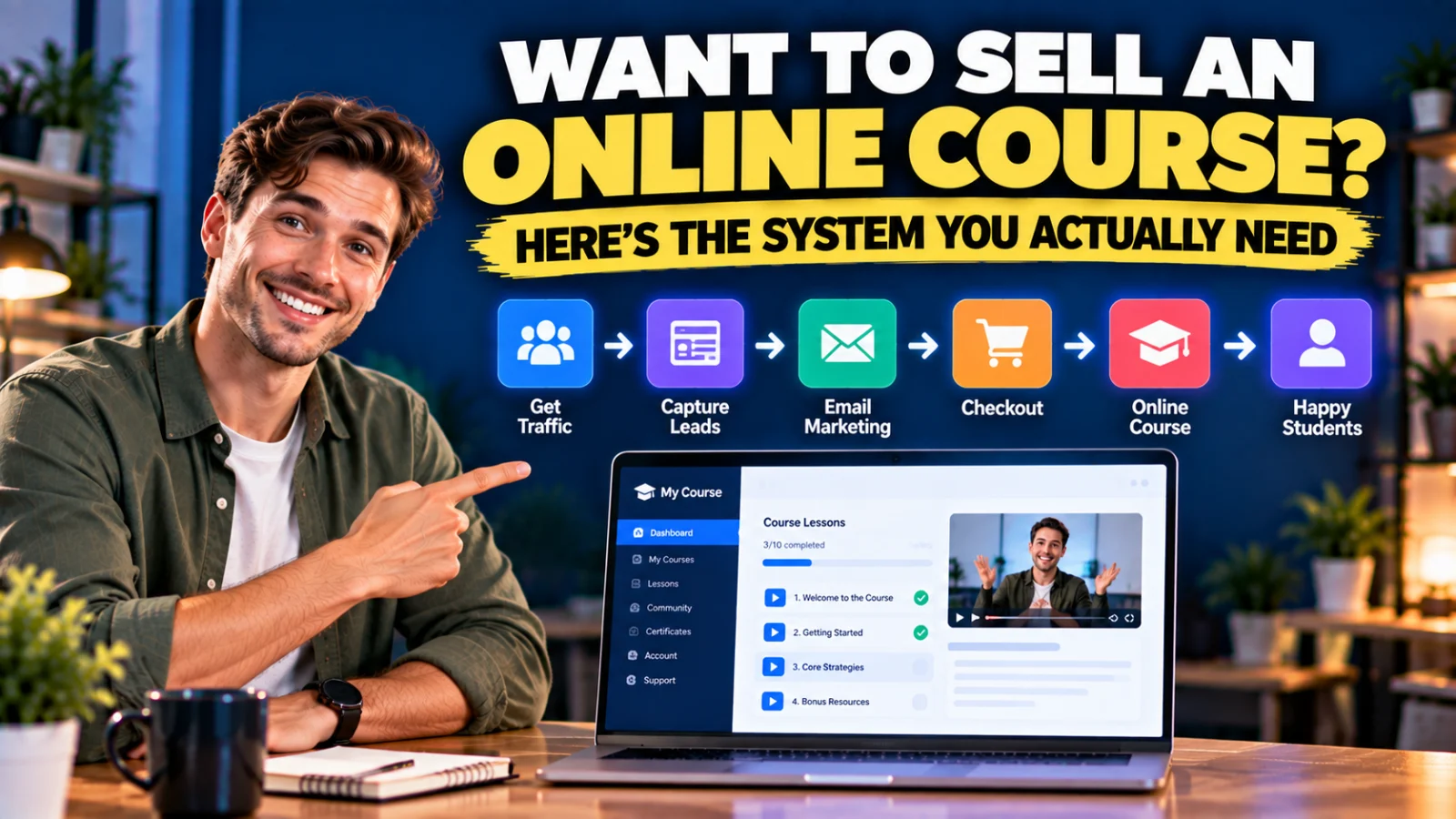
You have an idea for an online course.
You know what you want to teach. You may already have lesson notes, slides or several videos recorded.
So the next question seems simple:
Where should I upload my course?
That is an important question—but it is not the whole problem.
Because uploading lessons does not automatically give you a system for finding students, collecting leads, accepting payments, creating student accounts, delivering access and following up after the sale.
To sell an online course, you need more than course hosting.
You need a small business system built around the course.
Want to Sell an Online Course? Here’s the System You Actually Need
A basic online course business has several jobs to perform.
The complete journey can look like this:
Visitor → Landing Page → Email List → Sales Page → Checkout → Course Access → Lessons → Follow-Up
Not every creator needs every step on day one.
But if you intend to sell rather than simply publish lessons for free, you will probably encounter most of these requirements sooner or later.
Want to Sell an Online Course? Here’s What Your System Must Actually Do
Your platform or software stack needs to solve five broad problems:
- Create and deliver the learning experience.
- Turn interested visitors into leads.
- Explain and sell the course.
- Collect payment and grant the correct access.
- Communicate with students before and after purchase.
This is why choosing a course platform based only on its video player can lead to surprises later.
Problem 1: Where Will the Lessons Actually Live?
This is the part most first-time course creators think about first.
You need somewhere to organize:
- modules;
- lessons;
- video;
- text;
- downloadable resources;
- student access.
A folder of video files is not the same as an online course experience.
Students need a logical place to sign in, see what they purchased and move through the material.
Depending on the course, you may also want lessons to become available gradually rather than all at once.
Problem 2: How Will People Discover the Course?
A course platform does not automatically create demand.
You still need traffic.
That traffic may come from:
- YouTube;
- Google search;
- social media;
- your existing audience;
- paid advertising;
- partners or affiliates;
- email marketing.
Once someone discovers you, they need somewhere focused to go.
That might be a sales page.
Or it might be a landing page offering a free resource before you ask them to buy.
Problem 3: Not Everyone Is Ready to Buy Immediately
Imagine somebody watches one of your videos and likes the topic.
They are interested.
But they are not ready to spend money today.
If your only options are:
Buy Now
or:
Leave
you have no way to continue the relationship.
This is why many course businesses use an email list.
A simple flow might be:
YouTube Video → Free Checklist → Email List → Helpful Emails → Course Offer
Now your “course platform” problem has become a landing-page and email-marketing problem too.
Problem 4: You Need a Sales Page
Your course curriculum tells students what is inside.
Your sales page needs to explain why the course matters.
A useful sales page may answer:
- Who is this course for?
- What problem does it solve?
- What will the student learn?
- What is included?
- How is the course delivered?
- How much does it cost?
- What should the visitor do next?
This page may be the first place a potential customer sees the complete offer.
So course creation and course selling are already two different jobs.
Problem 5: You Need a Checkout
When somebody decides to buy, the process needs to move from marketing to transaction.
You need a checkout or order form connected to a payment processor.
The exact processor options depend on the platform and your country.
You also need to understand the difference between:
- the course platform’s fee;
- the payment processor’s fee;
- any transaction or platform fee.
Those are not always the same thing.
Problem 6: What Happens Immediately After Payment?
This is one of the most important operational questions.
A customer has paid.
Now what?
Ideally, the system should know what they purchased and provide the appropriate course access without requiring you to manually create an account every time.
The customer should receive clear instructions about what to do next.
A simple post-purchase path might be:
Payment → Confirmation → Course Access → Welcome Email → Start Learning
If you sell while sleeping or while you are busy with other work, manual enrollment quickly becomes inconvenient.
Problem 7: You Need to Communicate With Students
Email does not stop being useful after the sale.
You may want to send:
- welcome instructions;
- login reminders;
- lesson announcements;
- new-module notifications;
- support information;
- additional resources;
- related offers.
If your course host does not handle the communication you need, you may end up adding a separate email platform.
Problem 8: Your Course May Need Automation
Automation becomes useful whenever the same action should happen repeatedly.
Examples include:
When someone joins the email list → send a welcome message.
When someone purchases → enroll them in the course.
When someone gets access → send onboarding instructions.
When a lead is interested → start a follow-up sequence.
None of this requires enterprise-level automation on day one.
But the systems involved need to communicate somehow.
The Hidden Problem: You May Be Building a Software Stack, Not Just a Course
This is the point where a beginner can accidentally create a collection of subscriptions.
For example:
Course Platform
+ Landing Page Builder
+ Email Marketing
+ Checkout
+ Automation
+ Affiliate Software
There is nothing inherently wrong with this approach.
Specialist tools can be excellent.
The problem is that every additional product introduces another:
- account;
- interface;
- bill;
- integration;
- configuration;
- potential failure point.
For an established course business, that complexity may be justified.
For your first course, it may not be.
What If One Platform Could Handle Most of This?
This is where an all-in-one platform becomes interesting.
Instead of starting with “Which course host has the nicest lesson page?”, start with:
Which system can take someone from interested visitor to enrolled student with the fewest unnecessary moving parts?
That is one reason Systeme.io is worth considering for a first online course.
It combines course functionality with sales funnels, email marketing, automation and checkout-related tools in the same platform.
The System to Sell an Online Course Without Piecing Everything Together
What a System to Sell an Online Course Needs to Connect
At minimum, that system needs to connect the offer, payment, access and communication. The more of those handoffs that happen natively, the fewer integrations you have to configure and troubleshoot.
Why Systeme.io Fits the Beginner Course-Selling Workflow
The current Systeme.io Free plan gives you enough components to test a real course business rather than only upload a lesson.
It currently includes:
- 2,000 contacts;
- 3 sales funnels;
- 15 funnel steps;
- unlimited email sends;
- 1 email campaign;
- 1 automation rule;
- 1 workflow;
- 1 course;
- 1 custom domain;
- 1 affiliate program;
- 1 A/B test;
- 1 one-click upsell;
- 1 order bump;
- unlimited file storage.
The Free plan is currently $0 and does not require a credit card.
Systeme.io also currently states that it charges 0% platform transaction fees. Your payment processor can still charge its own fees.
If you have never used Systeme.io, you can create your free Systeme.io account here and build the course-selling system from the beginning.
Affiliate disclosure: The Systeme.io link above is an affiliate link. If you later upgrade to a paid plan, I may earn a commission at no additional cost to you.
Step 1: Create the Course
Inside Systeme.io, courses are organized into modules and lectures.
That gives you a structure for turning raw teaching material into an experience students can navigate.
A simple beginner course might be:
Module 1 — Getting Started
- Welcome
- What You Need
- How the Course Works
Module 2 — Core Process
- Lesson 1
- Lesson 2
- Lesson 3
Module 3 — Implementation
- Action Plan
- Examples
- Next Steps
Do not create 40 lessons just because the platform allows you to add more content.
The course should be as long as necessary to deliver the promised outcome.
Step 2: Decide How Students Receive the Content
Systeme.io supports different course-access approaches, including full access and drip-style access.
That means you can choose whether students should see the entire course immediately or receive lessons according to your configured schedule.
This decision should follow the learning experience.
A short reference course may work well with immediate access.
A structured program may benefit from staged delivery.
Step 3: Build the Course Sales Page
Now move from teaching to selling.
Your sales page should make the offer understandable without requiring a personal explanation from you.
A straightforward structure is:
- Headline focused on the outcome or problem.
- Who the course is for.
- The problem it helps address.
- What the student will learn.
- Course modules.
- What is included.
- Price.
- Frequently asked questions.
- Clear call to action.
Systeme.io’s funnel builder gives you a place to create this sales journey without needing a separate page-builder subscription.
Step 4: Connect the Checkout to Course Access
This is where using one integrated platform becomes particularly useful.
The goal is not merely to collect money.
The goal is:
Customer Pays → Correct Course Access Is Granted
Systeme.io’s course documentation supports granting access through the sales funnel and automation system.
That reduces the need to manually enroll every new customer.
Before publishing, test the purchase and access flow yourself.
Step 5: Create the Welcome Experience
Do not assume the customer knows what happens next.
Your post-purchase experience should make the next action obvious.
For example:
“Your payment is complete. Check your email for your course access details, then start with Module 1.”
A clear welcome email can explain:
- where to log in;
- how to access the course;
- where to begin;
- how to get support;
- what to expect next.
Step 6: Build a Lead Funnel for People Who Are Not Ready to Buy
Now you can add the marketing layer.
Instead of sending every visitor directly to the course sales page, offer something useful first.
For example, if your course teaches photography:
YouTube Tutorial → Free Camera Settings Checklist → Email → Photography Course
If it teaches bookkeeping:
Google Article → Free Monthly Closing Checklist → Email → Bookkeeping Course
If it teaches fitness:
Social Post → Free Training Plan → Email → Full Program
The lead magnet should attract the same type of person who may benefit from the paid course.
Step 7: Use Email to Bridge the Gap Between Free and Paid
Not every subscriber should receive an immediate barrage of sales messages.
A simple sequence can provide value while helping the reader understand the problem your course solves.
For example:
Email 1: Deliver the promised resource.
Email 2: Explain a common mistake.
Email 3: Show a useful method or example.
Email 4: Introduce the course where relevant.
The exact sequence depends on the offer and audience.
The advantage of using an integrated system is that the subscriber already lives in the same environment as the funnel.
Step 8: Test the Entire Journey Before Sending Traffic
Do not test only the sales page.
Test the complete customer experience.
Check:
- Does the landing page work on mobile?
- Does the form create the contact correctly?
- Does the email arrive?
- Does the sales-page button go to the correct checkout?
- Can the payment be completed?
- Does the buyer receive the correct course access?
- Can the student log in?
- Are the right lessons visible?
- Are welcome instructions clear?
A funnel is only as strong as the handoff between its steps.
Why This Can Be Simpler Than Using Separate Course and Marketing Platforms
Suppose you choose a specialist course host.
It may be excellent at delivering lessons.
But if your preferred email system, funnel builder or checkout workflow lives elsewhere, you may need integrations.
That can still be the right architecture.
The advantage of Systeme.io is different:
you can start with an integrated baseline and add complexity only when a real requirement appears.
For a beginner, this can make it easier to understand the complete business process.
What About Teachable, Thinkific or Kajabi?
Dedicated online-course platforms deserve consideration.
They can offer stronger specialist learning features, mature course-management workflows and different student experiences.
Kajabi also positions itself as a broad all-in-one business platform rather than only a course host.
The right comparison therefore depends on what matters most to you.
If your priority is a sophisticated learning environment, investigate specialist course features carefully.
If your priority is launching a first course while also needing landing pages, email, funnels and checkout without assembling several subscriptions, Systeme.io becomes particularly interesting.
Where Systeme.io May Not Be Enough
Systeme.io should not be presented as the perfect learning management system for every organization.
You may need another platform if your project depends on requirements such as:
- advanced academic or enterprise LMS administration;
- specialized assessment workflows;
- complex accreditation;
- native certificate generation;
- highly specialized student reporting;
- institution-level learning features.
Systeme.io’s own current course information notes that native certificate generation is not included.
If certificates are essential, account for that before committing to the platform.
Do You Need a Website Before You Sell the Course?
Not necessarily.
You need a credible path that explains the offer and lets a customer complete the purchase.
That can be:
Content / Social / Ad → Systeme.io Sales Page → Checkout → Course
A full website can become valuable later for SEO, brand authority, multiple products and a broader content strategy.
But it is not a prerequisite for testing whether people will buy one focused course.
Do You Need to Finish the Entire Course Before Building the Sales System?
You should know exactly what you are promising before taking payment.
But you do not need to postpone every business-system decision until after editing the final lesson.
Building the sales path early can reveal important questions:
- Who exactly is the course for?
- What outcome are you promising?
- What should the course cost?
- What information belongs on the sales page?
- How will students receive access?
- What support will you provide?
Those decisions can improve the course itself.
What Should You Build First?
Do not begin with every feature available in the software.
Start with the minimum sellable system:
1. Course
2. Sales Page
3. Checkout
4. Student Access
5. Welcome Email
Then test it.
After the basic purchase flow works, add:
6. Lead Magnet
7. Opt-In Page
8. Email Follow-Up
9. Additional Automation
This keeps the project focused on selling and delivering the course rather than configuring software for its own sake.
A Simple Online Course System You Can Build With Systeme.io
Here is the complete model:
Traffic
↓
Free Resource / Landing Page
↓
Email Subscriber
↓
Email Follow-Up
↓
Course Sales Page
↓
Checkout
↓
Automatic Course Access
↓
Welcome / Student Communication
This is the system many first-time creators are actually looking for when they search for somewhere to “sell an online course.”
Try Building the Complete System Before Paying for Multiple Tools
If you are still choosing software, the Free plan gives you a practical way to test whether this integrated workflow suits you.
You can start your free Systeme.io account here, create one course and build the sales path around it.
You do not need to migrate an existing business or commit to a paid subscription just to see whether the workflow makes sense.
Final Takeaway
If you want to sell an online course, do not choose software based only on where the videos will live.
Think about the complete journey:
How will people discover you?
Where will they learn about the offer?
How will you capture people who are not ready to buy?
How will they pay?
How will access be granted?
How will you communicate with students?
Once you see the complete workflow, the value of an integrated platform becomes much easier to understand.
Systeme.io is not the only way to build an online course business, and specialist course platforms can be more appropriate for advanced learning requirements.
But for a beginner who needs course hosting, sales funnels, email, checkout and automation without immediately assembling several separate tools, it is a particularly strong option to test.
Build the smallest complete system first.
Get one student through it.
Then add complexity when the business gives you a reason to.
Suggested Articles to Read
 Want to Sell an Online Course Without Building a Website?
 Systeme.io vs WooCommerce: Which Is Simpler for Selling One Digital Product?
 Systeme.io vs Teachable: Which Is Better for Selling Your First Online Course?
 Systeme.io Review: Is It Worth It for Beginners in 2026?
 Is Systeme.io Really Free? What You Get Before Paying in 2026