How to Set a Price for Your First Digital Product

Choosing a price for your first digital product is difficult because there is rarely one obvious number. An ebook, template, workbook, course, or toolkit can be inexpensive to reproduce while still taking time and money to create, sell, support, and update.
Instead of searching for a universal “correct” price, build a starting price you can explain and test.
How to Price a Digital Product Using a Practical Starting Framework
A useful starting price comes from several inputs rather than one formula:
Real Selling Costs → Buyer Value → Comparable Alternatives → Offer Scope → Testable Starting Price
Your production time matters to your business, but it does not automatically determine what a customer is willing to pay. At the same time, ignoring fees, support, refunds, updates, and other selling costs can leave you with a price that is difficult to sustain.
The goal is not to discover a perfect price before launch. The goal is to choose a defensible starting price, observe real buyer behaviour, and improve it with evidence.
How to Price a Digital Product Without Relying on One Magic Number
Start by separating three questions that beginners often mix together: What does the product cost you to sell? What is the outcome worth to the intended buyer? What alternatives will that buyer compare it with?
1. Define Exactly What One Purchase Includes
Price becomes easier to reason about when the offer is specific.
Write down what the customer receives:
- the main file, template, guide, course, or resource;
- bonuses or supporting files;
- updates, if any;
- support, if included;
- commercial or personal usage rights;
- access duration where relevant;
- any software or external service the buyer also needs.
A downloadable checklist with no support is a different offer from a template library with updates and customer assistance, even if both are described as “digital products.”
2. Calculate the Costs That Still Exist
Digital delivery can remove manufacturing, inventory, and shipping, but selling is not necessarily cost-free.
Depending on your setup, consider:
- payment processing fees;
- marketplace or platform fees;
- advertising or affiliate commissions;
- software subscriptions used to sell or deliver the product;
- customer support time;
- refunds or chargebacks;
- future updates and maintenance;
- taxes or other obligations applicable to your business.
You do not need to allocate every business expense perfectly to one download. The purpose is to identify a realistic lower boundary below which the offer may no longer be worthwhile for you to sell.
3. Do Not Price Only From the Hours You Spent Creating It
Creation time is useful for understanding your investment, but it is a weak standalone pricing method.
Imagine two products:
| Product | Creation Effort | Potential Buyer Outcome |
|---|---|---|
| Long general ebook | High | Mostly information the buyer could find elsewhere |
| Focused working template | Lower | Could save repeated setup or decision time |
The longer product does not automatically deserve the higher price. Buyers evaluate usefulness, relevance, convenience, trust, and expected outcome—not your timesheet.
4. Describe the Buyer Outcome in One Sentence
Before choosing a number, finish this sentence:
This product helps [specific buyer] do [specific useful thing] with less [time, effort, uncertainty, cost, or complexity].
If you cannot describe the outcome clearly, pricing research becomes harder because you do not yet know what value you are comparing.
For example, “50 spreadsheet templates” describes quantity. “A ready-to-use quotation and job-costing system for a small service business” describes a use case.
5. Estimate Value Without Inventing a Fake ROI
Some products have an outcome that can reasonably be connected to time or money. Others do not.
If a template replaces a repeated manual task, you can ask how much time it could realistically save the intended user. If a guide helps someone avoid a known paid service or tool, that alternative cost can provide context.
But avoid turning uncertain benefits into precise promises. A marketing guide does not automatically “make the buyer $10,000,” and a productivity template does not guarantee a fixed number of hours saved for everyone.
Use value as a pricing input, not as an unsupported earnings claim.
6. Research Comparable Products—But Compare the Offer, Not Just the Number
Competitor research can tell you what buyers are already seeing in the market. It should not become “find three prices and copy the average.”
For each genuinely comparable offer, note:
- target customer;
- main outcome;
- what is included;
- depth or complexity;
- support and updates;
- license or usage rights;
- seller reputation or proof;
- current selling price.
A $20 template and a $200 template bundle may not be comparable if the second includes training, updates, commercial rights, and support.
7. Include Free Alternatives in Your Comparison
Your buyer may not compare you only with paid competitors.
They may compare your product with:
- a free template;
- YouTube tutorials;
- blog posts;
- AI-generated instructions;
- a spreadsheet they can build themselves;
- doing nothing for now.
This does not mean your product must be cheaper than free. It means your paid offer should make the reason to buy understandable—for example, better organization, a more complete workflow, specialized knowledge, saved setup time, support, or useful rights.
8. Choose a Pricing Model That Matches the Product
Before debating the exact number, decide what the customer is paying for.
| Model | Can Fit When | Watch For |
|---|---|---|
| One-time payment | A defined download, toolkit, or permanent-access product | Ongoing support or updates can create continuing costs |
| Tiered pricing | Different packages contain genuinely different value | Too many tiers can make a simple offer harder to understand |
| Subscription | The buyer receives continuing access, content, service, or updates | You need an ongoing reason for the recurring payment |
| Payment plan | A higher-priced offer benefits from spreading payments | Do not confuse installments with a subscription |
| Bundle | Several related products solve a broader problem together | A bundle of unrelated extras does not automatically add value |
9. Build a Floor, Target, and Test Price
Instead of forcing yourself to find one magical number, create a small decision range.
- Floor: the lowest price that still makes sense after relevant selling costs and support burden.
- Target: the price that appears reasonable for the buyer outcome, offer scope, and market context.
- Test price: the actual number you will put in front of buyers and evaluate.
The target and test price may be the same initially. The point of the framework is to stop a nervous last-minute discount from becoming your pricing strategy.
10. Use a Simple Pricing Worksheet
You can make the decision concrete with a short worksheet:
| Question | Your Answer |
|---|---|
| Who is the specific buyer? | __________ |
| What useful outcome do they want? | __________ |
| What does one purchase include? | __________ |
| What are the relevant selling/support costs? | __________ |
| What paid alternatives are comparable? | __________ |
| What free/manual alternatives exist? | __________ |
| What is your pricing floor? | __________ |
| What is your target price? | __________ |
| What price will you test first? | __________ |
This gives you a reason behind the number rather than a price selected only because it “feels affordable.”
11. Be Careful With Very Low Introductory Pricing
A lower launch price can be useful when you have a specific reason—for example, an early version has less content, early customers are helping you collect feedback, or the offer clearly states when introductory pricing ends.
But a low price should not hide an unclear offer.
If people do not understand what the product does, reducing the price may not solve the real problem.
12. Do Not Create Three Tiers Just Because Pricing Pages Often Have Three Columns
Tiered pricing works best when each level serves a meaningful difference in need.
For example:
Core Template → Template + Examples → Template + Examples + Commercial License
That is easier to justify than creating “Basic,” “Pro,” and “Premium” versions with nearly identical deliverables.
For a simple first product, one clear offer can be easier to test.
13. Account for Support Before You Promise It
Support can increase the usefulness of a product, but it also changes the economics.
If a low-priced product includes unlimited individual help, custom setup, or lengthy troubleshooting, the support workload can become larger than the product revenue justifies.
Define what support is included before using it as a bonus.
14. Price Licenses and Usage Rights Deliberately
A product used by one person for personal work may create different value from the same asset used commercially for multiple clients.
If your product can be licensed for commercial use, teams, client projects, multiple websites, or resale-related activities, make the permitted use clear and consider whether different rights justify different pricing.
Do not leave important usage rights ambiguous and then try to solve the problem after customers have purchased.
15. Test the Offer Before Assuming the Price Is the Problem
If a product does not sell immediately, price is only one possible cause.
Also check:
- whether the traffic matches the intended buyer;
- whether the product solves a clear problem;
- whether the sales page explains the outcome;
- whether buyers understand what is included;
- whether there is enough trust or proof for the decision;
- whether checkout works properly.
Dropping the price without checking these factors can produce the wrong lesson from weak sales.
16. Measure More Than Conversion Rate
A cheaper price can increase purchases while still producing worse economics. A higher price can reduce purchase volume while increasing revenue per customer. Neither result should be judged from conversion rate alone.
Depending on your business, useful signals can include:
- qualified visitors;
- completed purchases;
- revenue;
- net amount after relevant fees;
- refunds;
- support workload;
- buyer questions and objections.
Use the measurements that help you decide whether the offer is sustainable and understandable.
17. Change One Important Variable at a Time
If you change the price, headline, product bundle, guarantee, audience, and traffic source simultaneously, it becomes difficult to know what caused a different result.
For a small business without large testing volume, formal A/B testing may not always be practical. You can still keep a simple record of meaningful changes and compare results cautiously over time.
18. Know When a Price Increase Is Worth Testing
Consider testing a higher price when the product has materially improved, the offer now includes more useful value, your positioning has become clearer, or real sales show that buyers understand the current offer.
Do not manufacture fake scarcity or invent a higher “regular price” simply to make the current price look discounted.
19. Know When to Rework the Offer Instead of Lowering the Price
Sometimes the product is difficult to price because the offer itself is vague.
If you cannot identify the buyer, outcome, deliverables, or meaningful difference from free alternatives, revisit the offer before repeatedly reducing the number.
A clearer product can be easier to price because customers have something specific to evaluate.
A Practical First-Product Pricing Checklist
- Define the exact buyer and use case.
- List everything included in one purchase.
- Identify relevant payment, platform, support, and selling costs.
- Describe the buyer outcome without unsupported promises.
- Research genuinely comparable paid products.
- Identify free and manual alternatives.
- Choose one-time, tiered, subscription, payment-plan, or bundle pricing intentionally.
- Set a floor, target, and first test price.
- Check whether support and usage rights change the economics.
- Test the complete offer before assuming price is the only problem.
- Review revenue, costs, refunds, support, and buyer feedback—not conversion alone.
- Adjust from evidence rather than copying another seller’s price.
Final Takeaway
Your first digital product price does not need to be permanent. It needs to be reasonable enough to launch, clear enough to explain, and measurable enough to improve.
Start with your real selling costs, the outcome for a specific buyer, comparable alternatives, and the scope of the offer. Then test a price and learn from actual customer behaviour instead of relying on a universal price chart.
Once you are ready to put that price into a real checkout, Systeme.io is one platform you can explore for selling digital products. Its current setup supports digital offers with one-time payments, subscriptions, or payment plans, alongside sales funnels and checkout pages.
Suggested Articles to Read
 Want to Sell an Online Course Without Building a Website?
 Want to Sell an Online Course? Here’s the System You Actually Need
 Systeme.io vs WooCommerce: Which Is Simpler for Selling One Digital Product?
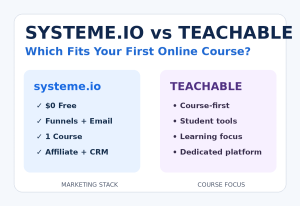 Systeme.io vs Teachable: Which Is Better for Selling Your First Online Course?
 Systeme.io Review: Is It Worth It for Beginners in 2026?