Is Your Digital Product Idea Worth Building? A Practical Validation Test
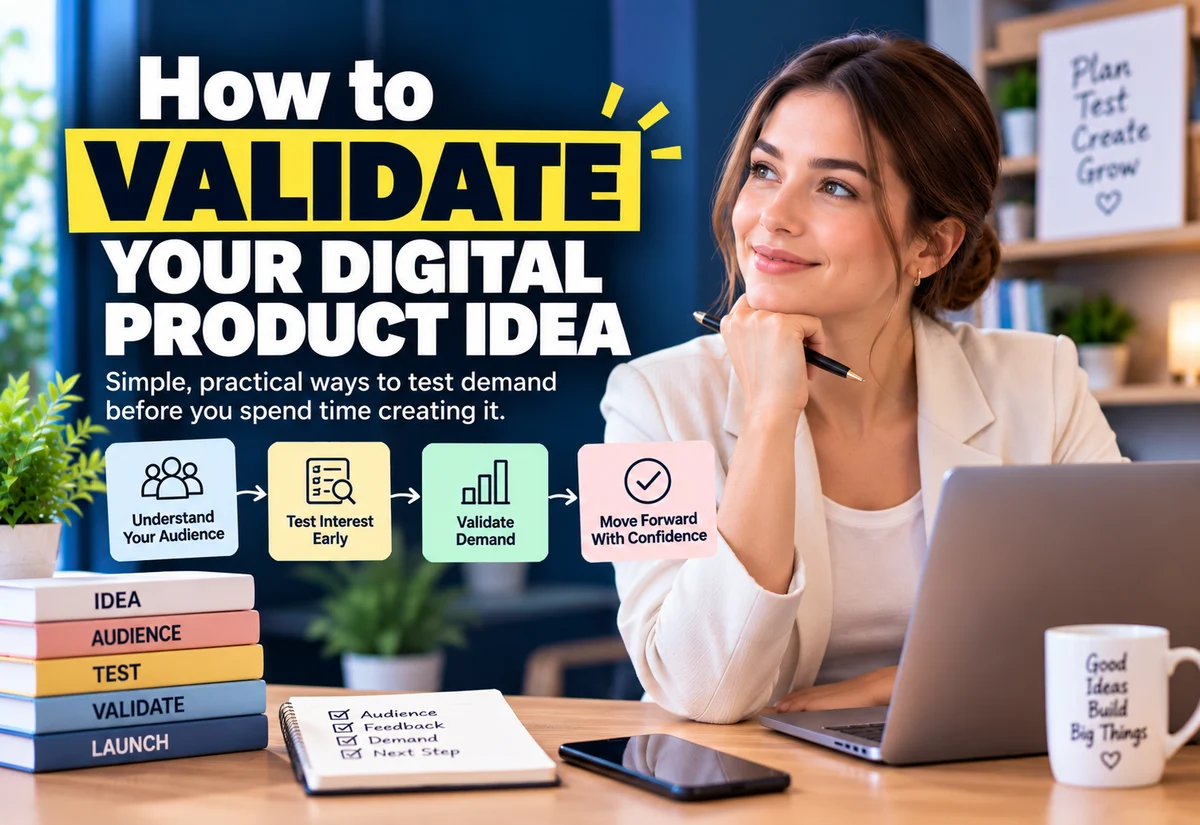
A promising digital product idea can still be a poor use of your time. Before writing the ebook, recording the course, or building the template library, look for evidence that a specific group of people actually wants the outcome.
Validation is not about proving your idea is brilliant. It is about reducing uncertainty before you commit to the full build.
How to Validate a Digital Product Idea With Evidence, Not Encouragement
A useful validation process moves from weaker evidence to stronger evidence:
Problem Evidence → Existing Behaviour → Offer Response → Commitment → Payment
Searches, comments, interviews, waitlists, and pre-sales can all teach you something, but they do not prove the same thing. A person saying “great idea” is much weaker evidence than a person taking a meaningful action.
Do not ask only, “Do people like this idea?” Ask, “What evidence shows that the problem matters enough for people to act?”
How to Validate a Digital Product Idea Before You Spend Weeks Building It
Start by writing down the assumptions that must be true for the product to work. Then test the riskiest assumptions with the cheapest credible evidence you can collect.
1. Turn the Idea Into a Testable Statement
“I want to make a productivity ebook” is an idea, but it is too broad to validate well.
Make it more specific:
I believe [specific type of person] has [specific problem] and wants [specific outcome] enough to take [meaningful action] toward solving it.
For example:
“I believe solo service-business owners who repeatedly forget client follow-ups want a simpler way to track the next action and would join a waitlist or pay for a ready-to-use system.”
Now you have several things you can investigate: the audience, problem, current workaround, desired outcome, and willingness to act.
2. Separate the Problem From Your Proposed Product
A common mistake is becoming attached to the format too early.
You may think the answer is:
- a 60-page ebook;
- a Notion template;
- a video course;
- a spreadsheet;
- a prompt pack;
- a membership.
But the first question is whether the underlying problem deserves solving. If people care about the outcome but dislike your chosen format, the problem may be valid while the product concept needs to change.
3. Look for Evidence That the Problem Already Exists
Do not begin by asking people to evaluate your solution. First look for places where the problem appears naturally.
Useful sources can include:
- search queries and autocomplete suggestions;
- questions in relevant communities;
- comments under videos or articles;
- reviews of existing products;
- support questions you already receive;
- client conversations;
- marketplace listings and reviews;
- competitor FAQs.
Pay attention to the language people use. Their wording can reveal the actual problem more accurately than the label you gave it.
4. Look for Repeated Problems, Not One Interesting Comment
One complaint can inspire an idea, but repetition is more useful for validation.
Create a simple evidence log:
| Evidence | Where Found | What It Suggests |
|---|---|---|
| Repeated question | Community discussions | People may be confused about the same task |
| Complaints about current tools | Product reviews | An existing solution may have a gap |
| People sharing manual workarounds | Forums or social posts | The problem may already motivate action |
| Existing paid products | Marketplaces or direct sellers | Buyers are already being offered solutions |
The goal is not to collect a huge pile of screenshots. Look for patterns that help you understand who has the problem and how they currently deal with it.
5. Treat Competition as Information, Not Automatic Bad News
Finding competing products does not automatically mean you should abandon the idea.
Existing products can help answer:
- Are sellers already addressing this problem?
- What formats are common?
- What outcomes do they promise?
- What do customers praise?
- What do customers complain about?
- Which audience segments appear underserved?
- What price range and offer structures are visible?
At the same time, competition alone does not prove that your specific offer will sell. It is market context, not a purchase order.
6. Study What People Already Do to Solve the Problem
Current behaviour is useful because it shows whether the problem is strong enough to cause action.
Ask potential customers what they do today:
- Do they use a spreadsheet?
- Do they pay for software?
- Do they hire someone?
- Do they combine several free tools?
- Do they repeatedly search for instructions?
- Do they tolerate the problem and do nothing?
A clumsy workaround can be meaningful evidence. It shows that someone is already spending time, effort, or money to get an outcome.
7. Interview the Problem, Not Your Ego
If you speak to potential buyers, avoid questions designed to produce encouragement.
Weak question:
“I am making a client follow-up template. Would you buy it?”
More useful questions:
- When did this problem last happen?
- What did you do about it?
- What was frustrating about that process?
- Have you tried another solution?
- What did you pay for or spend time on?
- Why did you keep or stop using it?
- What would a better outcome look like?
Questions about past and current behaviour can give you more concrete information than hypothetical praise for a product that does not exist yet.
8. Write Down the Assumptions That Could Kill the Idea
Every product depends on assumptions.
For example:
| Assumption | If It Is Wrong | Possible Test |
|---|---|---|
| The target buyer experiences the problem regularly | The product may feel unnecessary | Interviews and problem evidence |
| They want a ready-made template | The format may be wrong | Concept page or prototype |
| They will give contact details to learn more | Interest may be weak | Waitlist page |
| They will pay at the intended price | The commercial offer may not work | Transparent pre-sale or paid pilot |
Test the assumption that would make the rest of your work pointless if it were false.
9. Create the Smallest Clear Offer You Can Test
You do not need the finished product to test whether people understand the offer.
Create a concise description containing:
- who it is for;
- the problem it addresses;
- the outcome;
- the proposed format;
- what is included;
- the expected price or price range when appropriate;
- the next action you want the visitor to take.
This can become a simple landing page, direct message, email, proposal, or pre-sale page depending on your audience and product.
10. Use a Waitlist for Interest—But Do Not Confuse It With Sales
A waitlist can tell you whether a clear offer motivates some people to provide contact information.
That is useful evidence, especially when the traffic comes from people who match the intended audience.
But joining a free waitlist requires less commitment than paying. Treat it as an intermediate signal rather than proof that your eventual product and price will convert.
11. Measure the Source of the Interest
“100 signups” means little without context.
Ask:
- How many relevant people saw the offer?
- Where did they come from?
- Did they match the intended buyer?
- What message brought them to the page?
- Did one source produce much stronger interest than another?
Ten relevant prospects can teach you more about a niche offer than a large wave of unrelated visitors.
12. Test the Intended Price Earlier Than Feels Comfortable
An idea can receive positive feedback until a price appears.
If you plan to charge for the product, introduce realistic pricing before investing heavily in production. That does not mean you must immediately run a full public launch.
You might test:
- a founding-customer offer;
- a small paid pilot;
- a transparent pre-order;
- a paid workshop that delivers part of the intended outcome;
- a manually delivered version of the service behind the product.
The appropriate test depends on what you are selling and what you can responsibly deliver.
13. If You Pre-Sell, Be Clear About What Exists
Pre-selling can provide strong evidence because the customer makes a real purchase decision. It also creates an obligation.
Make it clear that the product is not yet complete, what the buyer will receive, the expected delivery timing, and what happens if you cannot deliver as promised.
Do not present an unfinished product as already available merely to make the validation test look stronger.
14. Validate With a Small Manual Version When Possible
Some digital products can be tested by delivering the outcome manually before automating or packaging everything.
Examples:
- run a live workshop before recording a course;
- customize a spreadsheet for a few users before building a template pack;
- deliver a manual audit before creating an automated toolkit;
- coach a small group through a process before writing the full guide.
This can reveal which parts people value, where they get stuck, and what language they use to describe the result.
15. Rank Validation Signals by the Effort Required From the Buyer
Not every signal deserves equal weight.
| Signal | What It Can Tell You | Relative Commitment |
|---|---|---|
| Like or positive comment | The idea sounds interesting | Low |
| Detailed problem conversation | The problem is real for this person | Low to moderate |
| Email waitlist signup | The offer earns a small action | Moderate |
| Booked call or pilot participation | The person will spend meaningful time | Higher |
| Deposit, pre-order, or purchase | The person will commit money under the stated terms | High |
This is not a universal scoring system. It is a reminder to distinguish inexpensive expressions of interest from actions that require greater commitment.
16. Decide Your Success Criteria Before Seeing the Results
If you wait until after the test to decide what counts as success, it is easy to reinterpret weak evidence because you already want to build the product.
Before testing, define what would make you:
Proceed → Revise and Retest → Stop for Now
The threshold should match your situation. A niche B2B toolkit sold through direct conversations should not automatically use the same signup target as a low-priced consumer download promoted to a large audience.
Avoid copying arbitrary numbers from someone else’s validation case study without considering traffic quality, audience size, price, and product type.
17. Diagnose What Failed Instead of Calling the Whole Idea Bad
A weak test can fail for different reasons:
- the problem is not important enough;
- you targeted the wrong people;
- the offer was unclear;
- the format was unattractive;
- the price and perceived value did not align;
- the traffic source was poorly matched;
- people wanted a different outcome;
- the test itself created too much friction.
Do not automatically rebuild the entire product after one weak signal. Identify which assumption the test actually challenged.
18. Know What Validation Cannot Prove
Even a successful pre-sale does not guarantee a permanent business.
Early validation does not automatically prove:
- long-term demand;
- customer retention;
- future acquisition costs;
- low refund rates;
- scalability;
- that every audience segment will respond the same way.
Validation reduces uncertainty. It does not remove business risk.
19. Keep an Evidence Sheet Instead of Relying on Memory
A simple document can prevent selective memory.
| Assumption | Evidence | Strength | Decision |
|---|---|---|---|
| Problem occurs repeatedly | Interview notes + public discussions | Medium | Continue testing |
| People want this format | Waitlist page response | Medium | Refine offer |
| People will pay intended price | Pre-orders | Strong | Build initial version |
Use your own evidence labels consistently. The purpose is to make the decision traceable, not to create a complicated scoring model.
20. Build the Smallest Version That Delivers the Validated Outcome
If the evidence is strong enough to proceed, do not immediately add every feature or bonus you imagined before validation.
Build around what the research actually supported:
- the audience that responded;
- the problem they described;
- the outcome they cared about;
- the format they understood;
- the scope they committed to buying.
You can expand later using feedback from real customers.
Digital Product Validation Checklist
- Define one specific buyer and problem.
- Separate the problem from your preferred product format.
- Find repeated evidence that the problem exists.
- Research current workarounds and competing offers.
- Talk to potential customers about past and current behaviour.
- List the assumptions that could invalidate the idea.
- Test the riskiest assumption before building the full product.
- Create a clear offer people can react to.
- Use waitlists as interest signals, not guaranteed sales.
- Introduce realistic pricing before heavy production.
- Use a transparent paid pilot or pre-sale where appropriate.
- Define proceed/revise/stop criteria before reviewing results.
- Record the evidence rather than relying on enthusiasm.
- Build the smallest version supported by the evidence.
Final Takeaway
A good validation process does not ask the market to praise your idea. It tests whether a real problem exists, whether identifiable people already care enough to act, and whether your proposed offer can earn progressively stronger commitment.
Start with cheap evidence and increase the strength of the test as confidence grows. If the evidence changes your original idea, that is useful information—not a failed validation exercise.
If you want to test an offer with a simple page, collect interested leads, send follow-up emails, and later add a checkout, Systeme.io is one platform you can explore. Its current tools include landing pages, email, funnels, and digital-product selling, which can support a validation flow without making the platform itself the validation strategy.
Suggested Articles to Read
 Want to Sell an Online Course Without Building a Website?
 Want to Sell an Online Course? Here’s the System You Actually Need
 Systeme.io vs WooCommerce: Which Is Simpler for Selling One Digital Product?
 Systeme.io vs Teachable: Which Is Better for Selling Your First Online Course?
 Systeme.io Review: Is It Worth It for Beginners in 2026?