ClickFunnels Alternative With Email Marketing Built In
A sales funnel rarely ends when someone submits a form.
A visitor may download your lead magnet today, read two emails over the next week and only then decide to buy. That means a funnel builder and email marketing often need to work together.
For years, this led many online businesses to assemble a stack that looked like this:
Funnel Builder → Email Marketing Tool → Checkout → Product Delivery
That approach still works. But it is no longer the only option.
Modern funnel platforms increasingly include email marketing inside the same system. ClickFunnels itself now includes email capacity in its current plans, while alternatives such as Systeme.io combine funnels and email from a much lower starting price.
So if you are searching for a ClickFunnels alternative with email marketing built in, the useful question is not simply, “Which platform can send email?”
The better question is: how much of your funnel and follow-up system can you run together, at the stage your business is actually in?
ClickFunnels Alternative With Email Marketing Built In: What Should You Look For?
A useful all-in-one setup should do more than place an email editor next to a page builder.
The funnel and email system should share the same customer journey.
Landing Page → Form → Contact → Email Sequence → Sales Page → Checkout
When those steps are connected, the platform can respond to what the contact actually does.
For example:
- a visitor submits an opt-in form;
- the contact is added to your database;
- an email campaign begins;
- the contact receives follow-up messages;
- a purchase can trigger a different action;
- tags can help organize or segment contacts.
Systeme.io supports this type of connected workflow. Its current documentation shows automation rules that can subscribe contacts to an email campaign after events such as a funnel-step form subscription, a new sale or a tag being added.
Why a ClickFunnels Alternative With Email Marketing Built In Can Simplify a Beginner Funnel
The benefit is not that integrations are inherently bad.
Specialist tools can be excellent.
The benefit is removing integrations you do not yet need.
A beginner selling one product may only need:
Page → Lead → Email → Offer → Checkout
If one platform can handle that entire path reliably, adding a separate email platform immediately may create more setup than value.
Important: ClickFunnels Already Includes Email Marketing
Any current comparison needs to make this clear.
ClickFunnels is not simply a page builder that always requires a separate autoresponder.
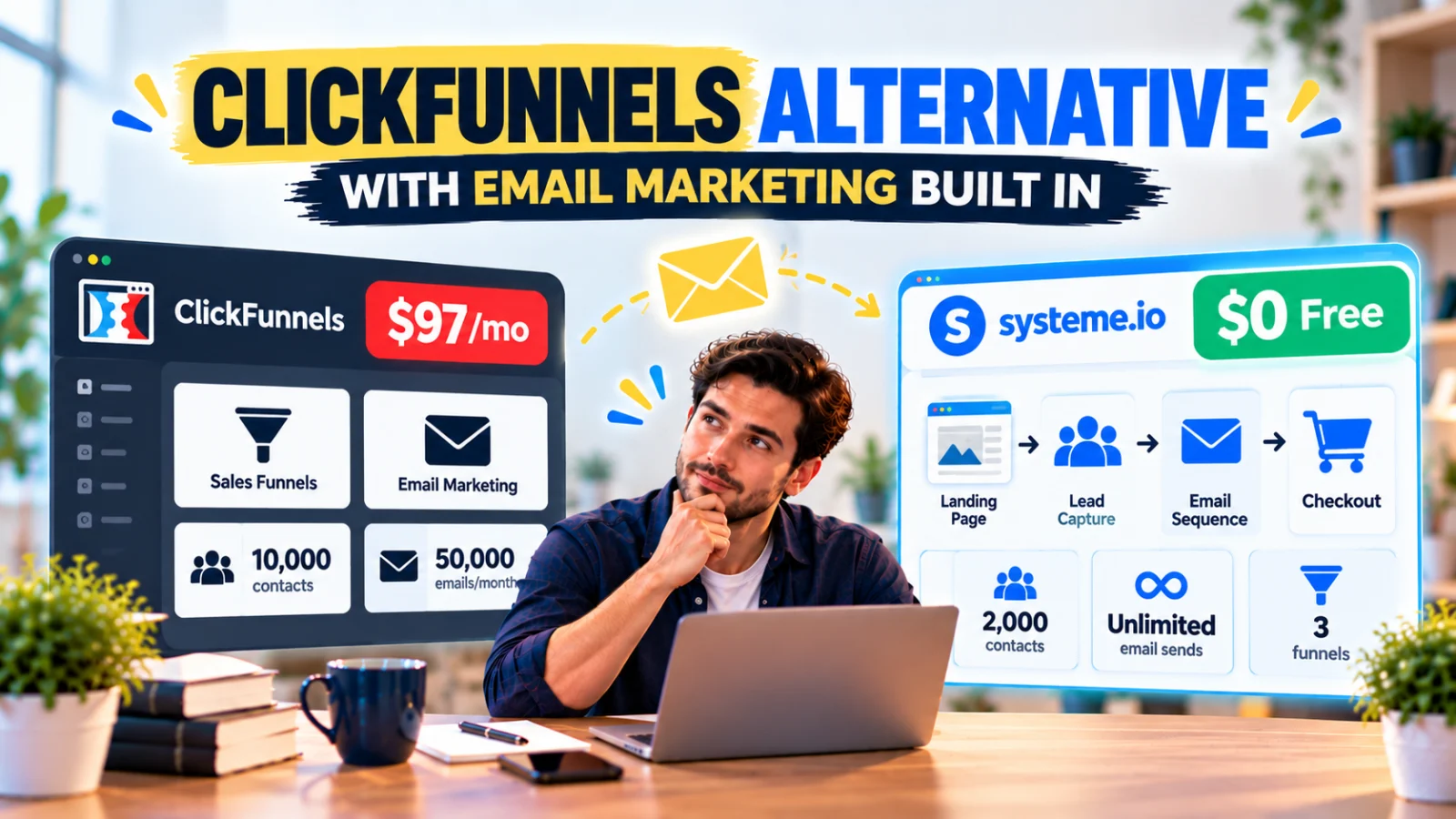
Its current Launch plan is listed at $97 per month and includes 10,000 email contacts and 50,000 emails per month, alongside unlimited funnels during its current limited-time offer.
Higher plans increase those limits.
| Current Plan | Monthly Price | Email Contacts | Emails / Month |
|---|---|---|---|
| ClickFunnels Launch | $97 | 10,000 | 50,000 |
| ClickFunnels Scale | $197 | 75,000 | 300,000 |
| ClickFunnels Optimize | $297 | 150,000 | 750,000 |
That is substantial capacity.
For an established business with thousands of contacts, the Launch allowance may be more useful than a smaller free plan.
But for a beginner with 137 subscribers and one funnel, the question changes.
Do you need to begin at $97/month just to keep your funnel and email in the same account?
Systeme.io Starts the Same Basic Idea at $0
Systeme.io currently offers a permanent Free plan with:
- up to 2,000 contacts;
- unlimited email sends;
- three sales funnels;
- one automation rule;
- one workflow;
- one email campaign;
- one custom domain;
- one course;
- one CRM pipeline;
- one affiliate program.
The Free plan does not require a credit card.
This makes Systeme.io particularly relevant to someone who wants to test the all-in-one model before committing to a larger monthly subscription.
What Does “Built-In Email Marketing” Actually Mean?
It should mean more than sending an occasional newsletter.
For a funnel, there are four email functions worth checking.
1. Broadcast Emails
A broadcast is a one-time email sent to a group of contacts.
Examples include:
- a new article;
- a product announcement;
- a promotion;
- a webinar reminder;
- a business update.
Systeme.io supports newsletters/broadcast-style email from the same contact system used by its funnels.
2. Automated Email Sequences
This is often more important for a funnel.
Instead of manually emailing every new lead, you create a sequence once.
Day 0: Deliver Lead Magnet → Day 1: Helpful Tip → Day 3: Case Study → Day 5: Offer
Systeme.io calls reusable sequences of this kind campaigns. Contacts can be subscribed to a campaign through automation rules.
3. Segmentation and Tags
Not every contact should receive the same message forever.
You may want to distinguish:
Lead → Customer → Course Student → Consultation Lead
Tags and automation help organize those differences without creating a completely separate email database for every situation.
4. Event-Based Follow-Up
The most useful integration happens when email responds to funnel activity.
Examples:
Form Submitted → Start Welcome Campaign
New Sale → Start Customer Onboarding
Tag Added → Start Relevant Follow-Up
Systeme.io documents all three of those trigger patterns for subscribing contacts to campaigns.
Why Separate Funnel and Email Tools Can Become Annoying
Suppose you build the landing page in Tool A and email in Tool B.
Now you need to make sure the contact moves correctly from one system to the other.
Landing Page → Integration → Email Platform → Automation
That can involve native integrations, Zapier-style connectors, webhooks or APIs depending on the stack.
For a mature business, this can be perfectly reasonable.
For a beginner, every connection introduces another place to troubleshoot.
Common questions become:
- Did the form submit?
- Was the contact created?
- Did the integration run?
- Was the correct tag added?
- Did the email sequence start?
- Which platform contains the source of truth?
When funnel and email live together, some of those handoffs disappear.
Example: A Free Lead Magnet Funnel
Imagine you offer a free PDF called “10 Questions to Ask Before Hiring a Web Designer.”
The funnel is simple:
Article → Opt-In Page → Email Address → PDF Delivery → Follow-Up
You could build the page in one tool and connect it to a separate email service.
Or you could use an integrated system where the form subscription itself triggers the campaign.
Your emails might be:
- deliver the PDF immediately;
- send an additional useful tip the next day;
- explain a common website mistake;
- introduce your service;
- invite the lead to request a quote.
For this use case, 10,000 contacts on day one may not matter.
Reliable connection between the page and the emails matters more.
Example: A $29 Digital Product
Now imagine you sell a spreadsheet template.
The journey could be:
Lead Magnet → Email Sequence → Product Page → Checkout → Customer
After purchase, the customer should not continue receiving messages that say, “You still haven’t bought the product.”
This is where shared contact data and automation become useful.
The platform knows that a sale occurred and can trigger customer-specific actions.
That is more useful than merely having an email editor.
Example: A Service Business
A consultant may not need an online checkout at all.
The funnel could be:
Landing Page → Enquiry → Email Follow-Up → Call → Proposal
Systeme.io’s broader stack also includes CRM Pipelines, with one pipeline on the current Free plan.
This creates another possible path:
Lead Capture → Email → CRM Pipeline → Human Follow-Up
For a service business, that may be more relevant than advanced ecommerce features.
Unlimited Email Sends Does Not Mean Unlimited Contacts
This distinction is important when looking at Systeme.io.
The platform currently advertises unlimited email sends across its plans.
But the number of contacts is still governed by your plan.
On Free, that is currently 2,000 contacts.
So “unlimited email” should not be interpreted as “unlimited audience on the Free plan.”
You can send without a monthly email-send cap to the contacts allowed by your plan, subject to platform policies and normal email-deliverability considerations.
ClickFunnels Has More Entry-Level Contact Capacity
This is one area where ClickFunnels Launch is clearly larger than Systeme.io Free or Startup.
ClickFunnels Launch currently supports 10,000 email contacts.
Systeme.io Free supports 2,000 contacts, while Startup supports 5,000.
If you already have 8,000 contacts, comparing ClickFunnels Launch with Systeme.io Free would not make practical sense.
You should compare plans that can actually hold your list.
Systeme.io Gives You a Much Lower Entry Point
For someone with a small list, Systeme.io’s pricing ladder is easier to enter gradually.
| Systeme.io Plan | Current Monthly Price | Contacts |
|---|---|---|
| Free | $0 | 2,000 |
| Startup | $17 | 5,000 |
| Webinar | $47 | 10,000 |
| Unlimited | $97 | Unlimited |
All current Systeme.io plans include unlimited email sends.
At the same headline $97 monthly price as ClickFunnels Launch, Systeme.io currently positions its Unlimited plan at the top of its standard pricing ladder.
Again, this does not make the plans identical. Their ecosystems, limits and workflows differ.
It simply shows why Systeme.io deserves consideration when budget is part of the decision.
What About the Email Editor?
Systeme.io supports both newsletters and campaign emails and currently provides a visual editor for those email types.
The editor supports drag-and-drop content, layout elements and desktop/mobile previews.
That means “built in” does not require writing every email as raw plain text.
However, businesses that make sophisticated email design, deep reporting or specialist email functionality central to their operation should still test the editor and reporting capabilities against dedicated email platforms.
An all-in-one system trades some specialization for integration.
What About Email Automation?
Systeme.io’s automation is particularly relevant because it connects email to the rest of the platform.
Its current automation documentation describes triggers such as a signup, purchase, link click or date, with actions including sending emails, granting course access, updating tags and moving contacts through workflows.
For a beginner, the useful part is not building the most complicated automation possible.
It is automating obvious repetitive actions.
Opt-In → Send Welcome Sequence
Purchase → Deliver Access
Known Interest → Add Tag → Relevant Follow-Up
Free Automation Has Limits
Systeme.io Free is not an unlimited automation plan.
Its current Free tier lists one automation rule, one workflow and one email campaign.
That is enough to experiment with a simple funnel, but a business running many offers and customer journeys will need more capacity.
This is exactly why “free” should be viewed as a starting environment rather than a promise that you will never need to upgrade.
When a Separate Email Platform Is Still the Better Choice
Built-in email is convenient, but convenience is not the only criterion.
A specialist email platform may make more sense when:
- email is the core product of your business;
- you have sophisticated segmentation requirements;
- you need particular integrations;
- advanced email reporting is central to decision-making;
- your team already has established workflows in another platform;
- you require specialist deliverability or enterprise features.
In those situations, connecting a funnel builder to a dedicated email platform may be intentional rather than inefficient.
When Built-In Email Makes More Sense
An integrated system is particularly attractive when:
- you are building your first funnel;
- your email list is still small;
- you sell one or a few offers;
- you want fewer integrations;
- you need basic sequences and broadcasts;
- you want funnel actions and email automation to share contact data;
- you want to keep fixed monthly costs low while validating the business.
For this type of business, Systeme.io is one of the strongest starting options I would consider.
Do Not Choose Only by Email-Send Limits
50,000 emails per month versus unlimited sends sounds like an easy comparison.
It is not.
Imagine Business A has 8,000 contacts and sends four newsletters per month.
Imagine Business B has 500 contacts and sends an eight-email onboarding sequence plus occasional broadcasts.
The contact limit, send pattern and funnel structure are different.
You need to calculate your own likely usage rather than choosing whichever number looks bigger.
Do Not Choose Only by Monthly Price Either
Systeme.io Free and Startup are substantially less expensive than ClickFunnels Launch at current published prices.
But price is only useful if the platform can support your workflow.
If your team is already trained on ClickFunnels, you have 9,000 contacts, multiple working funnels and ClickFunnels is producing profitable sales, migrating to save a subscription fee may be a poor trade.
Switching has a cost too.
A Simple Decision Framework
| Your Situation | What Matters Most |
|---|---|
| First funnel + tiny list | Low entry cost and simple integration |
| Under 2,000 contacts | Systeme.io Free can be a practical test environment |
| 5,000–10,000 contacts | Compare the appropriate paid tiers, not Free vs Launch |
| Established ClickFunnels operation | Migration cost and existing revenue matter |
| Email-first business | Compare dedicated email platforms as well |
| Funnels + email + course + affiliate needs | Broader all-in-one functionality becomes more valuable |
| Service business | Lead capture, email and CRM workflow may matter more than ecommerce |
How I Would Build the First Version
For a new business, I would avoid creating a giant automation system before the offer has proven itself.
Start with:
1 Landing Page → 1 Form → 1 Email Campaign → 1 Offer
Then test:
- Does the form create the contact correctly?
- Does the first email arrive?
- Do subsequent emails arrive at the intended delay?
- Does the offer link work?
- Does a purchase trigger the correct next action?
- Does the customer stop receiving inappropriate prospect messages?
Once that works, add complexity only when there is a reason.
What Should You Test Before Moving Your Entire List?
If you already use another email platform, do not migrate thousands of contacts just because an all-in-one option looks cheaper.
Create a small test funnel first.
Check:
- page-building experience;
- form behavior;
- email editor;
- automation setup;
- email delivery to your own test addresses;
- tagging and segmentation;
- checkout triggers;
- analytics you actually use;
- export options;
- the workflow your team will repeat every week.
Software is easier to evaluate with a real workflow than with a feature checklist alone.
Final Takeaway
If you are searching for a ClickFunnels alternative with email marketing built in, Systeme.io deserves serious consideration.
Not because ClickFunnels lacks email—it does not.
ClickFunnels’ current Launch plan includes 10,000 contacts and 50,000 emails per month alongside its funnel tools.
The difference is where you can begin.
Systeme.io currently lets you start at $0 with up to 2,000 contacts, unlimited email sends and three funnels, while connecting lead capture, campaigns, automation, checkout and other business tools inside the same platform.
For a beginner or small solo business, that can be enough to build:
Landing Page → Lead → Email Sequence → Offer → Customer
without immediately paying for a larger funnel platform or connecting a separate email service.
If your business already has thousands of contacts, complex email requirements or profitable ClickFunnels workflows, compare the appropriate paid tiers and include switching costs in the decision.
But if your main goal is simply to launch a connected funnel-and-email system at the lowest sensible starting cost, Systeme.io is a particularly strong option to test.
Suggested Articles to Read
 Systeme.io Pricing: Which Plan Do You Actually Need in 2026?
 How to Build an Email List From Scratch: A Beginner’s Step-by-Step Guide
 Email Marketing Checklist Before You Send Your First Campaign
 Best Free Email Marketing Tools for Beginners: What Do You Really Get for $0?
 Want to Sell an Online Course Without Building a Website?