Systeme.io Pricing: Which Plan Do You Actually Need in 2026?
You have decided that Systeme.io might fit your business.
Now comes the pricing question:
Should you stay on Free, pay $17 for Startup, jump to Webinar, or buy Unlimited?
The answer is easier than most pricing comparisons make it sound.
You do not need to choose the plan with the most features.
You need the lowest plan that supports what your business is actually using today.
Systeme.io’s current plans are primarily separated by capacity: contacts, funnels, automation, courses, domains and a few advanced capabilities such as evergreen webinars. Core features such as unlimited email sending, file storage and 0% Systeme.io transaction fees are available across the plans.
That means many beginners can start on Free and wait for a real limit before upgrading.
Systeme.io Pricing: Which Plan Do You Actually Need in 2026?
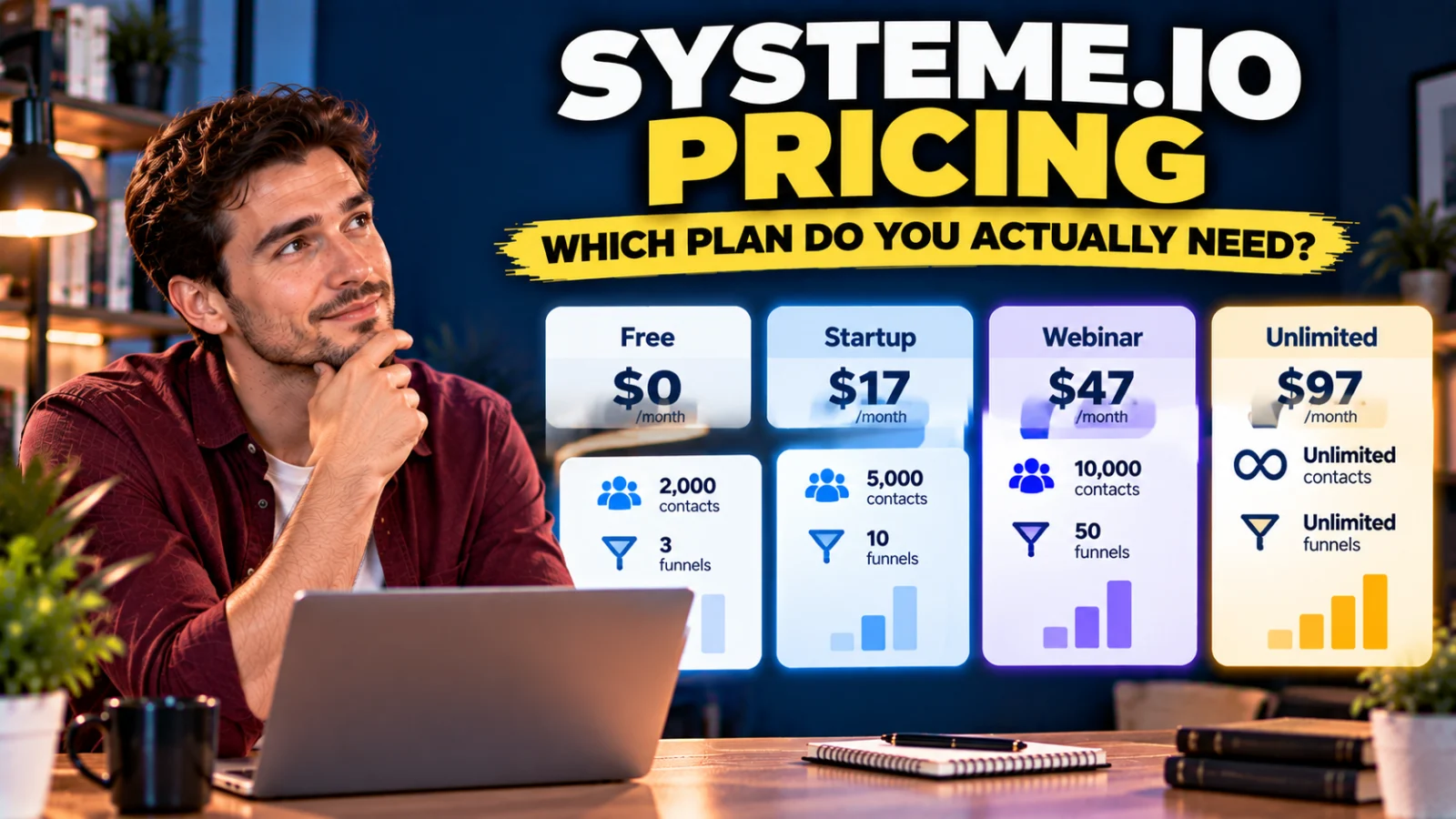
As of September 2026, Systeme.io’s main monthly plans are:
| Plan | Price | Contacts | Funnels | Best Starting Use Case |
|---|---|---|---|---|
| Free | $0 | 2,000 | 3 | Testing / first business |
| Startup | $17/mo | 5,000 | 10 | Growing small business |
| Webinar | $47/mo | 10,000 | 50 | More campaigns + evergreen webinars |
| Unlimited | $97/mo | Unlimited | Unlimited | High-volume / complex usage |
Annual billing is also available, with the official pricing page currently advertising two months free compared with paying monthly.
Prices and limits can change, so verify the official pricing page before making a long-term purchase decision.
Systeme.io Pricing: Which Plan Do You Actually Need If You Are Just Starting?
For most beginners, start with Free.
That is not simply because $0 is cheaper.
The current Free plan is large enough to build a real customer journey:
Landing Page → Email Contact → Follow-Up → Sales Page → Checkout → Product Delivery
You can test whether your offer works before increasing your software budget.
What Is Included in Systeme.io Free?
The current Free plan includes:
- 2,000 contacts;
- unlimited email sends;
- 1 email campaign;
- unlimited newsletters;
- 1 automation rule;
- 1 workflow;
- 1 tag;
- 3 sales funnels;
- 15 funnel steps;
- 1 A/B test;
- 1 custom domain;
- unlimited file storage;
- 1 one-click upsell;
- 1 order bump;
- 1 website;
- 1 blog;
- 1 CRM pipeline;
- 1 course;
- 500 students;
- 1 community;
- 1 booking-calendar event;
- 1 coupon code;
- affiliate-program functionality;
- 0% Systeme.io transaction fees.
Your payment processor can still charge its own fees.
If these limits cover your current business, upgrading early does not make the funnel sell better.
If you have never used the platform, create your Free Systeme.io account here and test the workflow before choosing a paid plan.
Affiliate disclosure: The Systeme.io link above is an affiliate link. If you later upgrade to a paid plan, I may earn a commission at no additional cost to you.
Who Can Realistically Stay on the Free Plan?
Consider a beginner selling one PDF product.
You might use:
- Funnel 1: free lead magnet;
- Funnel 2: digital-product sales funnel;
- Funnel 3: another offer or test;
- one email campaign;
- one workflow;
- one domain;
- one order bump;
- one course if you later need it.
That is enough to operate a meaningful first version of the business.
A beginner with 300 contacts does not need Unlimited because Unlimited has more contacts.
Unused capacity is not a business advantage.
The Free Plan’s Most Important Limitation Is Not Email Sending
Systeme.io currently allows unlimited email sending on all four main plans.
The restriction is how many contacts and how much campaign/automation structure you can maintain.
On Free, you currently have:
- 2,000 contacts;
- 1 campaign;
- 1 automation rule;
- 1 workflow;
- 1 tag.
If your marketing becomes more segmented and automated, those limits can matter before you hit 2,000 contacts.
When Should You Upgrade From Free to Startup?
Startup currently costs $17/month.
It increases key limits to:
- 5,000 contacts;
- 10 tags;
- 10 email campaigns;
- 10 automation rules;
- 5 workflows;
- 10 sales funnels;
- 50 funnel steps;
- 10 A/B tests;
- 3 custom domains;
- 10 one-click upsells;
- 10 order bumps;
- 5 websites;
- 5 blogs;
- 5 CRM pipelines;
- 5 courses;
- unlimited course students;
- 5 communities;
- 5 booking-calendar events;
- 10 coupon codes.
For many small businesses, this is the most logical first paid step.
Upgrade Trigger #1: You Are Approaching 2,000 Contacts
This is the clearest trigger.
If your list is genuinely growing toward the Free plan’s contact ceiling, Startup raises capacity to 5,000.
Do not upgrade at 200 contacts because you hope to have 5,000 someday.
Upgrade when the limit becomes operationally relevant.
Upgrade Trigger #2: One Workflow Is No Longer Enough
A simple beginner business may use one workflow.
As your offers grow, you might need separate workflows for:
- lead-magnet delivery;
- new-customer onboarding;
- course enrollment;
- abandoned or incomplete journeys;
- different products.
Startup’s five workflows and ten automation rules provide more room without moving all the way to a higher plan.
Upgrade Trigger #3: You Need More Than Three Funnels
Three funnels can go surprisingly far.
But imagine you now operate:
- lead magnet funnel;
- ebook funnel;
- course funnel;
- consulting funnel;
- affiliate promotion funnel.
At that point, the Free plan’s funnel limit becomes a real constraint.
Startup currently increases it to 10 funnels and 50 total funnel steps.
Upgrade Trigger #4: You Have More Than One Course
Free currently includes one course and up to 500 students.
Startup raises this to five courses with unlimited students.
That makes the upgrade easier to justify for a creator whose first course works and who is now building a second or third program.
Upgrade Trigger #5: You Need Multiple Custom Domains
Free currently allows one custom domain.
Startup allows three.
If one business and one domain are enough, this should not influence your decision.
If you operate several brands or projects, it can.
What Does the Webinar Plan Add?
Webinar currently costs $47/month.
Its limits rise substantially:
- 10,000 contacts;
- 100 tags;
- 100 email campaigns;
- 100 automation rules;
- 20 workflows;
- 50 funnels;
- 300 funnel steps;
- 50 A/B tests;
- 10 custom domains;
- 100 upsells;
- 100 order bumps;
- 20 websites;
- 20 blogs;
- 20 CRM pipelines;
- 20 courses;
- 20 communities;
- 20 booking events.
But one feature creates a clearer dividing line:
evergreen webinars.
The current Webinar plan includes up to 10 evergreen webinars. Free and Startup include none.
When Does Webinar Make Sense?
Consider Webinar if at least one of these is true:
- you specifically need Systeme.io’s evergreen webinar feature;
- your contacts are moving beyond Startup’s 5,000 limit;
- 10 funnels are becoming restrictive;
- you need substantially more automation/workflows;
- you operate multiple products, domains or campaigns at meaningful scale.
Do not buy Webinar merely because “webinars sound professional.”
If you do not have a webinar strategy, you are paying for capacity you may not use.
What Does Unlimited Actually Mean?
Unlimited currently costs $97/month.
It removes limits across many of the platform’s major capacity categories, including:
- contacts;
- tags;
- email campaigns;
- automation rules;
- workflows;
- funnels;
- funnel steps;
- evergreen webinars;
- A/B tests;
- custom domains;
- upsells;
- order bumps;
- websites;
- blogs;
- courses;
- communities.
The official pricing page also highlights free migration and early access to new features at this level.
Who Actually Needs Unlimited?
Unlimited becomes easier to justify when your business is already operating at a scale where lower-plan limits create repeated friction.
Examples:
- your contact list exceeds 10,000;
- you run many funnels across multiple offers;
- you manage many domains;
- you run extensive automation;
- you operate a large course/product portfolio;
- you regularly use evergreen webinars;
- your business would otherwise spend significant time managing around plan limits.
It is not a “serious entrepreneur badge.”
If Startup supports everything you need, paying $97 instead of $17 does not make your business more legitimate.
A Simple Decision Tree
Use this instead of reading every row of the pricing table.
Are you under 2,000 contacts and within 3 funnels?
Start with Free.
Do you need up to 5,000 contacts, 10 funnels, more automation or multiple courses?
Look at Startup.
Do you need evergreen webinars, more than 5,000 contacts, or much higher campaign/funnel capacity?
Look at Webinar.
Are you beyond 10,000 contacts or repeatedly hitting high-tier limits?
Evaluate Unlimited.
Free vs Startup: The Most Important Comparison for Beginners
For most new users, this is the comparison that matters.
| Feature | Free | Startup |
|---|---|---|
| Price | $0 | $17/mo |
| Contacts | 2,000 | 5,000 |
| Funnels | 3 | 10 |
| Funnel steps | 15 | 50 |
| Campaigns | 1 | 10 |
| Automation rules | 1 | 10 |
| Workflows | 1 | 5 |
| Courses | 1 | 5 |
| Custom domains | 1 | 3 |
| Email sends | Unlimited | Unlimited |
| Systeme.io transaction fee | 0% | 0% |
If you cannot point to a row where Free is actively blocking you, staying on Free is reasonable.
Startup vs Webinar: Do Not Pay $30 More Without a Reason
The price difference is currently $30/month.
Webinar gives you much more capacity and evergreen webinars.
But ask whether you will use those things now.
If your business has:
- 3,000 contacts;
- six funnels;
- two courses;
- four workflows;
- no webinar strategy;
Startup currently covers that example.
The extra capacity on Webinar has no immediate operational value.
Webinar vs Unlimited: Look at Growth, Not Prestige
The difference is currently $50/month.
If you have 8,000 contacts and 15 funnels, Webinar may still be sufficient.
If you are approaching 10,000 contacts or need limits removed across many categories, Unlimited becomes more relevant.
The decision should come from usage data inside your account—not from the name of the plan.
What Features Do You Get Without Upgrading?
This is easy to miss.
Several capabilities are available across the plan range, so you should not assume you need a paid plan merely to access the platform’s basic business model.
The current pricing page lists:
- unlimited email sends;
- unlimited file storage;
- 0% platform transaction fees;
- affiliate-program capability;
- 24/7 email support;
- multiple supported payment integrations;
- physical-product support;
- unlimited sub-accounts under the current plan structure.
Limits within individual features still vary by plan, so check the current comparison table for your specific use case.
Do You Need a Paid Plan to Sell a Digital Product?
No.
The Free plan can support a basic digital-product sales path.
You can create a funnel, use an order form, configure a digital-product price plan and deliver the product.
Systeme.io’s current digital-product pricing setup supports:
- one-time payments;
- subscriptions;
- payment plans.
That means “I want to sell my first PDF” is not, by itself, a reason to upgrade.
Do You Need a Paid Plan for Email Marketing?
Not simply to send emails.
Free currently includes unlimited email sends.
The reason to upgrade is more likely to be:
- more than 2,000 contacts;
- more campaigns;
- more tags;
- more workflows;
- more automation rules.
This distinction matters because “unlimited email” can sound like “unlimited email marketing structure.” It is not the same thing.
Do You Need a Paid Plan for a Course?
Not for your first course.
Free currently includes one course and up to 500 students.
Startup increases that to five courses and unlimited students.
If you are validating your first course, the Free plan can be a reasonable starting point.
Do You Need Webinar Just Because You Host Live Webinars Elsewhere?
No.
The plan name refers to Systeme.io’s evergreen webinar capability.
If you already use another live-meeting or webinar service and do not need Systeme.io evergreen webinars, evaluate the plan based on the other capacity limits.
What About Annual Billing?
The official pricing page currently advertises annual billing with two months free.
Annual payment can lower the effective cost if you already know you will use the plan for the year.
But a discount is not a reason to commit before validation.
If you are brand new, test the Free plan first.
If you later know Startup is part of your working stack, then annual billing becomes a more meaningful decision.
What About Transaction Fees?
Systeme.io currently lists 0% transaction fees across the main plans.
That means Systeme.io does not add its own percentage platform fee to your transaction.
It does not mean accepting payments is free.
Stripe, PayPal or another payment provider can still charge processing fees according to its own pricing and your region.
Do Not Upgrade Because Your Revenue Increased
Revenue itself is not a plan limit.
Suppose your one-product funnel makes $5,000 per month but uses:
- 900 contacts;
- one funnel;
- one workflow;
- one course;
- one domain.
If the Free plan still supports the technical requirements, revenue alone does not force you to upgrade.
You might choose to upgrade for operational reasons, but that is different from needing to.
Upgrade When the Constraint Costs More Than the Plan
This is the most useful pricing rule.
Suppose you need a fourth funnel for a proven product.
Trying to restructure your whole business to avoid a $17 subscription may waste more time than the subscription costs.
Or suppose your list is approaching 2,000 engaged contacts.
Deleting useful contacts merely to stay free could damage the business.
At that point, the paid plan is solving a real constraint.
Do Not Build Around Artificial Limits Just to Stay Free
Free software is useful for validation.
It becomes counterproductive when avoiding a small software bill creates bad business decisions.
Examples:
- deleting valuable contacts;
- combining unrelated campaigns;
- avoiding a second profitable course;
- refusing to create a funnel that customers need;
- using awkward manual processes to avoid another workflow.
When the business earns enough to justify the tool, let it pay for the tool.
What I Would Test Before Paying
Before upgrading, make sure you have actually used the relevant feature.
Build:
Traffic → Landing Page → Contact → Email → Sales Page → Checkout → Delivery
Then ask:
- Does the editor fit how I work?
- Can I build the pages I need?
- Does email delivery fit my workflow?
- Can I connect my payment processor?
- Can I deliver my product correctly?
- Do I understand the automation model?
- Which Free-plan limit am I actually approaching?
That gives you a better answer than comparing pricing tables in isolation.
Which Systeme.io Plan Should a New Digital-Product Seller Choose?
If you are selling your first ebook, PDF, template or small course, begin with Free unless you already know you exceed a specific limit.
You can build a real funnel and accept payments without committing to a paid Systeme.io plan.
When you need more funnels, contacts, courses or automation, Startup is the natural next plan to evaluate.
Which Plan Should a Growing Creator Choose?
If you have multiple products and a growing list but remain below 5,000 contacts, Startup may cover a surprisingly broad setup.
If you cross that threshold, need significantly more automation, or want evergreen webinars, evaluate Webinar.
Which Plan Should an Established Business Choose?
If you are beyond 10,000 contacts and operating many funnels, domains, courses and automations, Unlimited removes much of the capacity management.
At that stage, the decision is less about saving $50 and more about whether removing limits simplifies an already functioning operation.
Start With the Business You Have, Not the Business You Imagine
A beginner often buys software for the business they hope to have in two years.
That reverses the order.
Start with the smallest plan that supports the business you have now.
Let customers, contacts and actual campaigns create the reason to upgrade.
If you have not tested Systeme.io yet, start on the Free plan here.
Final Takeaway
Systeme.io’s pricing is easier to understand when you stop asking which plan has the most features.
Ask which limit your business is hitting.
Free is suitable for testing and many first-product businesses.
Startup is the logical next step when you need more contacts, funnels, automation, courses or domains.
Webinar becomes relevant when you need evergreen webinars or substantially more capacity.
Unlimited is for businesses that genuinely benefit from removing the major capacity limits.
Do not upgrade because a pricing table makes the higher plan look impressive.
Upgrade when a real limit starts getting in the way of real growth.
Suggested Articles to Read
 Systeme.io vs WooCommerce: Which Is Simpler for Selling One Digital Product?
 Systeme.io vs Teachable: Which Is Better for Selling Your First Online Course?
 Systeme.io vs Kajabi: Do Beginners Need to Pay for an All-in-One Platform?
 Systeme.io vs Gumroad: Which Is Better for Selling Your First Digital Product?
 Systeme.io vs GoHighLevel: Which Makes More Sense for a Solo Business?