Systeme.io Free vs Startup: When Should You Upgrade in 2026?
You can build a surprising amount on Systeme.io without paying anything.
Then, at some point, the $17 Startup plan begins to look tempting.
More contacts. More funnels. More automation. More courses. More domains.
But having more capacity available does not mean you need it yet.
The useful question is:
What has to happen in your business before upgrading from Systeme.io Free to Startup actually makes sense?
This comparison focuses on that decision.
Systeme.io Free vs Startup: When Should You Upgrade?
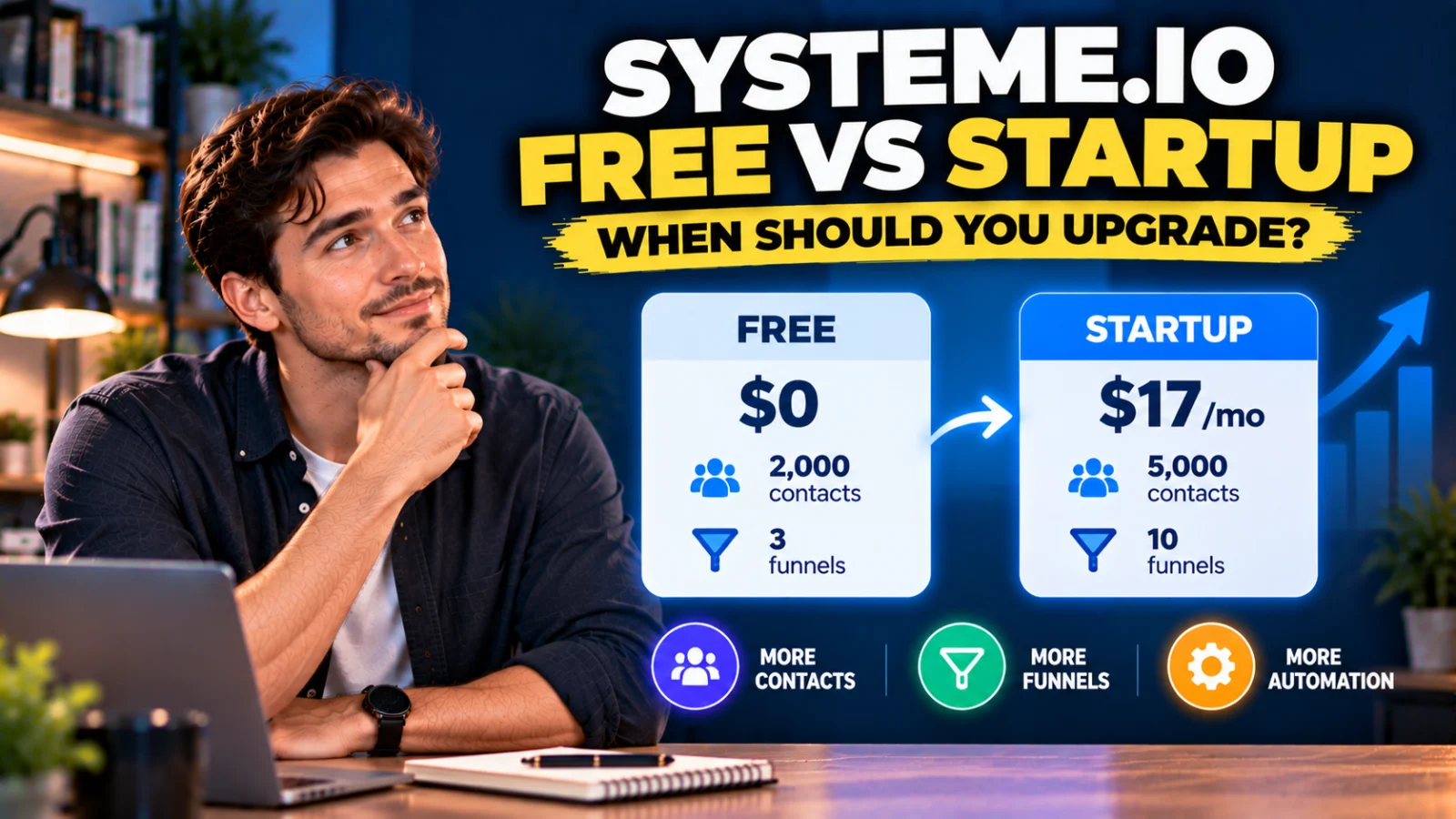
Systeme.io currently prices its Free plan at $0 and Startup at $17 per month.
The biggest differences are capacity.
| Feature | Free | Startup |
|---|---|---|
| Price | $0 | $17/month |
| Contacts | 2,000 | 5,000 |
| Tags | 1 | 10 |
| Email campaigns | 1 | 10 |
| Email sends | Unlimited | Unlimited |
| Automation rules | 1 | 10 |
| Workflows | 1 | 5 |
| Sales funnels | 3 | 10 |
| Funnel steps | 15 | 50 |
| A/B tests | 1 | 10 |
| Custom domains | 1 | 3 |
| Courses | 1 | 5 |
| CRM pipelines | 1 | 5 |
| Platform transaction fee | 0% | 0% |
Startup does not suddenly unlock the ability to run an online business.
Free already gives you the core tools.
Startup gives you more room to use them.
Systeme.io Free vs Startup: The Simplest Upgrade Rule
Stay on Free until a Free-plan limit is interfering with something useful you are actually trying to do.
Upgrade when the limitation begins costing you more—in lost opportunities, bad workarounds or wasted time—than the $17 monthly subscription.
That rule is more useful than trying to predict how large your business might become.
What Can You Already Do on Systeme.io Free?
The current Free plan is not merely a dashboard demo.
You can build a functioning sales path such as:
Lead Magnet → Email → Sales Page → Order Form → Product Delivery
It currently includes:
- 2,000 contacts;
- 3 funnels;
- 15 funnel steps;
- unlimited email sends;
- 1 campaign;
- 1 automation rule;
- 1 workflow;
- 1 custom domain;
- 1 course;
- 1 CRM pipeline;
- unlimited file storage;
- 0% Systeme.io transaction fees.
Payment processors can still charge their own fees.
If you have not tested the platform yet, you can create a Free Systeme.io account here before deciding whether Startup is necessary.
Affiliate disclosure: The Systeme.io link above is an affiliate link. If you later upgrade to a paid plan, I may earn a commission at no additional cost to you.
Upgrade Trigger #1: You Are Approaching 2,000 Contacts
This is the easiest trigger to understand.
Free supports up to 2,000 contacts. Startup raises the limit to 5,000.
If your list contains 1,850 useful subscribers and continues to grow, Startup solves a real problem.
If your list contains 180 subscribers, paying for 5,000 contacts does not improve your marketing.
Capacity has value only when you use it.
Do Not Delete Good Contacts Just to Stay Free
There is a point where optimizing around a free plan becomes counterproductive.
If people intentionally joined your list and remain relevant to your business, deleting them simply to avoid $17 can be a poor trade.
The list itself may be more valuable than the software saving.
Free is excellent for validation. It should not force you into damaging a working marketing asset.
Upgrade Trigger #2: You Need Funnel Number Four
Free currently includes three funnels.
A beginner might use them like this:
- Lead Magnet Funnel
- Main Product Funnel
- Course or Second Offer Funnel
Then you decide to launch another product.
You have three choices:
- delete or rebuild an existing funnel;
- force unrelated offers into your current structure;
- upgrade.
If the existing funnels are useful, Startup’s 10-funnel capacity can be the cleaner decision.
Do You Really Need 10 Funnels?
Not necessarily.
The question is not whether 10 is better than 3.
The question is whether you need more than 3.
If one product and one lead magnet are all you currently sell, the extra seven funnels may sit unused.
Upgrade Trigger #3: One Automation Rule Is Becoming a Bottleneck
This may be the most important trigger for an active marketer.
Free currently includes one automation rule and one workflow.
Startup increases that to 10 automation rules and 5 workflows.
Imagine your business now needs:
- lead-magnet delivery;
- new-buyer onboarding;
- course enrollment;
- a separate follow-up sequence;
- different actions based on what someone buys.
Trying to compress all of that into one simple automation structure can become awkward.
At that point, Startup is buying operational flexibility—not just a bigger number on a pricing table.
Upgrade Trigger #4: You Need More Than One Email Campaign
Free currently includes one email campaign.
Startup includes 10.
One campaign may be enough if you have:
- one audience;
- one core offer;
- one simple nurture sequence.
But suppose you sell:
- a freelancer template pack;
- a beginner course;
- a client onboarding kit.
Those customers may need different sequences.
Multiple campaigns can make the account easier to organize and the messaging more relevant.
Unlimited Email Sending Does Not Remove the Need to Upgrade
Both Free and Startup currently include unlimited email sends.
So the upgrade is not about buying more email volume.
It is about buying more:
- contacts;
- campaigns;
- tags;
- automation rules;
- workflows.
This is an important distinction when evaluating the $17 plan.
Upgrade Trigger #5: One Tag Is Not Enough
Free currently includes one tag. Startup includes 10.
Tags become useful when you want to distinguish groups such as:
- lead magnet subscribers;
- customers;
- course students;
- people interested in Product A;
- people interested in Product B.
If everyone in your account follows the same simple journey, one tag may be fine.
If segmentation is becoming part of your marketing, Startup provides more room.
Upgrade Trigger #6: You Want a Second Course
Free currently includes one course.
Startup includes five courses.
If you are validating your first course, paying for five course slots before you have students makes little sense.
But once Course #1 works and Course #2 is ready to launch, the limitation is real.
That is a clean upgrade trigger.
Upgrade Trigger #7: You Need Multiple Custom Domains
Free currently includes one custom domain. Startup includes three.
One business with one brand may never care.
Someone operating multiple brands or separate projects might.
Again, do not pay for three domains because they might be useful someday.
Upgrade when domain #2 has a business purpose.
Upgrade Trigger #8: You Need More CRM Pipelines
The current detailed pricing table lists one CRM pipeline on Free and five on Startup.
A solo service provider may only need one:
New Lead → Contacted → Proposal → Won / Lost
If you begin managing distinct sales processes, separate pipelines can become useful.
This is a more niche upgrade reason than contacts or automation, but it matters for service businesses using Systeme.io as a lightweight CRM.
What About A/B Testing?
Free currently includes one A/B test. Startup includes 10.
A beginner with little traffic should not upgrade simply to run more tests.
A/B testing becomes more useful when you have enough traffic for the result to inform a meaningful decision.
If you are actively testing several high-traffic funnels, Startup’s additional capacity may matter.
What Does Not Change When You Upgrade?
This is just as important as what changes.
Both plans currently include:
- unlimited email sends;
- unlimited file storage;
- 0% Systeme.io transaction fees;
- core funnel and selling capabilities.
You are not upgrading because Free is incapable of making a sale.
You are upgrading because the business has become too complex for Free’s quotas.
Does Startup Unlock Evergreen Webinars?
No.
The current pricing table lists zero evergreen webinars on both Free and Startup.
Evergreen webinars begin on the Webinar plan, which currently costs $47/month and includes up to 10 evergreen webinars.
Do not upgrade to Startup specifically for this feature.
Can You Sell Paid Products on Free?
Yes.
Systeme.io’s current help documentation supports digital-product price plans using:
- one-time payments;
- subscriptions;
- payment plans.
You do not need Startup merely because your product has a price.
Does Startup Reduce Systeme.io Transaction Fees?
No, because the current Systeme.io platform fee is already 0% on Free.
Both Free and Startup list 0% transaction fees from Systeme.io.
Your connected payment processor can still charge processing fees.
Therefore, “I want lower Systeme.io transaction fees” is not a reason to upgrade from Free to Startup under the current pricing structure.
Scenario 1: First Digital Product
You have:
- 250 contacts;
- one lead magnet;
- one PDF product;
- one funnel;
- one campaign;
- one workflow.
Free is likely enough.
Startup gives you more capacity, but the business is not using it.
Scenario 2: Your Email List Is Growing
You have:
- 1,900 contacts;
- two funnels;
- one product;
- steady new subscribers every week.
Startup is becoming relevant.
You are approaching a hard capacity limit that directly affects growth.
Scenario 3: Several Products, Small List
You have:
- 700 contacts;
- four products;
- four separate customer journeys;
- multiple follow-up sequences.
You may need Startup even though you are nowhere near 2,000 contacts.
The bottleneck is funnels and automation—not list size.
Scenario 4: One Successful Product
You have:
- 1,000 contacts;
- one funnel;
- one product;
- one course;
- simple automation;
- strong monthly revenue.
Revenue alone does not force an upgrade.
If Free still supports the workflow, you can remain on Free.
You may voluntarily upgrade for other operational reasons, but that is a choice rather than a platform requirement.
Scenario 5: You Need an Evergreen Webinar
Startup is not the solution.
Under the current plan structure, you need to evaluate Webinar or Unlimited.
This is a good example of why you should upgrade for a specific requirement rather than automatically moving one tier at a time.
Free vs Startup for a Course Creator
If you have one course, Free can be enough to validate it.
If you are creating a second course, Startup becomes more relevant because it currently supports five courses.
The same logic applies to funnels and automation around those courses.
A growing course catalog usually creates several upgrade triggers at once.
Free vs Startup for a Digital Product Seller
A seller with one ebook or template pack may be able to remain on Free for a long time.
A seller building a catalog of products may need:
- more funnels;
- more campaigns;
- more tags;
- more workflows;
- more upsells/order bumps.
Startup is more useful when the product portfolio grows—not merely because the first product starts earning revenue.
Free vs Startup for a Service Business
A simple service funnel can fit on Free:
Landing Page → Enquiry → Pipeline → Follow-Up
Startup becomes more relevant when you have multiple lead sources, multiple services, separate pipelines or more complex follow-up automation.
How Much Does Startup Cost Annually?
Systeme.io’s official Startup annual page currently lists the equivalent of about $14.17 per month instead of the standard $17 monthly rate, reflecting two months free.
Annual billing can make sense after you know the platform fits your business.
A discount is not a reason to commit before testing.
Should You Upgrade Before Launching?
Usually not, unless your planned setup already exceeds Free’s limits.
If your launch needs:
- one product;
- one funnel;
- one campaign;
- one workflow;
- fewer than 2,000 contacts;
you can test the process on Free first.
If your launch genuinely requires several campaigns and automation paths, upgrading before launch can avoid rebuilding the structure later.
Should You Upgrade Because Startup Is Cheap?
$17 per month is relatively modest compared with many business software subscriptions.
But “cheap” and “necessary” are different questions.
Software costs accumulate when you apply this logic to every tool.
A useful discipline is:
Every paid tool should solve a current problem.
If Startup solves no current problem, wait.
The Wrong Ways to Stay on Free
Do not let avoiding $17 make the business worse.
Bad workarounds include:
- deleting valuable contacts;
- deleting a working funnel to make room for a new one;
- mixing unrelated customers into one campaign;
- avoiding useful segmentation;
- manually doing repetitive work that automation could handle;
- refusing to launch a validated second product because you need another funnel.
At that point, the free plan is creating an opportunity cost.
A Better Upgrade Calculation
Instead of asking, “Can I avoid paying $17?” ask:
“What does staying Free cost me now?”
Suppose you spend two hours every month manually handling something that an additional workflow could automate.
Or suppose you cannot launch a proven second offer without reorganizing a working funnel.
The cost is no longer $0.
Your time and lost opportunities have value too.
Seven Questions Before You Upgrade
- Am I close to 2,000 contacts?
- Do I need more than three funnels?
- Do I need more than one campaign?
- Do I need several automation rules or workflows?
- Do I need more than one course?
- Do I need more than one custom domain?
- Is working around Free’s limits costing more than $17 per month in time or opportunity?
If you repeatedly answer yes, Startup is becoming easier to justify.
When You Should Not Upgrade Yet
Stay on Free if:
- you are still learning the platform;
- you have not launched your first offer;
- your current funnel fits comfortably;
- your contact list is well below the limit;
- one campaign and workflow are sufficient;
- you have no immediate use for additional courses or domains.
Do not pay for hypothetical future complexity.
When Startup Becomes the Sensible Choice
Startup is particularly logical when your business has moved from:
one simple customer journey
to:
several offers, audiences or automated journeys.
That is the stage where 10 funnels, 10 campaigns, 10 automation rules, 5 workflows and 5 courses can have operational value.
What Happens If You Later Need More Than Startup?
The next current tier is Webinar at $47/month.
It increases capacity to 10,000 contacts, 50 funnels, 100 automation rules and 20 workflows, and it adds evergreen webinar capacity.
Unlimited is currently $97/month and removes many major capacity limits.
You do not need to plan around those tiers today unless your usage is already close to Startup’s limits.
My Practical Free vs Startup Rule
If you are a beginner with one main offer, start on Free.
Build the funnel.
Collect contacts.
Send the emails.
Make the offer.
See where the system actually becomes restrictive.
Then upgrade for that reason.
If you already know your setup requires multiple funnels, campaigns, workflows or courses, Startup’s $17 price can save you from designing the business around artificial Free-plan constraints.
If you want to test the Free limits first, start with Systeme.io Free here.
Final Takeaway
The Systeme.io Free vs Startup decision is not really about $0 versus $17.
It is about validation versus capacity.
Free gives you enough capacity to validate a simple business.
Startup gives a growing business more room for contacts, funnels, campaigns, automation, courses and domains.
If Free still supports everything you need, stay there.
If staying Free forces you to delete useful assets, avoid good automation or delay a proven offer, the $17 upgrade has a business reason behind it.
Upgrade when the constraint becomes real—not when the bigger numbers merely look attractive.
Suggested Articles to Read
 How to Stop Managing Your Online Business Across Too Many Tools
 How to Organize Leads So You Don’t Forget Who to Follow Up With
 What Do You Actually Need to Run an Affiliate Program? A Beginner’s Checklist
 How to Build a Landing Page and Affiliate Program Using One Platform
 How to Manage Sales Leads Without a Spreadsheet