Can You Build a Sales Funnel Without Paying for ClickFunnels?
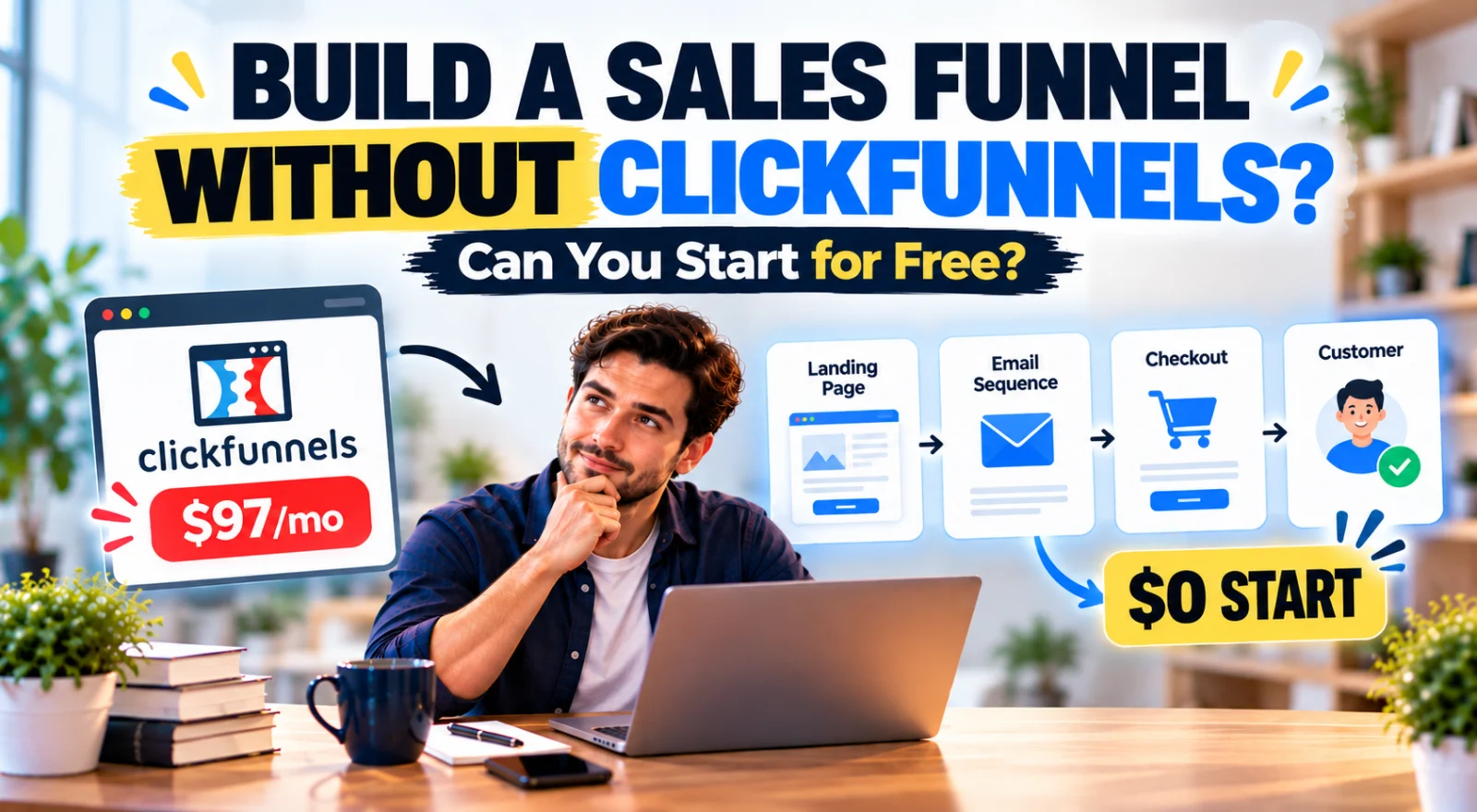
You do not need ClickFunnels to build a sales funnel.
That may sound obvious once you understand how funnels work, but it is not obvious when you are just starting out. Search for information about selling online and you will quickly encounter funnel builders, landing-page software, email platforms, checkout tools and automation systems. ClickFunnels is one of the best-known names in that category, so beginners can easily assume that paying for a dedicated ClickFunnels subscription is simply part of launching a funnel.
It is not. A sales funnel is a customer journey, not a specific piece of software. The software only gives you the tools to create that journey.
Can You Build a Sales Funnel Without ClickFunnels?
Yes. You can build a functional sales funnel without paying for ClickFunnels, and you do not necessarily need to connect five different free tools to do it.
For example, Systeme.io currently offers a permanent Free plan that includes three sales funnels, up to 2,000 contacts and unlimited email sends. It also includes selling, automation and course-related functionality within Free-plan limits.
By comparison, ClickFunnels’ current Launch plan is listed at $97 per month, or $970 per year when billed annually. That does not make ClickFunnels a bad product. Its Launch plan currently includes unlimited funnels, 10,000 contacts, 50,000 emails per month, courses and other substantial capacity.
But a beginner does not need to pay $97/month merely to prove that a funnel can generate a lead or sale.
Build a Sales Funnel Without ClickFunnels by Starting With the Journey, Not the Software
Before choosing any platform, draw the funnel itself.
Visitor → Landing Page → Form → Thank You Page → Follow-Up Email
A simple digital-product funnel might be:
Visitor → Sales Page → Checkout → Payment → Product Delivery
A slightly more advanced funnel could be:
Lead Magnet → Email Sequence → Sales Page → Checkout → Upsell → Customer
None of those diagrams contains the word ClickFunnels. They describe what needs to happen to the customer.
What Do You Actually Need to Build a Sales Funnel?
Strip away the software branding and most beginner funnels need only a handful of functions.
| Function | Why You Need It |
|---|---|
| Landing or sales page | Explains the offer and gives the visitor a next action |
| Form | Captures a lead when the funnel begins with an opt-in |
| Contact database | Stores the people who enter your funnel |
| Email follow-up | Continues the conversation after the visitor leaves the page |
| Checkout | Collects payment when you sell directly |
| Automation | Connects events and actions without constant manual work |
| Delivery | Gives the buyer access to the product, course or next step |
Some funnels need all seven. Others need only three. That distinction can save you a lot of money.
Your First Funnel Can Be Much Simpler Than You Think
Imagine you have written a free checklist to attract potential customers. You do not need a complicated ten-page funnel.
Landing Page → Email Form → Thank You → Checklist Delivery
Then perhaps:
Subscriber → Welcome Email → Useful Follow-Up → Relevant Offer
That is already a funnel. The goal is not to create as many steps as possible. The goal is to move the right person toward the right next action.
Why Beginners Often Think ClickFunnels Is Required
ClickFunnels helped popularize the language and structure of online sales funnels. It provides funnel templates, page building, checkout functionality, email capacity, courses and a large ecosystem around funnel marketing.
As a result, the brand name sometimes becomes shorthand for the concept itself. But a funnel is a marketing process. You can implement that process with ClickFunnels, another all-in-one platform, WordPress plus plugins, or a collection of connected specialist tools.
Option 1: Use ClickFunnels
ClickFunnels remains a legitimate way to build the funnel. Its current Launch plan costs $97/month and currently includes unlimited funnels, 10,000 email contacts, 50,000 emails per month, two team members, three courses, five custom domains, unlimited visitors, unlimited site pages and unlimited landing pages.
For an established business that expects to build many funnels, those limits may be entirely reasonable. The question is whether you need that capacity before you have validated your first funnel.
Option 2: Connect Several Free or Low-Cost Tools
You can also build a funnel from separate components.
Page Builder → Form Tool → Email Platform → Checkout → Product Delivery
This can work well, especially if you already have a website and prefer specialist tools. But “free” can become operationally expensive if you spend hours connecting and debugging the stack.
You may need to manage multiple accounts, dashboards, integrations, contact syncing, separate billing later and different support teams when something breaks.
So the goal should not be “use as many free tools as possible.” It should be “build the simplest reliable funnel at the lowest sensible cost.”
Option 3: Use a Free All-in-One Funnel Platform
This is where Systeme.io becomes relevant. Its current Free plan is not just a landing-page demo.
It currently lists 2,000 contacts, three sales funnels, unlimited email sends, one course, one affiliate program, one custom domain, one blog, unlimited file storage, plus selling and automation features within plan limits.
The Free plan does not require a credit card and, according to Systeme.io’s current pricing page, does not expire. That gives a beginner enough infrastructure to test a genuine online sales process.
What Can You Actually Build on Systeme.io Free?
1. A Lead Magnet Funnel
Landing Page → Form → Contact → Email → Free Download
This is useful for a blogger, consultant, creator or small business building an email list. The visitor exchanges an email address for something useful and can receive follow-up emails.
2. A Simple Digital Product Funnel
Sales Page → Order Form → Payment → Digital Product
This could be used for an ebook, template, spreadsheet, guide or downloadable resource. You can add follow-up later instead of designing a sophisticated funnel before making the first sale.
3. A Course Funnel
Landing Page → Course Offer → Checkout → Course Access
Systeme.io currently includes one course on Free, making it possible to test a small course business without immediately adding a separate course-hosting subscription.
4. A Service Lead Funnel
Landing Page → Enquiry → Contact → Follow-Up → Client
For service businesses, the final conversion may happen through a call, quotation or proposal rather than instant online payment. Systeme.io also currently includes one CRM Pipeline on Free, useful when leads require human follow-up.
Free Does Not Mean Unlimited
Systeme.io Free is useful because it provides enough functionality to start, not because it removes every limitation. The current Free plan is limited to 2,000 contacts and three funnels, among other plan limits.
If your audience grows, you build more funnels or your business needs more capacity, you may need to upgrade. The advantage is that you can postpone the subscription decision until actual usage creates the need.
What Happens When You Outgrow the Free Plan?
Systeme.io’s current pricing page lists Startup at $17/month with 5,000 contacts and currently unlimited funnels. Webinar is $47/month and Unlimited is $97/month.
This lets you begin with a small funnel and expand only when the business demands it.
Do You Need a Website Before You Build a Funnel?
No. A funnel page can be the first web presence for a simple offer. If you are testing a digital product, you may not need to spend weeks building a homepage, About page, large navigation menu, multiple service pages, full blog and complex WordPress setup.
Traffic → Offer Page → Conversion
A full website can be added when it has a clear role.
Do You Need Email Marketing?
Not every funnel requires email, but many benefit from it. A lead-capture step can create a longer relationship:
Visitor → Email Subscriber → Helpful Follow-Up → Offer → Customer
Systeme.io currently includes unlimited email sends across its plans, including Free. ClickFunnels also includes email functionality in Launch, with 50,000 emails per month. The difference is not whether either platform can send email; it is the cost and capacity at which you gain access.
Do You Need a Checkout?
If the funnel only collects leads, no. If it sells directly, yes. The checkout must connect the offer to a payment processor and trigger what happens after payment.
Order → Successful Payment → Confirmation → Product Access
A funnel is not finished when the Buy button looks good.
Do You Need an Upsell?
Not on day one. A beginner is often better served by making this work first:
One Product → One Checkout → Successful Delivery
Once people are buying reliably, you can test a main product, order bump and upsell. Systeme.io supports these mechanics subject to current plan limits.
Do You Need Automation?
Only automate predictable steps: deliver the lead magnet, send purchase confirmation, give access after payment, tag known actions and start appropriate email follow-up.
Avoid building an elaborate automation map just because the software allows it. Your first funnel should be understandable enough that you can diagnose it when something goes wrong.
What Should You Build First?
Step 1: Define One Offer
Write down who it is for, the problem it solves, what the buyer receives, the price and the next action.
Step 2: Build One Sales Page
Explain the problem, solution, offer and call to action. It does not need dozens of sections.
Step 3: Connect Checkout
Make sure a real buyer can complete payment. Test the full transaction yourself.
Step 4: Configure Delivery
Decide what happens immediately after successful payment: file delivery, course access or instructions.
Step 5: Add Basic Follow-Up
Create the minimum emails needed to support the customer journey.
Step 6: Test the Funnel End to End
Open Page → Click CTA → Checkout → Pay → Receive Product
Check desktop, mobile, emails, payment status and product access before driving meaningful traffic.
When Does Paying for ClickFunnels Make Sense?
ClickFunnels may make sense when you are already generating revenue from funnels, need many funnels immediately, value its established funnel ecosystem and training, your team already knows it, or its specific workflow fits your marketing process better.
Software should be evaluated against business value, not just monthly price.
When Does Starting Free Make More Sense?
A Free-first approach is sensible when you have never built a funnel, are validating a first product, have a small audience, need only one or two funnels, or want to keep fixed costs low.
At this stage, learning whether the offer converts is usually more important than owning the most powerful funnel software.
The Real Cost Is Not Just the Subscription
Consider subscription cost, setup cost, integration cost and switching cost. A free stack of five disconnected tools can be more frustrating than one inexpensive integrated platform. Equally, a $97/month platform can be excellent value when it supports a profitable operation.
The cheapest sticker price is not automatically the lowest total cost.
What About WordPress?
WordPress can absolutely build sales funnels. If you already run WordPress, you may combine a page builder, forms, ecommerce or checkout plugins, email platform and automation tools.
WordPress → Theme / Builder → Form → Email → Checkout Plugin → Automation
For someone comfortable managing WordPress, that flexibility may be valuable. For a beginner testing one product, an integrated hosted platform can remove setup decisions.
You Can Also Use WordPress and Systeme.io Together
The choice does not have to be WordPress or Systeme.io.
WordPress Article → Systeme.io Landing Page → Email → Checkout
This can preserve WordPress for publishing and SEO while using a hosted funnel system for specific conversion flows.
Do Not Rebuild a Working Funnel Just to Save Money
If you already use ClickFunnels and the funnel is profitable, moving can require rebuilding pages, forms and automations, moving contacts, reconnecting domains, reconfiguring checkout and retesting tracking.
A $97 monthly subscription may be cheaper than disrupting a funnel that reliably produces far more value. This article is primarily about whether you need to start by paying for ClickFunnels. You do not.
A Sensible Beginner Funnel Stack
1 Platform → 1 Offer → 1 Funnel → 1 Checkout → Basic Email Follow-Up
A platform such as Systeme.io is worth considering because its current Free plan can cover those core functions without forcing you to create a multi-tool stack before you understand what you actually need.
If the funnel starts generating sales, then optimize. Add another funnel when there is a reason. Add an upsell when you have purchase data. Upgrade when limits become real rather than hypothetical.
Final Takeaway
You can build a sales funnel without paying for ClickFunnels. ClickFunnels is software; the funnel is the customer journey.
Your first funnel may require nothing more than a landing page, a form or checkout, basic email follow-up and reliable delivery.
ClickFunnels Launch currently starts at $97/month and provides significant capacity, including unlimited funnels, 10,000 contacts and 50,000 emails per month.
Systeme.io currently lets beginners start at $0 with three funnels, 2,000 contacts and unlimited email sends, alongside other integrated business tools within Free-plan limits.
If you are already operating a mature funnel business, paying for a more substantial platform may make perfect sense. But if you are still trying to make your first funnel work, start by proving the journey. You can always pay for more software after the funnel gives you a reason to.
Suggested Articles to Read
 How to Build Your First Sales Funnel With Systeme.io for Free
 How to Build a Sales Funnel Without Paying for Software
 Want to Sell an Online Course Without Building a Website?
 Want to Sell an Online Course? Here’s the System You Actually Need
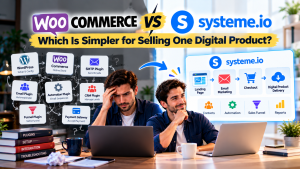 Systeme.io vs WooCommerce: Which Is Simpler for Selling One Digital Product?