Digital Product Ideas That Solve Real Problems: Where to Start

The hardest part of creating a digital product is often not making the file. It is choosing an idea that gives a specific person a good reason to want it.
Instead of starting with “Should I sell an ebook or a template?”, start with the problem. A useful digital product turns knowledge, structure, calculation, organization, or a repeatable process into something that helps a buyer make progress.
Digital Product Ideas That Solve Real Problems Start With the Buyer
A simple way to generate stronger ideas is to work in this order:
Buyer → Problem → Current Workaround → Desired Outcome → Product Format → Validation
This changes the question from “What digital product is popular?” to “What useful outcome could I package for a specific group of people?”
The product format should follow the problem. Do not choose a PDF, spreadsheet, course, or template first and then search for a reason someone might buy it.
How to Find Digital Product Ideas That Solve Real Problems
Look for situations where people already spend time, effort, attention, or money trying to get an outcome. Those behaviours can give you better starting evidence than a generic list of trending products.
1. Start With a Group of People You Can Understand
A niche becomes easier to research when you can describe the buyer more specifically than “everyone who wants to be productive.”
Examples include:
- freelance designers managing several clients;
- small service businesses preparing quotations;
- job seekers applying to many positions;
- students preparing for examinations;
- teachers organizing lessons and student records;
- couples planning a wedding;
- households managing irregular income;
- content creators planning recurring campaigns.
You do not necessarily need to be a member of the audience, but you need enough access to understand its language, problems, current tools, and buying context.
2. Search for Repeated Work, Confusion, and Friction
Many practical digital products come from tasks people repeat.
Look for statements such as:
- “I keep forgetting…”
- “How do I calculate…”
- “Is there a template for…”
- “I spend too much time…”
- “I don’t know what to include…”
- “How do I organize…”
- “What should I check before…”
These do not automatically prove demand, but they can reveal jobs that are worth investigating.
3. Study the Workaround Before Inventing the Product
Ask what people currently do when your proposed product does not exist.
| Current Behaviour | Possible Opportunity |
|---|---|
| Rebuilding the same spreadsheet every month | A reusable spreadsheet system |
| Searching for the same instructions repeatedly | A concise guide or checklist |
| Copying old client documents | A structured document/template pack |
| Calculating prices manually | A calculator or pricing worksheet |
| Using scattered notes for a recurring process | A planner, tracker, or workflow template |
| Paying for help with the same basic task | A self-service toolkit for an appropriate segment |
A workaround can be valuable evidence because it shows that the person is already trying to make progress.
4. Choose the Product Format That Reduces the Friction
Different problems call for different formats.
| If the Buyer Needs… | Formats Worth Considering |
|---|---|
| Instructions | Guide, ebook, checklist, mini-course |
| Calculation | Spreadsheet, calculator, worksheet |
| Organization | Planner, tracker, database template |
| Faster creation | Document, design, email, or presentation templates |
| A repeatable process | SOP kit, workflow system, checklist bundle |
| Practice | Workbook, exercises, question bank |
| Customization | Editable template or modular toolkit |
A spreadsheet may solve a calculation problem better than a 70-page ebook. A short checklist may be more useful than a course when the buyer simply needs to avoid missing steps.
5. Prioritize Problems That Stay Relevant
Evergreen does not mean a product never needs updating. It means the underlying problem is not dependent on a short-lived trend.
Examples of relatively durable problem categories include:
- earning and managing money;
- finding work and developing careers;
- running a small business;
- organizing projects and recurring work;
- learning and studying;
- planning important events;
- managing a household;
- communicating and marketing more efficiently.
The tools and terminology may change, but these underlying jobs can remain relevant for long periods.
6. Small Business and Freelance Products
This is one of the first categories worth researching because businesses repeatedly handle administrative, pricing, client, and project tasks.
Potential product directions include:
- quotation and estimate calculators;
- job-costing spreadsheets;
- client onboarding kits;
- project profitability trackers;
- service pricing worksheets;
- content approval systems;
- client follow-up trackers;
- standard operating procedure templates;
- simple inventory sheets;
- freelance project dashboards.
The stronger angle is usually not “business template.” Narrow it to a role, workflow, or decision.
Generic: Small Business Spreadsheet
More specific: Job-Costing Spreadsheet for Small Service Businesses
7. Spreadsheet and Calculator Products
Spreadsheets are particularly useful when the buyer needs to calculate, compare, track, or make recurring decisions.
Ideas can include:
- profit-margin calculator;
- quotation calculator;
- commission tracker;
- cash-flow planner;
- inventory reorder sheet;
- project budget tracker;
- freelancer income dashboard;
- event budget calculator;
- debt payoff tracker;
- irregular-income budget sheet.
The value is not the spreadsheet file itself. It is the decision or repetitive work the spreadsheet makes easier.
8. Career and Job-Search Products
Generic resume templates are only one part of the career category.
You can explore products around the complete job-search workflow:
- job application trackers;
- interview preparation workbooks;
- role-specific resume kits;
- portfolio planning templates;
- career-change planning workbooks;
- interview question practice packs;
- application document checklists.
Specificity can help here. A toolkit for first-time graduates has a different job to do from one designed for experienced professionals changing industries.
9. Personal Finance Products
Money management is evergreen, but generic budget planners face substantial competition. Look for a specific financial situation or recurring decision.
Possible directions include:
- paycheck budgeting sheets;
- irregular-income planners;
- debt tracking systems;
- sinking-fund trackers;
- subscription expense audits;
- household bill calendars;
- side-income trackers;
- savings-goal dashboards.
Keep the product within an appropriate educational or organizational scope. A budgeting template is different from personalized financial advice.
10. Education and Study Products
Students, teachers, tutors, and homeschooling families have different needs, so “education” should be narrowed before creating the product.
Potential directions include:
- assignment and deadline trackers;
- exam revision planners;
- study-session templates;
- teacher lesson planners;
- attendance and grade trackers;
- reading logs;
- homeschool planning systems;
- subject-specific practice worksheets.
A useful next step is to narrow by age, subject, curriculum context, role, or recurring task rather than trying to make one planner for every learner.
11. Wedding and Event Planning Products
Events create many connected tasks, deadlines, decisions, and expenses—conditions that suit structured digital products.
Ideas include:
- wedding budget spreadsheets;
- guest and RSVP trackers;
- vendor comparison sheets;
- seating planners;
- event timelines;
- photography shot checklists;
- vendor payment trackers;
- event-day coordination sheets.
You can also narrow by event type rather than competing only in the broad wedding-planner category.
12. Home Organization Products
Home organization can support practical products when the focus is a recurring household job rather than decorative printables alone.
Examples include:
- home maintenance schedules;
- moving planners;
- household inventory systems;
- decluttering checklists;
- meal and grocery planning systems;
- cleaning schedules;
- family document organizers.
Think in terms of reducing forgotten tasks, repeated decisions, or scattered information.
13. Marketing and Content Workflow Products
Marketing templates can be crowded when they are generic, but a product tied to a particular workflow or profession can be more focused.
Instead of “100 social media templates,” consider:
- campaign planning sheets for small businesses;
- content approval workflows for agencies;
- monthly promotion calendars for local businesses;
- lead follow-up scripts for a specific service;
- content repurposing checklists;
- client content request forms;
- simple campaign reporting dashboards.
The niche should determine what information, format, and terminology belong in the product.
14. Do Not Confuse a Popular Category With an Easy Opportunity
A category can have buyers and still be difficult to enter with a generic product.
If many sellers already offer similar planners, templates, or guides, you have several options:
- serve a narrower buyer;
- solve a narrower problem;
- improve the workflow rather than the appearance;
- combine related tools into a coherent system;
- provide clearer instructions;
- choose a less generic format.
Competition is useful information. It should influence how you position the product rather than automatically pushing you toward an obscure niche with no evidence of demand.
15. Use a Simple Priority Score Before You Build
You can compare ideas using a lightweight decision table rather than choosing based on excitement alone.
| Question | What You Are Looking For |
|---|---|
| Is the buyer specific? | You can describe who the product is for |
| Is the problem observable? | You can find examples of people experiencing it |
| Does the problem cause action? | People already search, improvise, spend time, or buy alternatives |
| Can a digital product help? | The outcome can reasonably be supported by information, structure, calculation, or reusable assets |
| Can you reach the buyer? | You know potential channels for validation and distribution |
| Can you build a useful first version? | The scope is small enough to test before overbuilding |
This is not a universal scoring formula. Use it to expose weak assumptions that need research.
16. Validate the Idea Before Creating the Full Product
Once an idea looks promising, move from brainstorming to evidence.
Check:
- how often the problem appears in relevant communities and searches;
- what existing products already solve it;
- how buyers describe the problem;
- what current solutions cost;
- what people dislike about current solutions;
- whether potential buyers respond to a clear offer;
- whether stronger signals such as pilots or pre-sales are appropriate.
Our separate guide, Is Your Digital Product Idea Worth Building? A Practical Validation Test, goes deeper into that process.
17. Decide How You Want to Sell Before Building Around a Marketplace
Marketplaces can be useful for discovery, especially when they already attract the type of buyer you want. But they are not the only distribution model.
Before designing the product around one platform, compare:
| Marketplace Route | Direct-Selling Route |
|---|---|
| May provide built-in discovery | You are responsible for generating traffic |
| Platform rules shape the listing and transaction | You have more control over the sales page and customer journey |
| Platform fees may apply | Platform fees may be reduced or structured differently, but payment-processing and other costs can still apply |
| Customer relationship may remain partly inside the marketplace | You can build your own lead and customer journey, subject to applicable consent and privacy requirements |
The better choice depends on the product, audience, traffic source, costs, and how much control you want.
18. Think Beyond a Single Product
A good niche can support related products at different levels of complexity.
For example, a small-business pricing niche might expand like this:
Free Pricing Checklist → Pricing Worksheet → Quotation Calculator → Job-Costing System → Complete Business Toolkit
This is more useful than launching unrelated products for unrelated audiences because each product can serve another stage of the same problem.
19. Build a Product Cluster Around One Buyer
Once you find a buyer group with several recurring problems, map adjacent products.
A freelancer cluster might include:
- client inquiry form;
- quotation calculator;
- proposal template;
- client onboarding checklist;
- project tracker;
- revision tracker;
- invoice follow-up workflow;
- project profitability sheet.
You do not need to create all of them. The map simply shows where one validated product could lead.
20. Choose One Idea to Test Next
After brainstorming, narrow the list aggressively.
Choose an idea where you can answer:
- Who is the buyer?
- What exact problem does it address?
- What do they do now?
- Why is your proposed format appropriate?
- Where can you find potential buyers?
- What evidence would convince you to proceed?
- What evidence would make you revise or stop?
Then test that idea before spending weeks polishing the finished product.
Digital Product Idea Checklist
- Start with a buyer, not a file format.
- Find a repeated problem or recurring job.
- Study the current workaround.
- Choose a format that reduces real friction.
- Prefer durable problems over short-lived novelty.
- Narrow competitive categories by buyer or workflow.
- Check whether the buyer already takes action to solve the problem.
- Confirm you have a realistic way to reach potential buyers.
- Validate before building the full version.
- Compare marketplace and direct-selling routes before committing to one platform.
- Look for adjacent products that could serve the same buyer later.
Where This Series Goes Next
This guide is the starting point. The next articles can go deeper into digital products for small businesses and freelancers, spreadsheet products that solve business problems, career and job-search products, personal finance products, education products, and other evergreen categories.
That approach lets each article examine the buyer, recurring problems, useful formats, competition, and validation opportunities in more detail instead of forcing hundreds of shallow ideas into one page.
Final Takeaway
A strong digital product idea is not simply a popular file type. It is a useful piece of information, structure, calculation, or workflow packaged around a problem that a defined group of people wants to solve.
Start with the problem, inspect current behaviour, choose the format afterward, and validate the idea before building the full product. Once you have a validated offer, you can decide whether marketplace discovery is worth its fees and constraints or whether you prefer to drive traffic to your own selling flow.
For a direct-selling setup, Systeme.io is one option you can explore for building a sales page or funnel, collecting leads, accepting payments, and delivering digital products. Selling directly can give you more control over the customer journey and may avoid some marketplace-specific fees, although payment-processing charges and other costs can still apply.
Suggested Articles to Read
 Want to Sell an Online Course Without Building a Website?
 Want to Sell an Online Course? Here’s the System You Actually Need
 Systeme.io vs WooCommerce: Which Is Simpler for Selling One Digital Product?
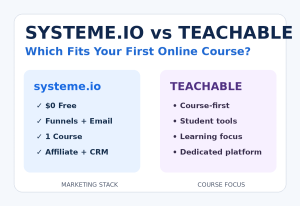 Systeme.io vs Teachable: Which Is Better for Selling Your First Online Course?
 Systeme.io Review: Is It Worth It for Beginners in 2026?