How to Start an Affiliate Program Without Expensive Software

You have a digital product, course, membership, service, or other offer that people can buy online. Now you want other people to recommend it and earn a commission when their referrals purchase.
The idea sounds simple: give each affiliate a link, track the sales, and pay the commission.
Then the questions start.
How do you know which affiliate made the sale? Who creates the tracking links? Where can affiliates see their results? What happens if a customer asks for a refund? How do you calculate commissions? How do you pay ten, fifty, or hundreds of affiliates without maintaining another complicated spreadsheet?
This is where beginners can accidentally turn a simple affiliate program into a collection of separate tools and manual processes.
How to Start an Affiliate Program Without Expensive Software
You do not need the most advanced affiliate platform on day one. You need a system that handles the core workflow correctly.
Affiliate Joins → Unique Link → Visitor Clicks → Sale Is Tracked → Commission Is Recorded → Payout Becomes Due
If your system can manage that journey and connect it to the way you already sell your product, you can launch a useful first affiliate program without building custom tracking software.
How to Start an Affiliate Program Without Expensive Software — What Beginners Actually Need
Before comparing software, make a short requirements list. For most beginner programs, the important features are:
- unique affiliate tracking links;
- sales and referral attribution;
- commission settings;
- an affiliate dashboard;
- payout controls;
- a delay before commissions become payable;
- a way to communicate with affiliates;
- integration with your sales pages and checkout;
- basic reporting;
- room to grow without rebuilding everything immediately.
Recruitment pages, promotional resources, email automation, second-tier commissions, and more advanced reporting can become useful later. They should not prevent you from launching a simple program.
Problem 1: “How Will I Know Which Affiliate Made the Sale?”
This is the first problem an affiliate-management system needs to solve.
If you simply give every partner the same product URL, there is no reliable way to know who referred a customer. Asking buyers to type an affiliate’s name into checkout is also fragile because customers can forget, misspell the name, or leave the field empty.
A proper system gives each affiliate an identifiable tracking link and records the referral automatically.
Beginner requirement: Do not launch until you understand how your chosen platform attributes a visitor or customer to an affiliate. Tracking rules matter just as much as the link itself.
Problem 2: “Do I Need to Create Every Affiliate Link Manually?”
You can do this manually for three friends. It becomes unpleasant when you have dozens of affiliates or several offers.
A better system generates an affiliate ID or unique link for each partner and gives the affiliate a reliable place to retrieve or receive it.
This is also why an affiliate dashboard matters. Affiliates should not need to email you every week asking for their link, clicks, sales, or commission balance.
Problem 3: “How Much Commission Should I Pay?”
There is no universal commission rate that is correct for every business.
Your decision depends on selling price, product margin, refunds, payment-processing costs, support costs, recurring revenue, customer lifetime value, and how much of the sale you are comfortable sharing to acquire a customer.
A simple starting calculation is:
Selling Price − Relevant Costs − Affiliate Commission = Remaining Contribution
Run the numbers before recruiting affiliates. A commission that looks attractive on the sales page may be unsustainable if the underlying product margin is thin.
Your software should let you configure commission rates rather than forcing every product into the same structure.
Problem 4: “What If the Customer Gets a Refund?”
If you pay an affiliate immediately and the customer later receives a refund, you can create unnecessary reconciliation work.
That is why payout delay is an important feature.
The idea is simple: record the commission when the sale occurs, but wait for a defined period before treating it as payable. Your delay should reflect your actual refund policy and operating model.
Beginner requirement: Look for software that distinguishes recorded/pending commissions from commissions that are ready for payout.
Problem 5: “How Do I Calculate and Pay Everyone?”
A spreadsheet can work while the program is tiny. You can record affiliate, sale, commission rate, amount, refund status, and payout status.
But manual administration becomes another job as the program grows.
Affiliate software should reduce this work by calculating commissions from tracked sales, showing amounts due, and helping you process payouts. It is important to check exactly which payout steps are automated and which still require your approval or action.
Problem 6: “How Will Affiliates Know Whether Their Links Work?”
Good affiliates want visibility.
They may want to know whether their link is receiving clicks, generating leads, or producing sales. Without a dashboard, the program owner becomes the reporting department.
A self-service affiliate dashboard can reduce repetitive questions and give partners a clearer picture of their own activity.
Problem 7: “Do I Need Separate Software for the Funnel, Email, Checkout, and Affiliates?”
This is where beginner costs and complexity can grow quickly.
You might start with:
- one tool for landing pages;
- another for email;
- another for checkout;
- another for affiliate tracking;
- a spreadsheet for payouts;
- and manual emails for affiliate onboarding.
Each tool can be useful individually. The problem is the number of connections you must configure, test, maintain, and troubleshoot.
For a beginner, an integrated platform can be more practical if it already contains the sales and marketing tools you need.
What I Would Look for in a Beginner Affiliate System
| Need | Why It Matters |
|---|---|
| Affiliate tracking | Identifies which partner referred a sale |
| Unique affiliate links | Removes manual referral identification |
| Configurable commission | Lets the economics match your offer |
| Payout delay | Helps account for refund periods |
| Affiliate dashboard | Gives partners visibility without asking you |
| Sales-page integration | Keeps tracking connected to the buying journey |
| Email / automation | Useful for onboarding and communicating with affiliates |
| Low starting cost | Lets you validate the program before scaling |
The Simpler Option I Would Start With: Systeme.io
Once you put those requirements together, Systeme.io becomes particularly interesting for a beginner because affiliate management is not a separate add-on that requires another dedicated platform.
According to Systeme.io’s current official pricing and affiliate-management pages, its affiliate-program tools are included across its plans, including the Free plan. The current Free plan supports up to 2,000 contacts, three sales funnels, one affiliate program, and one custom domain, and it does not require a credit card.
More importantly, affiliate management sits beside the other tools a beginner may already need: funnels, checkout/selling tools, contacts, email marketing, and automation.
That changes the setup from:
Page Builder + Email Tool + Affiliate Software + Manual Tracking
into something closer to:
Sales Funnel → Checkout → Affiliate Tracking → Contacts → Email Follow-Up
inside one broader platform.
For someone launching a first affiliate program, that is why I would put Systeme.io near the top of the shortlist: you can test the workflow before paying for a dedicated affiliate-management stack.
What Systeme.io Affiliate Management Can Handle
Systeme.io’s current documentation shows that an account owner can configure an affiliate program, set commission percentages, define payout delays, use second-tier commissions, provide affiliate tracking links, and let registered affiliates access an affiliate dashboard.
Its affiliate-management page also states that commissions and invoices are calculated for the program owner, with payouts processed through supported methods such as PayPal or Wise. The final payment step still requires owner action in relevant workflows, so “automated payout” should not be interpreted as completely hands-off money movement.
This is a useful distinction: the platform can remove a large amount of calculation and administration without pretending that you should lose control over payments.
You Can Automatically Give Affiliates Their Own Links
One of the more useful Systeme.io features for a growing program is the way affiliate IDs can be inserted dynamically.
Systeme.io’s documentation describes the {affiliate_id} variable, which can be placed into an email link so each affiliate receives a link containing their own ID. It also provides an {affiliate_dashboard} variable for dashboard access.
A beginner-friendly onboarding flow can therefore look like:
Affiliate Opt-In Page → Tag as Affiliate → Welcome Email → Unique Affiliate Link → Affiliate Dashboard
This is much cleaner than manually copying an ID into an email for every new partner.
You Can Build an Affiliate Recruitment Funnel Too
Affiliate management is only half the job. You still need people to join.
Because Systeme.io also includes funnel and email tools, you can create a dedicated affiliate recruitment page explaining:
- what the product is;
- who it helps;
- the commission structure;
- what affiliates may and may not do;
- how tracking works;
- when commissions become payable;
- what promotional resources are available.
After signup, an automation can tag the new affiliate and send onboarding instructions.
This means the same platform can manage both recruiting the affiliate and tracking the affiliate’s referrals.
Do Not Skip Your Affiliate Resource Kit
Software does not make affiliates promote your product.
Give partners useful resources such as:
- product description;
- target customer;
- key benefits;
- approved images;
- demo or tutorial links;
- FAQ;
- example email copy;
- social-post ideas;
- important promotional rules.
The objective is not to force everyone to publish identical copy. It is to make accurate product information easy to access.
Test the Tracking Before Recruiting Affiliates
This is one area where a few minutes of testing can prevent a lot of confusion.
Systeme.io uses affiliate IDs in tracking URLs. Its documentation also contains specific URL guidance: links to Systeme.io itself should not incorrectly add www, while links involving a custom domain need to follow the documented domain format so tracking parameters are not lost during redirects.
Before announcing your program:
- Create a test affiliate.
- Copy the actual affiliate link.
- Open it in a clean browser session.
- Complete the same journey a customer would take.
- Verify that the referral appears correctly.
- Check the commission amount.
- Confirm the payout status/delay behaves as expected.
Do this again after major funnel, checkout, or domain changes.
A Small Setting Can Cause a 0% Commission
This is a good example of why understanding the system before recruiting people matters.
Systeme.io’s current setup documentation notes that a new order form can start with an affiliate commission of 0%. The commission for the offer needs to be configured appropriately.
If you launch without checking it, an affiliate could refer a legitimate sale while your offer is configured differently from what you intended.
Launch check: Verify the commission at the actual order form/offer level, not only the general affiliate settings.
Understand Attribution Before Affiliates Start Asking Questions
Affiliate attribution can become confusing when a customer interacts with more than one affiliate.
Systeme.io’s documentation explains its attribution rules and even has a dedicated troubleshooting article for cases where users believe a commission went to the wrong person. For Systeme.io’s own affiliate program, affiliation is normally fixed when the customer registers through an affiliate link, with a documented exception involving a purchase made directly through another affiliate’s payment-page link.
The broader lesson for your own program is simple: document your attribution rules and test the exact customer journey you intend to use.
Do not wait for two affiliates to dispute a sale before learning how your platform attributes it.
What If Your Main Website Is WordPress?
You do not necessarily have to rebuild your entire content site just because your affiliate program uses Systeme.io.
Systeme.io documents affiliate proxy links for scenarios involving an external page that ultimately sends visitors into a Systeme.io funnel or payment journey. It also states that tracking works with pages containing Systeme.io forms and with pages created inside Systeme.io.
That opens up a practical architecture for publishers and businesses that already have a website:
WordPress Content / Main Website → Systeme.io Sales Funnel or Checkout → Affiliate Tracking
The exact implementation should be tested with your own domain and funnel structure before affiliates start sending traffic.
What About Second-Tier Affiliates?
Systeme.io can also support second-tier commissions.
In a second-tier structure, Affiliate A can introduce Affiliate B to the program. If B later generates qualifying sales, A may receive an additional commission according to the structure configured by the program owner.
This can encourage affiliate recruitment, but it also changes your economics. Beginners do not need to enable it simply because the feature exists.
First make sure your normal commission structure is sustainable. Add another tier only when you understand what it costs and why it benefits the program.
A Simple Beginner Setup
If I were launching a small digital-product affiliate program from zero, I would keep version one deliberately simple:
- Create the offer. Know the selling price and margin.
- Choose the commission. Make sure the economics work.
- Set a payout delay. Align it with your refund policy.
- Create the affiliate signup page. Explain the program clearly.
- Create affiliate onboarding. Send the link, dashboard access, rules, and resource kit.
- Test tracking. Complete a full test journey.
- Recruit a small first group. Start with partners who understand the audience.
- Review real questions. Improve the program before recruiting at scale.
Why I Prefer This Approach for a Beginner
A dedicated affiliate platform can make sense for a larger company with complex partner operations, integrations, fraud controls, or reporting requirements.
But that is not where most beginners start.
If you are launching one digital product or a small product line, the first goal is to prove that:
- people want to become affiliates;
- affiliates can understand the offer;
- tracking works;
- referred visitors buy;
- the commission remains profitable;
- you can administer payouts reliably.
Systeme.io is particularly compelling at this stage because its current Free plan lets you test an affiliate program while also giving you the surrounding funnel and email infrastructure. You are not forced to pay for dedicated affiliate software before knowing whether your program will gain traction.
Problems You Avoid by Choosing the System Before Launch
The troubleshooting topics we discussed earlier are not reasons to avoid affiliate marketing. They are reasons to set up the program carefully from the beginning.
| Potential Problem | Preventive Step |
|---|---|
| Affiliate link does not track as expected | Test real URLs, redirects, domains, and affiliate IDs |
| Commission shows 0% | Check the actual offer/order-form commission before launch |
| Affiliate disputes attribution | Understand and document attribution rules |
| Commission paid before refund window ends | Configure an appropriate payout delay |
| Manual link creation becomes tedious | Use generated affiliate IDs and onboarding automation |
| Payout spreadsheet becomes messy | Use built-in commission and invoice tracking |
| Affiliates keep asking for stats | Provide affiliate dashboard access |
Each of these can later become its own detailed troubleshooting article, but a beginner who understands them now has a better chance of avoiding unnecessary confusion.
Is Systeme.io the Right Affiliate Management System for You?
For a beginner, solo creator, course seller, digital-product business, or small online business that also needs funnels and email marketing, Systeme.io is one of the strongest starting options I would consider.
The appeal is not one isolated feature. It is that affiliate management lives alongside the rest of the sales journey, and you can currently start with the Free plan rather than committing immediately to another monthly software subscription.
If your business eventually needs highly specialized partner management, enterprise integrations, or more complex affiliate operations, you can reassess the stack with real usage data instead of guessing what you might need someday.
For your first affiliate program, spend less time assembling software and more time making sure the offer, tracking, commission, affiliate onboarding, and payout process actually work.
Final Takeaway
Starting an affiliate program does not have to mean buying expensive dedicated software and connecting five different tools.
Begin with the actual workflow: recruit affiliates, give them unique links, track referrals, calculate commissions, delay payouts appropriately, provide a dashboard, and pay accurately.
Systeme.io brings those affiliate-management functions together with funnels, contacts, email marketing, automation, and selling tools. For a beginner who wants to launch without spending weeks assembling a software stack, that makes it a practical place to start.
Set up the simplest version, test it yourself, recruit a small first group, and improve the program from real affiliate activity rather than adding complexity before you need it.
Suggested Articles to Read
 Want to Sell an Online Course Without Building a Website?
 Want to Sell an Online Course? Here’s the System You Actually Need
 Systeme.io vs WooCommerce: Which Is Simpler for Selling One Digital Product?
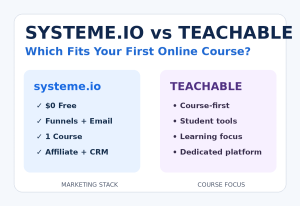 Systeme.io vs Teachable: Which Is Better for Selling Your First Online Course?
 Systeme.io Review: Is It Worth It for Beginners in 2026?