Systeme.io vs ConvertKit: Which Is Better for Creators?
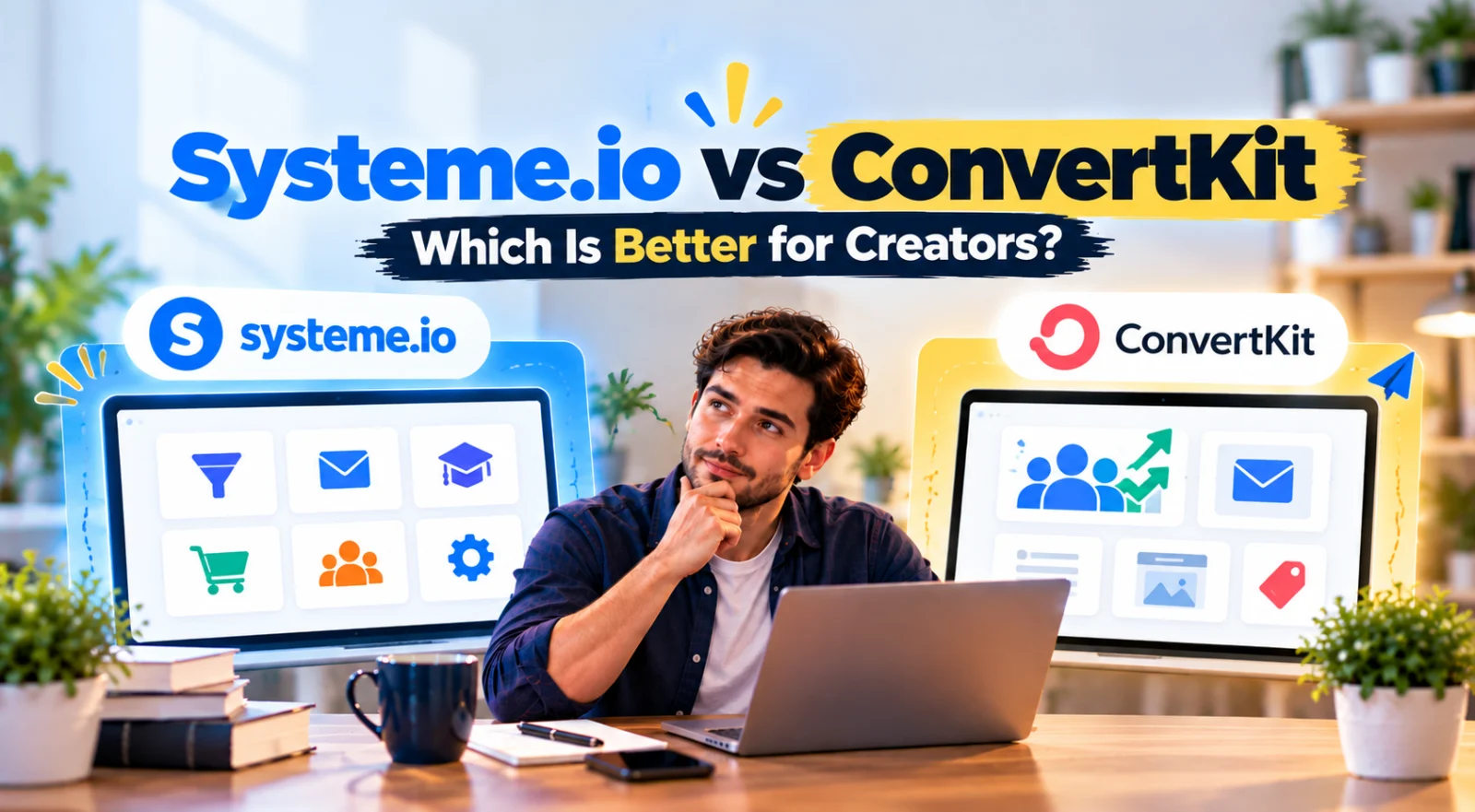
If you are a creator building an audience online, Systeme.io and ConvertKit can look like competing solutions.
Both can collect subscribers. Both can send email. Both can create landing pages. Both can help you sell digital products.
But they are built around different priorities.
ConvertKit is now officially called Kit, and the company describes it as an “email-first” operating system for creators. Systeme.io takes a broader all-in-one approach, combining email with sales funnels, checkout, courses, CRM pipelines, automation and affiliate management.
That difference matters more than a simple feature count.
A newsletter creator with 8,000 free subscribers has different needs from a course creator who wants a complete funnel, checkout, course area and affiliate program.
Systeme.io vs ConvertKit: Which Is Better for Creators?
The simplest way to understand this comparison is to ask what sits at the center of your creator business.
With Kit, the center is primarily your audience and email relationship.
With Systeme.io, the center is a broader online sales system that includes email.
| Current Free Plan | Systeme.io | Kit (formerly ConvertKit) |
|---|---|---|
| Free subscribers / contacts | 2,000 contacts | Up to 10,000 subscribers |
| Email broadcasts | Unlimited email sends | Unlimited broadcasts |
| Landing pages / forms | Included within platform limits | Unlimited |
| Audience tagging / segmentation | Available, with Free-plan limits | Included |
| Visual automations | Automation available with limited Free allowance | Paid Creator plan |
| Full sales funnels | 3 funnels / 15 steps | Not the core Kit model |
| Digital product selling | Yes | Yes, via Kit Commerce |
| Native course area | 1 course | Different model; Kit also promotes creator apps/integrations and commerce |
| CRM sales pipeline | 1 pipeline | Not a comparable built-in sales-pipeline focus |
| Run your own affiliate program | 1 affiliate program | Not a comparable built-in affiliate-management focus |
Immediately, one result is clear: this is not a comparison where one platform simply has a bigger free plan in every category.
Kit currently gives creators substantially more free subscriber capacity. Systeme.io gives creators a broader set of business-building tools around a smaller free contact allowance.
Systeme.io vs ConvertKit for Creators: The Core Difference
Think of the two platforms as starting from opposite directions.
Kit starts with:
Creator → Audience → Email → Monetization
Systeme.io starts more like:
Traffic → Funnel → Contact → Email → Checkout → Product / Course
Neither approach is automatically better. The right one depends on the business you are trying to build.
A Note About the Name: ConvertKit Is Now Kit
If you searched for “ConvertKit,” you have not found the wrong product.
ConvertKit officially rebranded to Kit. The company says the new identity reflects its expansion beyond its original email-marketing role while keeping creators at the center of the product.
You will therefore see “Kit” throughout current pricing pages and documentation, even though “ConvertKit” remains a familiar name among creators and in older tutorials.
For clarity, this article uses Kit when discussing the current product and ConvertKit where it helps readers recognize the comparison.
Kit Free Has a Major Advantage for Audience Growth
This is one area where the comparison is particularly interesting.
Kit’s current Free plan supports up to 10,000 email subscribers. It also includes unlimited email broadcasts, unlimited forms and landing pages, audience tagging and segmentation, digital products and subscriptions, and other creator-focused features.
Systeme.io Free currently supports 2,000 contacts with unlimited email sends.
So if your primary goal is:
Publish Content → Capture Subscribers → Send Newsletter → Grow Audience
Kit’s free subscriber allowance is difficult to ignore.
A creator can potentially build a fairly substantial newsletter audience before subscriber count alone requires moving beyond the Free plan.
Systeme.io Free Has a Different Advantage: More of the Sales Infrastructure
Systeme.io’s Free plan currently includes up to 2,000 contacts, but email is only one part of the package.
Its current Free plan also includes:
- unlimited email sends;
- three sales funnels;
- up to 15 funnel steps;
- one course;
- one CRM pipeline;
- one affiliate program;
- one custom domain;
- automation capabilities within Free-plan limits;
- one one-click upsell;
- one order bump;
- unlimited file storage.
That creates a different kind of value.
A creator can potentially build:
Lead Magnet → Email → Sales Page → Checkout → Course / Product
without assembling a separate funnel builder, course platform and affiliate system around the email account.
If You Are Primarily a Newsletter Creator
Imagine your business begins with a weekly newsletter.
You publish useful content, grow subscribers and eventually monetize through sponsorships, paid content, digital products or recommendations.
Your priority list might be:
- capture subscribers;
- organize them;
- send broadcasts reliably;
- grow the list;
- understand audience behavior;
- monetize the audience later.
Kit is designed specifically around this creator model.
Its current Free plan includes up to 10,000 subscribers, unlimited broadcasts, unlimited forms and landing pages, tagging and segmentation, plus access to its Creator Network recommendations system.
For an email-first creator, those capabilities may matter more than having a CRM pipeline or a native affiliate-management system.
If You Are Primarily Selling a Digital Product
Now imagine you are creating a $29 template bundle.
Your workflow might be:
Content → Lead Magnet → Email Follow-Up → Product Page → Checkout → Delivery
Both platforms can participate in this business model.
Kit Commerce currently allows creators to sell digital products and subscriptions directly from Kit, including on the Free plan. Kit can connect products to broadcasts, forms and landing pages, and it can deliver digital products after checkout.
That means it would be inaccurate to describe Kit as “email only.”
Systeme.io, however, approaches selling through a more traditional funnel structure. A creator can build connected funnel steps around opt-ins, sales pages, order forms and post-purchase offers.
If your selling strategy depends heavily on multi-step funnels, order bumps, upsells and related funnel mechanics, Systeme.io’s architecture is likely to feel more natural.
Kit Commerce Means You May Not Need a Separate Checkout
Kit’s commerce functionality deserves attention because older comparisons sometimes treat ConvertKit as if it can only collect emails.
That is outdated.
Kit says creators can sell digital products and subscriptions directly through the platform. Products can be promoted from emails and landing pages, and buyers can receive digital products automatically.
Current Kit documentation states that Commerce is available on every plan, including Free.
However, commerce fees need to be considered. Kit’s current help documentation lists a transaction charge for direct product sales in addition to the relevant payment-processing structure.
This makes the decision more nuanced than simply asking whether checkout exists.
Systeme.io Is More Funnel-Centric
A funnel is not merely a landing page.
For example:
Opt-In → Thank You → Sales Page → Order Form → Order Bump → Upsell → Thank You
Systeme.io is built around creating these connected sales journeys.
The Free plan currently provides three sales funnels and up to 15 funnel steps, which gives a beginner room to test a complete sales process.
Kit offers unlimited landing pages on Free, but its product philosophy remains email-first rather than funnel-builder-first.
If you simply need many landing pages to grow an audience, Kit’s unlimited allowance is compelling.
If you need those pages to operate as parts of a structured checkout funnel, Systeme.io has the clearer native workflow.
Email Automation Is Another Important Difference
Automation is one area where reading the current plan details matters.
Kit has sophisticated visual automations for subscriber journeys, including branching workflows, tags, delays and email sequences.
However, its current Free plan is primarily designed around audience growth. Kit’s own Free-plan documentation lists Visual Automations and the automation template library among features that require a paid Creator or Creator Pro plan.
Systeme.io Free includes automation functionality, but with meaningful limits. Its current pricing table lists one automation rule and one workflow on Free.
So there is a trade-off:
| Need | What Stands Out |
|---|---|
| Large free audience + broadcasts | Kit’s 10,000-subscriber Free allowance |
| Advanced Kit visual automation | Requires a paid Kit plan |
| Basic automation while staying Free | Systeme.io provides limited automation capacity |
| Automation connected to broader funnel stack | Systeme.io integrates it with funnels, checkout and other platform tools |
What About Landing Pages?
Both platforms can create landing pages.
Kit currently includes unlimited landing pages and forms on its Free plan.
This is particularly useful for creators who regularly launch:
- lead magnets;
- newsletter signup pages;
- waitlists;
- event registrations;
- different audience-entry points.
Kit also positions those landing pages as directly connected to the creator’s subscriber database.
Systeme.io provides page building inside its funnel ecosystem. The advantage is not unlimited Free landing pages; it is the ability to place pages inside a broader sales process.
What About Courses?
Course creators need to distinguish between selling access and actually managing the learning experience.
Systeme.io includes native course functionality and currently allows one course on its Free plan.
This means a beginner can create a flow such as:
Lead → Email → Course Sales Funnel → Checkout → Course Access
inside the same broader platform.
Kit has expanded its creator ecosystem significantly and promotes creator apps and integrations alongside its commerce tools. Its current feature ecosystem also references course-related creator tools.
But if your requirement is specifically an integrated sales-funnel-plus-native-course workflow, Systeme.io’s structure is more directly aligned with that use case.
What About Affiliate Marketing?
There are two different affiliate needs a creator may have.
The first is earning money by recommending other products.
The second is running your own affiliate program so other people can promote your product.
For the second use case, Systeme.io includes affiliate-management functionality and currently allows one affiliate program on Free.
That lets a creator connect:
Affiliate Link → Funnel → Checkout → Customer → Commission
Kit has strong creator-network and recommendation functionality, but that is not the same thing as Systeme.io’s built-in model for running your own conventional affiliate program around your offer.
If recruiting affiliates is central to your product-launch strategy, that distinction matters.
What About CRM?
Many creators will never need a sales CRM.
If people subscribe and buy self-service products directly, a subscriber database may be enough.
But creators selling consulting, coaching, agency work or higher-ticket services may need to track opportunities through stages such as:
New Lead → Contacted → Call Booked → Proposal → Won / Lost
Systeme.io currently includes a CRM Pipeline, including one pipeline on Free.
Kit is centered more heavily on subscriber relationships, email and creator monetization rather than functioning as a traditional deal-stage CRM.
This is an advantage only if your creator business actually has a sales process that needs it.
Kit Has a Stronger Creator-Network Story
Not every advantage belongs to Systeme.io.
Kit’s Creator Network and Recommendations features are specifically designed around audience growth between creators.
That can be valuable for newsletter writers, authors, educators and content creators whose primary asset is the audience itself.
Kit also has a growing app ecosystem designed to connect creator tools around an email-first core.
This represents a different philosophy from Systeme.io.
Systeme.io tries to bring more functions directly into one platform.
Kit increasingly acts as the email-centered operating layer for a creator business while also supporting commerce and integrations.
Free Plan Comparison for Different Creator Types
| Creator Type | What to Look At First |
|---|---|
| Newsletter writer | Kit’s large Free subscriber allowance, broadcasts and creator-focused growth tools |
| Blogger building an email audience | Kit is particularly compelling if list growth is the main goal |
| Digital-product seller | Both can sell; compare Kit Commerce with Systeme.io’s fuller funnel structure |
| Course creator | Systeme.io’s integrated funnel + native course workflow is particularly relevant |
| Coach / consultant | Systeme.io’s CRM Pipeline may matter if leads require manual follow-up |
| Creator planning an affiliate program | Systeme.io includes built-in affiliate-program management |
| Creator who wants advanced email-first automation | Examine Kit Creator/Pro, not just Kit Free |
| Creator wanting the broadest free audience capacity | Kit currently allows up to 10,000 subscribers |
Do Not Choose Based Only on the 10,000 vs 2,000 Number
At first glance, Kit’s 10,000 free subscribers versus Systeme.io’s 2,000 contacts looks decisive.
For an email-first newsletter business, it may indeed be one of the most important differences.
But subscriber capacity is only valuable if it matches your business model.
Suppose Creator A wants:
Newsletter → Sponsorships → Occasional Digital Products
Kit’s audience-focused Free plan could be an excellent fit.
Creator B wants:
Lead Magnet → Email → Sales Funnel → Checkout → Course → Affiliate Program
Creator B may value Systeme.io’s broader infrastructure more than an additional 8,000 free subscriber slots.
Neither creator is making the wrong choice. They are optimizing for different constraints.
Do Not Choose Based Only on the Number of Features Either
The reverse mistake is counting checkboxes.
Systeme.io can provide funnels, courses, CRM and affiliate management in the same account.
That does not automatically make those features valuable to a newsletter creator who only wants to publish excellent emails and grow an audience.
Unused features have little practical value.
The better comparison is:
Which platform’s strengths align with the workflow you expect to use every week?
A Practical Decision Framework
Choose an Email-First Approach When…
- your newsletter is the product or the center of the business;
- audience growth is your immediate priority;
- you want generous free subscriber capacity;
- you publish frequent broadcasts;
- creator-to-creator recommendations are useful to your growth strategy;
- you are comfortable adding integrations or specialist tools as needed.
Kit is particularly strong in this type of creator workflow.
Choose a Broader All-in-One Approach When…
- email is only one part of your sales system;
- you want multi-step sales funnels;
- you want checkout, upsells or order bumps in the same environment;
- you want to host a course;
- you need a CRM pipeline for leads;
- you want to run your own affiliate program;
- you would rather start with fewer separate platforms.
Systeme.io is one of the strongest starting options I would consider for this type of creator business.
What Happens When You Outgrow the Free Plan?
Free-plan comparisons are useful, but creators should also think one step ahead.
Kit’s current paid Creator plan unlocks functionality such as unlimited Visual Automations and unlimited email sequences. Pricing scales with subscriber count.
Systeme.io’s paid plans increase contact capacity and expand limits across funnels, courses, automation and other parts of the platform.
That means the upgrade decision follows the same fundamental difference:
With Kit, growth is closely tied to the scale and sophistication of the email audience.
With Systeme.io, upgrading expands a broader online-business system.
Systeme.io vs ConvertKit: The Better Question to Ask
Instead of asking which platform has more features, ask:
What am I actually building?
If the answer is:
“A large audience that I primarily reach through email,”
Kit deserves serious consideration. Its current Free plan’s 10,000-subscriber allowance, unlimited broadcasts and unlimited landing pages/forms create a strong starting point for email-first creators.
If the answer is:
“A complete creator business with funnels, checkout, courses, CRM and affiliates around my email list,”
Systeme.io becomes a particularly strong fit because more of that infrastructure exists inside the same platform.
Final Takeaway
The most important difference between Systeme.io and ConvertKit—now Kit—is not that one is for creators and the other is not.
Both are built to help creators build businesses.
The difference is where each platform puts its emphasis.
Kit is an email-first creator platform with a remarkably generous current Free allowance of up to 10,000 subscribers, unlimited broadcasts and unlimited landing pages/forms. It also supports direct digital-product and subscription sales.
Systeme.io currently offers a smaller 2,000-contact Free allowance, but surrounds email with a wider native business stack: sales funnels, checkout tools, a course, CRM Pipeline, automation and an affiliate program within Free-plan limits.
For a newsletter-first creator, Kit may provide more of what matters.
For a creator whose audience feeds directly into funnels, courses, services or affiliate-driven product sales, Systeme.io may reduce the number of separate systems needed to operate the business.
Choose based on the business you intend to build—not simply the longest feature list.
Suggested Articles to Read
 Want to Sell an Online Course Without Building a Website?
 Want to Sell an Online Course? Here’s the System You Actually Need
 Systeme.io vs WooCommerce: Which Is Simpler for Selling One Digital Product?
 Systeme.io vs Teachable: Which Is Better for Selling Your First Online Course?
 Systeme.io Review: Is It Worth It for Beginners in 2026?