Systeme.io vs Mailchimp: Which Free Plan Gives You More?
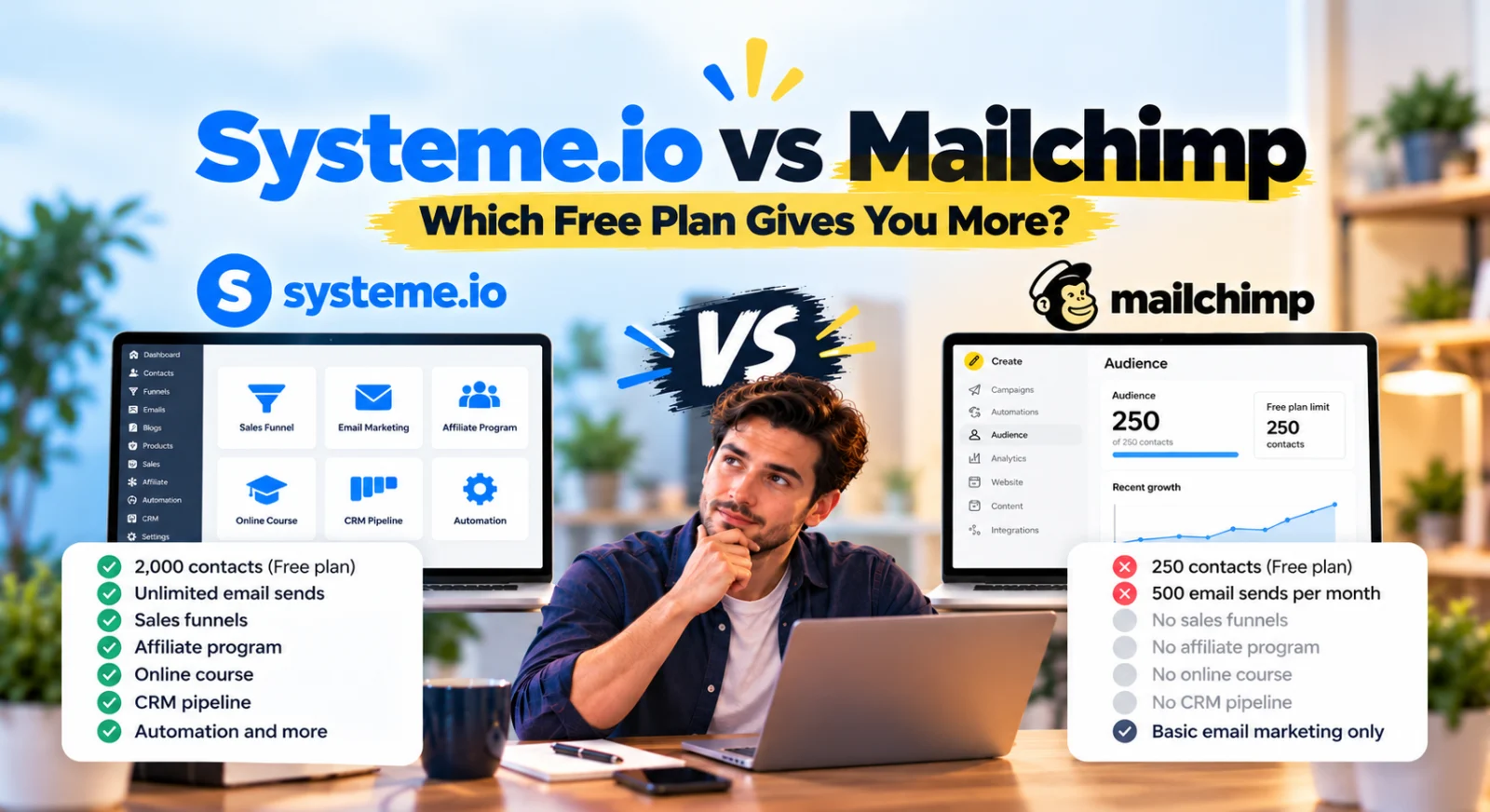
Mailchimp is one of the best-known names in email marketing. If you are starting an email list, it is an obvious platform to consider.
Systeme.io approaches the same beginner from a different direction. Email marketing is included, but it sits alongside sales funnels, checkout tools, courses, CRM pipelines and affiliate management.
That makes the free-plan comparison surprisingly different.
If your only question is, “Can I send an email newsletter?”, both platforms can help you start. If your question is, “What can I build around my subscribers without adding several other tools?”, the comparison becomes much broader.
Systeme.io vs Mailchimp Free Plan: Which Gives You More?
As of September 2026, the headline difference is capacity.
| Free Plan | Systeme.io | Mailchimp |
|---|---|---|
| Contacts | 2,000 | 250 |
| Email sends | Unlimited | 500 per month |
| Daily send limit | No published daily send cap on current plan | 250 per day |
| Credit card required | No | No for Free signup |
On raw free contact capacity, Systeme.io currently provides eight times the allowance: 2,000 contacts compared with Mailchimp’s 250.
Mailchimp’s current Free Marketing plan also limits sending to 500 emails per month and 250 per day. Systeme.io currently advertises unlimited email sends across its plans, including Free.
Those numbers matter, but they are not the most important difference between the products.
Systeme.io vs Mailchimp Free Plan: Email Tool vs Broader Business Platform
Mailchimp is fundamentally a marketing platform with a strong email heritage. Systeme.io is positioned as an all-in-one online-business platform.
So a fair comparison should not pretend the products are identical.
Mailchimp can be attractive when your priority is its email ecosystem, campaign tools, integrations and familiar marketing workflow. Systeme.io becomes especially interesting when the subscriber list needs to connect to a funnel, checkout, course, CRM pipeline or your own affiliate program.
Free-Plan Feature Comparison
The table below compares what is currently available on the two free plans. It does not mean Mailchimp lacks every listed capability across every paid product or integration.
| Capability | Systeme.io Free | Mailchimp Free |
|---|---|---|
| Contacts | 2,000 | 250 |
| Email sends | Unlimited | 500/month, 250/day |
| Email newsletters/campaigns | Yes | Yes |
| Landing pages | Yes | Yes |
| Sales funnels | 3 funnels / 15 steps | No comparable native multi-step sales-funnel builder on Free |
| CRM sales pipeline | 1 pipeline | No comparable deal pipeline on Free |
| Online course hosting | 1 course | No comparable native course-hosting system on Free |
| Run your own affiliate program | 1 affiliate program | No comparable built-in affiliate-program management on Free |
| 1-click upsell | Included within Free limits | No comparable native funnel upsell on Free |
| Order bump | Included within Free limits | No comparable native funnel order bump on Free |
| Custom domain | 1 | Not included with the current Free Marketing plan |
| Platform transaction fee | 0% | Depends on the commerce/payment feature used; not directly comparable to Systeme.io’s funnel checkout model |
The difference is not simply “more features.” It is that the two free plans are designed around different scopes.
Problem 1: Your Free Email List Reaches 250 Contacts Quickly
When you have zero subscribers, 250 can sound like plenty.
Suppose you create a useful lead magnet and attract an average of ten new subscribers per day.
At that pace, 250 contacts is roughly 25 days of growth.
Of course, real list growth is rarely perfectly consistent. The example simply shows that a free contact ceiling can become relevant earlier than expected when a campaign starts working.
Systeme.io currently allows up to 2,000 contacts on Free. That gives substantially more room before contact count alone forces a plan decision.
Problem 2: 500 Monthly Sends Can Be Smaller Than It Sounds
Email sending limits are easy to underestimate.
If you have 250 contacts and send one newsletter to the entire list, that is 250 sends.
Send another full-list newsletter and you have reached 500 sends.
That simple example does not include welcome messages, follow-ups or other campaigns.
Mailchimp states that sending pauses on its Free plan when the contact or email-send limit is exceeded until the next applicable cycle.
Systeme.io currently lists unlimited email sends, so its primary free email constraint is the contact allowance rather than a small monthly send quota.
Problem 3: Your Subscriber Eventually Needs Somewhere to Buy
Email is often the middle of a business journey rather than the end.
A common path is:
Lead Magnet → Subscriber → Email Follow-Up → Sales Page → Checkout → Customer
If your email platform handles only the audience and campaigns, you need to decide what will handle the rest.
Systeme.io Free currently includes three sales funnels with up to 15 funnel steps. That means you can build the lead-capture and sales journey inside the same broader account.
For example:
Opt-In Page → Thank You → Email Sequence → Sales Page → Order Form → Thank You / Delivery
This is a significant distinction for creators and small businesses that expect to sell something after building the list.
Problem 4: A Landing Page Is Not Always a Full Sales Funnel
Mailchimp provides landing-page capability, so it would be inaccurate to say that Mailchimp Free cannot create a landing page.
The difference is what happens when you want a more complete selling sequence.
A funnel may require several connected steps:
Opt-In → Sales Page → Order Form → Upsell → Thank You
Systeme.io is built around these multi-step sales journeys and currently includes funnel capacity on Free.
If your requirement is only a simple signup page feeding an email audience, Mailchimp may be enough. If the landing page is the entrance to a larger sales process, Systeme.io’s broader funnel structure becomes more relevant.
Problem 5: Some Subscribers Become Active Sales Leads
Consider a consultant, agency or service business.
A person who requests a quotation or consultation is no longer merely a newsletter subscriber. The business may need to track that opportunity through stages such as:
New Lead → Contacted → Proposal Sent → Negotiation → Won / Lost
Systeme.io Free currently includes one CRM Pipeline for this type of workflow.
This is different from segmenting an email audience. A CRM pipeline shows where an active opportunity is in the sales process.
If you need that capability with an email-first platform, you may need another CRM product or a different configuration depending on your requirements.
Problem 6: You Decide to Sell an Online Course
Imagine your list starts as a free newsletter.
Six months later, you create a paid course.
Now you need:
- a sales page;
- checkout;
- payment;
- student access;
- course content;
- email communication.
Systeme.io’s current Free plan includes one course alongside its funnel and email tools.
That creates a possible journey inside one platform:
Subscriber → Email Campaign → Course Sales Funnel → Checkout → Course Access
Mailchimp can remain the email component of a course business, but it is not a native course-hosting platform. You would normally pair it with another system for the learning product itself.
Problem 7: You Want Other People to Promote Your Product
Running your own affiliate program adds another layer.
You need a way to identify affiliates, track referrals, attribute sales, calculate commissions and give affiliates useful information about their results.
Systeme.io’s current Free plan includes one affiliate program.
That means the same environment can potentially handle:
Affiliate Link → Sales Funnel → Checkout → Customer → Affiliate Commission
Mailchimp is not designed as a built-in affiliate-program management platform. If you use Mailchimp for email and later want to run your own affiliate program, another affiliate system may be required.
What Systeme.io Free Currently Includes Beyond Email
Systeme.io’s current pricing page lists a broad collection of capabilities on Free, including:
- 2,000 contacts;
- unlimited email sends;
- three sales funnels;
- one course;
- one affiliate program;
- one custom domain;
- CRM functionality;
- automation capabilities;
- checkout and selling tools;
- 0% Systeme.io platform transaction fees.
Individual features have their own Free-plan limits, so “all-in-one” does not mean “everything unlimited.”
The advantage is access to the underlying tools without immediately creating a separate subscription for each job.
Where Mailchimp Still Makes Sense
This comparison should not turn into “Systeme.io has more boxes, therefore everyone should use it.”
Mailchimp remains worth considering when email marketing is the center of your requirements.
Reasons someone may still prefer Mailchimp include:
- they already know its workflow;
- they rely on a specific Mailchimp integration;
- they want an established email-focused ecosystem;
- their company already uses Mailchimp;
- they do not need funnels, courses, affiliate management or a sales pipeline inside the same platform.
A specialist can be the right choice when you actually need the specialist’s ecosystem.
Where Systeme.io Makes More Sense
Systeme.io becomes especially attractive when your email list is only one component of a larger online-business workflow.
For example:
Traffic → Landing Page → Email List → Sales Funnel → Checkout → Product / Course
Or:
Lead Form → Contact → CRM Pipeline → Follow-Up → Sale
Or:
Affiliate → Funnel → Checkout → Customer → Commission
If you expect to build several of those workflows, starting with an integrated platform can reduce the number of separate tools you need to connect later.
A Practical Beginner Scenario
Suppose you are starting a small digital-product business.
You want to:
- offer a free checklist;
- collect email subscribers;
- send a welcome sequence;
- promote a $29 template bundle;
- take payment;
- deliver the product;
- eventually let affiliates promote it.
If you start with a dedicated email platform, email is only one part of that stack.
You still need to decide how to handle the sales funnel, checkout, product delivery and affiliate program.
With Systeme.io, those functions are part of the same broader platform and several are available within the Free plan’s limits.
That is the stronger argument for Systeme.io—not simply that its free contact number is larger.
The Real Cost Is Not Always the Email Subscription
When comparing software, beginners often look at the price of one tool.
A better question is:
How many tools will I eventually need to complete the workflow?
An email-first stack might become:
Email Platform + Funnel Builder + Checkout + Course Platform + CRM + Affiliate Software
An integrated stack can potentially consolidate several of those jobs.
This does not guarantee that an all-in-one platform is cheaper for every business. Specialized tools can provide deeper functionality, and larger businesses may deliberately choose a best-of-breed stack.
For a beginner, however, fewer systems can mean fewer integrations, fewer logins and fewer things to configure before launching.
Do Not Ignore the Upgrade Path
Free software is useful for starting, but you should also ask what happens if the project works.
Consider:
- How many contacts do I expect in 6–12 months?
- How frequently will I email them?
- Will I sell a product?
- Will I need a sales funnel?
- Will I need a CRM pipeline?
- Will I host a course?
- Will I recruit affiliates?
- Which integrations are essential?
The answers tell you whether you are choosing an email tool or the beginning of your business stack.
Systeme.io vs Mailchimp Free: A Simple Decision Framework
| If Your Priority Is… | What to Consider |
|---|---|
| A familiar dedicated email-marketing ecosystem | Mailchimp deserves consideration. |
| More free contact capacity between these two | Systeme.io currently provides 2,000 vs Mailchimp’s 250. |
| Frequent sends without Mailchimp Free’s 500/month cap | Systeme.io currently advertises unlimited email sends. |
| Email + full sales funnels | Systeme.io includes funnel capacity on Free. |
| Email + CRM pipeline | Systeme.io includes a CRM pipeline on Free. |
| Email + course hosting | Systeme.io includes one course on Free. |
| Email + your own affiliate program | Systeme.io includes one affiliate program on Free. |
| A particular Mailchimp integration or workflow | Check that requirement before moving simply for higher limits. |
Final Takeaway
Systeme.io and Mailchimp overlap in email marketing, but their free plans are built around different ideas.
Mailchimp Free is an entry point into a dedicated marketing platform. Its current allowance is up to 250 contacts and 500 sends per month, with a 250-send daily limit.
Systeme.io Free currently allows up to 2,000 contacts and unlimited email sends, while also providing access to sales funnels, a course, an affiliate program, CRM functionality and other online-business tools within Free-plan limits.
If you only need email and prefer Mailchimp’s ecosystem, the broader Systeme.io feature list may not matter.
If you expect your subscribers to move into funnels, sales, courses, lead pipelines or affiliate-driven offers, Systeme.io gives you more of that infrastructure in the same account from the beginning.
So the useful comparison is not simply Systeme.io vs Mailchimp for sending email.
It is email marketing alone versus email marketing as part of a larger business system.
Suggested Articles to Read
 Want to Sell an Online Course Without Building a Website?
 Want to Sell an Online Course? Here’s the System You Actually Need
 Systeme.io vs WooCommerce: Which Is Simpler for Selling One Digital Product?
 Systeme.io vs Teachable: Which Is Better for Selling Your First Online Course?
 Systeme.io Review: Is It Worth It for Beginners in 2026?